
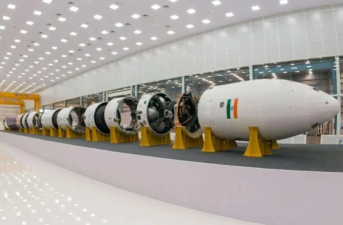
Hyderabad-based aerospace startup Skyroot Aerospace became India’s first space technology unicorn on 7 May 2026. The milestone was achieved after securing 60 million United States dollars in a fresh funding round co-led by Sherpalo Ventures and Singapore’s sovereign wealth fund GIC, raising the firm’s total valuation to 1.1 billion United States dollars. This capital infusion supports the scaling of manufacturing capabilities and an increased launch frequency. It also accelerates the development of advanced launch vehicles. The achievement positions India’s private aerospace sector as a competitive player in the global small satellite launch market.
Overview of Private Space Sector Reforms
The emergence of private launch capabilities results from structural policy shifts aimed at ending the state monopoly on space infrastructure.
Institutional Framework
- 2020 Space Reforms: The Government of India opened the space sector to private entities to enhance commercial participation and secure a larger share of the global space economy.
- IN-SPACe: The Indian National Space Promotion and Authorization Centre acts as an autonomous, single-window nodal agency under the Department of Space to permit, regulate, and monitor private space activities.
- NewSpace India Limited (NSIL): The commercial arm of the Indian Space Research Organisation (ISRO) focuses on transferring technologies to private industries and commercializing space assets.
Skyroot Aerospace Rocket Architecture
The startup designs and manufactures the “Vikram” series of launch vehicles, named after the father of the Indian space program, Dr. Vikram Sarabhai.
Vikram-S (Suborbital Pioneer)
- Launch Date: November 2022.
- Mission Prarambh: This mission marked the first time a privately built Indian rocket reached outer space.
- Technical Setup: An all-carbon-composite, single-stage solid-fuel suborbital rocket used to test core technologies and avionics.
Vikram-1 (Orbital Class)
- Structural Design: A three-stage launch vehicle built entirely using carbon-composite materials to reduce structural weight.
- Propulsion Systems: Utilizes solid fuel stages along with 3D-printed liquid-engine upper stages for precise orbital injection.
- Payload Capacity: Specially engineered to place small payloads ranging from 350 to 480 kilograms into Low Earth Orbit (LEO).
- Launch Plan: Flight hardware was flagged off by the Telangana Chief Minister to the Satish Dhawan Space Centre at Sriharikota for a scheduled launch window in mid-2026.
Vikram-2 (Heavy Variant Under Development)
- Payload Class: Designed as a one-tonne-class launch vehicle capable of carrying heavier satellite constellations.
- Cryogenic Stage: Will feature an advanced cryogenic engine running on specialized liquid propellants to improve efficiency and thrust performance.
Comparative Analysis of Indian Launch Capabilities
The introduction of private rockets supplements ISRO’s existing operational fleet by targeting the high-demand micro and small satellite segments.
| Launch Vehicle | Developer / Agency | Vehicle Class / Type | Primary Payload Capacity (LEO) | Target Commercial Market |
| Vikram-1 | Skyroot Aerospace | Private / 3-Stage Solid & Liquid | 350 – 480 kg | On-demand dedicated small satellites |
| Agnibaan | Agnikul Cosmos | Private / 2-Stage Semi-Cryogenic | 100 – 300 kg | Customizable, mobile-launched micro-satellites |
| SSLV | ISRO | Government / 3-Stage Solid | 500 kg | Low-cost, quick-turnaround commercial launches |
| PSLV | ISRO | Government / 4-Stage Solid & Liquid | 1,750 kg | Earth observation and multi-orbit deployments |
Technological Innovations in Private Rocketry
Indian space startups use modern manufacturing techniques to lower costs and reduce production timelines.
3D-Printed Liquid Propulsion
- Monolithic Construction: Regulus and Raman engines are printed as single pieces, eliminating joints, welds, and hundreds of individual parts.
- Material Integrity: Uses high-strength alloys capable of withstand extreme thermal loads and high pressure during operation.
Carbon-Composite Structural Engineering
- Weight Optimization: Replacing traditional aluminum-copper alloys with carbon-fiber wraps significantly improves the fuel-to-weight ratio.
- Structural Strength: Ensures the vehicle withstands intense aerodynamic resistance and structural vibration during atmospheric departure.
IASPOINT Booster Facts for UPSC
- Unicorn Milestone Details: Board member of Alphabet Inc. and founder of Sherpalo Ventures, Ram Shriram, joined the Skyroot board following the May 2026 funding round.
- Engine Nomenclature: Skyroot names its solid propulsion stages after Dr. APJ Abdul Kalam (“Kalam series”) and its liquid/cryogenic engines after Sir CV Raman (“Raman series”).
- Manufacturing Cadence: With its expanded facility infrastructure, Skyroot aims to scale its assembly operations to manufacture up to one orbital rocket per month.
- FDI Policy Relaxation: In early 2024, the Indian government permitted 100% Foreign Direct Investment (FDI) in space-tech components manufacturing, up to 74% in satellite manufacturing, and up to 49% in launch vehicles without prior government approval.
- Global Target Share: The Indian Space Association (ISpA) projects that these commercial space reforms will help India secure at least a 10% share of the global space economy by 2033, up from its current share of roughly 2%.