
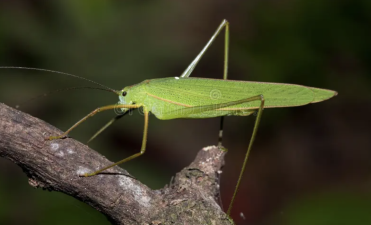
Researchers have identified three previously unknown species of the genus Conocephalus in Jammu and Kashmir, adding to the known diversity of meadow katydids in the Western Himalayas. The discovery was made during extensive field surveys across meadow grasses, bushes and deciduous forests in the region. Earlier, Kashmir was believed to host only one species of this genus.
Discovery and Scientific Study
The survey was led by Muzamil Syed Shah with entomologists from Aligarh Muslim University. Adult specimens were collected during daytime searches in different habitats across the mountainous landscape. The team used Scanning Electron Microscopy (SEM) to study minute body features and confirm that the insects represented new species.
Newly Named Species
The three species are:
- Conocephalus usmanii, named in honour of Professor Mohd Kamil Usmani.
- Conocephalus nagariensis, named after Dr Rajendra Nagar.
- Conocephalus ganderbali, named after Ganderbal district.
Each species has distinct physical traits, including differences in body shape, abdominal structures and the number of teeth on the stridulatory file, the wing structure used to produce chirping sounds.
Key Morphological Features
The study noted that C. nagariensis has spindle-shaped cerci and 34 teeth on the stridulatory file. C. ganderbali is small and slender, with 28 teeth and a V-shaped incision on the underside. C. usmanii has an elongated abdominal plate and 36 teeth on the stridulatory file. These differences helped establish them as separate species.
Significance for Biodiversity Research
The findings indicate that Kashmir’s complex topography, including the Western Himalayas and the Pir Panjal Range, supports richer insect diversity than previously recorded. The study also reported new regional records of other katydids, suggesting that Kashmir may act as a corridor for insect migration and evolution. Type specimens have been preserved at the Museum of Zoology, Aligarh Muslim University for future reference.
Last Modified: April 25, 2026