
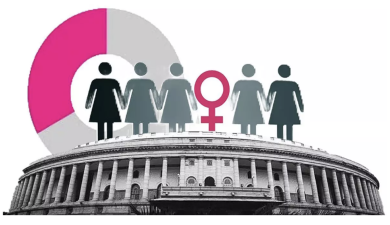
The Women’s Reservation Bill proposes increasing Lok Sabha seats from 543 to 850 by reserving one-third of seats for women. The bill aims to enhance women’s representation in the lower house of Parliament. It was introduced by the Ministry of Law and Justice and is pending parliamentary approval.
Seat Allocation and Reservation Mechanism
The bill mandates reserving 33.33% of total Lok Sabha seats for women candidates. The increase from 543 to 850 seats involves adding 307 new seats exclusively for women. Existing seats will remain unchanged, and the new seats will be distributed among states based on population.
Impact on Parliamentary Composition
The total number of Lok Sabha members will rise to 850, including 283 women members. This will make women the largest single group in the lower house. The bill also preserves the reservation for Scheduled Castes and Scheduled Tribes in the increased seat count.
Legislative Process and Status
The bill was introduced in Parliament and referred to a standing committee for review. It requires a constitutional amendment, needing two-thirds majority in both houses. The bill has faced opposition from some political parties over seat allocation and federal concerns.
State Representation and Electoral Changes
New women-reserved seats will be allocated to states proportionally, based on the 2011 Census. Electoral rolls and constituency boundaries will be adjusted accordingly. The Election Commission will oversee the delimitation and implementation process.
What to Study for UPSC Exams?
- Constitutional Amendment Procedure
- Women’s Representation in Politics
- Delimitation and Electoral Reforms
- Federalism and Centre-State Relations
Constitutional Amendment Procedure
A constitutional amendment in India requires a bill to be passed by a two-thirds majority in both Lok Sabha and Rajya Sabha. Some amendments also need ratification by at least half of the state legislatures. The process is outlined in Article 368 of the Indian Constitution. Amendments can be introduced only by a member of Parliament and do not require the President’s prior approval but need the President’s assent after passage.
Women’s Representation in Politics
Globally, Rwanda has the highest percentage of women in parliament, exceeding 60%. India’s first woman Prime Minister was Indira Gandhi, serving from 1966 to 1977 and 1980 to 1984. The concept of women’s reservation in legislatures aims to address historical gender disparities and has been implemented in various forms, such as local body reservations under the 73rd and 74th Constitutional Amendments.
Delimitation and Electoral Reforms
Delimitation is the act of redrawing boundaries of electoral constituencies based on census data to ensure balanced representation. India’s last delimitation exercise was completed in 2008 based on the 2001 Census. Electoral reforms include measures like Electronic Voting Machines (EVMs) and the introduction of the Model Code of Conduct to ensure free and fair elections.
Federalism and Centre-State Relations
India’s federal structure divides powers between the Centre and states via three lists: Union, State, and Concurrent. The Rajya Sabha represents states at the federal level. Centre-state relations have evolved with mechanisms like the Inter-State Council and the Finance Commission to resolve disputes and allocate resources. States have autonomy but can be subject to President’s Rule under Article 356 in certain conditions.
Last Modified: April 14, 2026