
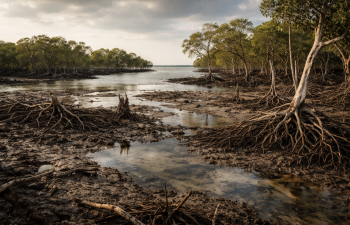
Recent studies reveal that mangrove-lined estuaries face severe environmental stress due to rising carbon dioxide (CO₂) levels. This has led to a condition called hypercapnic hypoxia, where high CO₂ coincides with low oxygen. Such changes threaten marine biodiversity and fisheries, especially in tropical regions.
About Hypercapnic Hypoxia
Hypercapnic hypoxia happens when CO₂ levels rise and oxygen levels fall in water. It mostly occurs during low tide and in warm, low-salinity estuaries. This condition stresses aquatic life by reducing oxygen availability. A global study of 23 mangrove sites found that mild to severe hypercapnic hypoxia already affects these areas frequently.
Climate Change Effects on Mangrove Waters
By 2100, oxygen in mangrove waters may drop by 5-35%, while CO₂ could rise by 8-60%. These changes will make stressful conditions last longer and happen 15 times more often in extreme climate scenarios. Higher water temperatures worsen the problem, with a 10°C rise causing a 30% oxygen drop and 50% CO₂ increase.
Impact on Marine Life and Fisheries
Mangroves serve as nurseries for many fish and crustaceans. Fish species vary in their tolerance to low oxygen. Reef-associated species, important for fisheries, require higher oxygen levels and are vulnerable to hypercapnic hypoxia. This shift threatens fish populations and the livelihoods of millions who depend on mangrove fisheries, especially in developing tropical nations.
Socioeconomic and Ecological Importance
Mangroves support about 20,000 extra fish per hectare annually compared to areas without vegetation. This service is valued at $10 million per hectare. Around 4 million fishers worldwide rely on mangroves, mainly in countries like Brazil, Indonesia, and Tanzania. Protecting mangrove habitats is vital for sustaining these communities and preserving marine ecosystems.
Topics for Prelims:
Hypercapnic Hypoxia
- Condition of high CO₂ and low oxygen in water.
- Common in mangrove estuaries during low tide.
- Caused by climate change and warming waters.
- Reduces oxygen availability for aquatic life.
- Leads to longer and more frequent stressful events.
Mangrove Ecosystems
- Coastal forests found in tropical and subtropical regions.
- Provide nursery grounds for fish, crabs, and shrimp.
- Support biodiversity and fisheries.
- Help protect shorelines from erosion.
- Valued at millions of dollars for ecological services.
Climate Change Effects on Marine Environments
- Increases CO₂ concentrations in water.
- Decreases dissolved oxygen levels.
- Raises water temperatures, intensifying stress.
- Alters species composition in ecosystems.
- Threatens food security and livelihoods globally.
Questions for Mains:
- Discuss in the light of recent research how climate change affects mangrove ecosystems and their associated fisheries. [GS-III-Environment & DM]
- Analyse the role of mangroves in coastal protection and biodiversity conservation, and examine the threats posed by hypercapnic hypoxia. [GS-III-Environment & DM]
- With suitable examples, discuss the socioeconomic impact of declining fish populations in tropical developing countries due to environmental stressors like hypercapnic hypoxia. [GS-III-Economic Development]
- Critically discuss the challenges and strategies for managing coastal ecosystems under climate change, focusing on mangrove estuaries and their ecological functions. [GS-II-Governance]
Answer Hints:
1. Discuss in the light of recent research how climate change affects mangrove ecosystems and their associated fisheries. [GS-III-Environment & DM]
- Climate change increases CO₂ levels and water temperatures, causing hypercapnic hypoxia (high CO₂, low oxygen) in mangrove estuaries.
- Oxygen concentrations may decrease by 5-35%, and CO₂ may rise by 8-60% by 2100, worsening water quality.
- Hypercapnic hypoxia events will become more frequent, severe, and prolonged, especially in tropical regions.
- Reduced oxygen limits fish entry into mangrove nurseries, shrinking habitat suitability for commercially important species.
- Shift in fish species composition away from reef-associated, low-tolerance species critical for fisheries.
- Decline in mangrove biodiversity and deterioration of nursery habitats threaten fisheries productivity and ecosystem balance.
2. Analyse the role of mangroves in coastal protection and biodiversity conservation, and examine the threats posed by hypercapnic hypoxia. [GS-III-Environment & DM]
- Mangroves stabilize shorelines, reduce erosion, and buffer storm surges, protecting coastal communities.
- They provide critical nursery habitats for fish, crabs, and shrimp, supporting marine biodiversity and fisheries.
- Mangroves enhance connectivity with coral reefs and seagrass beds, boosting overall ecosystem productivity.
- Hypercapnic hypoxia, driven by climate change, lowers oxygen and raises CO₂, stressing aquatic life and reducing habitat quality.
- This condition leads to loss of sensitive species, reduced biodiversity, and altered species composition in mangrove ecosystems.
- Prolonged hypoxia threatens ecological functions, undermining mangroves’ role in coastal protection and biodiversity support.
3. With suitable examples, discuss the socioeconomic impact of declining fish populations in tropical developing countries due to environmental stressors like hypercapnic hypoxia. [GS-III-Economic Development]
- Millions of fishers (~4 million globally) in developing countries (e.g., Brazil, Indonesia, Tanzania) depend on mangrove fisheries for livelihood.
- Declining fish populations reduce income and food security for coastal communities reliant on mangrove-associated fisheries.
- Species important for fisheries (e.g., common silver-biddy, silver grunt, pink ear emperor, Indian goatfish) are vulnerable to low oxygen stress.
- Loss of nursery habitats and altered species composition decrease fish catch and biodiversity, impacting local economies.
- Mangroves provide ecological services worth ~$10 million per hectare annually, denoting economic stakes of degradation.
- Environmental stressors thus exacerbate poverty and threaten socio-economic stability in tropical developing regions.
4. Critically discuss the challenges and strategies for managing coastal ecosystems under climate change, focusing on mangrove estuaries and their ecological functions. [GS-II-Governance]
- Challenges include increased hypercapnic hypoxia, habitat degradation, biodiversity loss, and declining fisheries due to climate change.
- Data gaps and variability in local conditions complicate monitoring and adaptive management of mangrove ecosystems.
- Strategies involve protecting and restoring mangrove forests to enhance resilience and maintain ecological functions.
- Integrating climate projections into coastal planning to mitigate impacts like temperature rise and oxygen depletion.
- Community engagement and sustainable fisheries management to balance livelihood needs with conservation.
- Policy measures should promote ecosystem-based adaptation, pollution control, and international cooperation for climate resilience.