
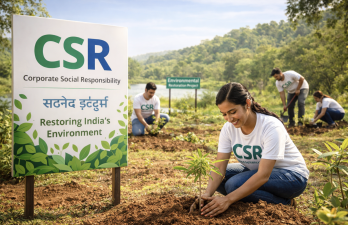
Recent Supreme Court rulings in India have transformed environmental spending under Corporate Social Responsibility (CSR) from optional charity to a constitutional obligation. This shift stems from the neglect of endangered species habitats like the Great Indian Bustard and invokes Article 51A (g) of the Constitution. Despite India’s net-zero emissions pledge by 2070, CSR funds largely ignore ecological restoration, focusing instead on immediate social issues. This knowledgebase outlines the current CSR trends, challenges in environmental restoration, and the need for strategic reforms.
Current CSR Spending Trends
CSR funds in India prioritise social sectors. Education receives about 38%, healthcare 22%, and rural development 10%. Environmental projects get only 7%-9%. Corporations often choose quick-impact projects like awareness drives over long-term restoration. Some exceptions exist, such as Mahindra’s large-scale tree planting and ITC’s forestry programmes, showing that effective environmental CSR is possible.
Challenges in Environmental Restoration
Restoration of forests and habitats faces many hurdles. India aims to restore 26 million hectares by 2030, yet private companies contribute just 2% of the 9.8 million hectares restored. Restoration projects require specialised knowledge in biodiversity and soil health, which many CSR partners lack. Popular fast-growth plantations like Miyawaki forests often harm native ecology. Urban bias and poor coordination with forest departments worsen the problem.
Need for Strategic Reforms
The judiciary mandates a shift to ecosystem recovery strategies. Corporate accountability must extend beyond shareholder profits to ecological health. Success indicators should include soil carbon, water retention, and biodiversity improvement. Partnerships among forest departments, universities, NGOs, and local committees are essential. Long-term funding can be secured through restoration trusts or escrow funds. Corporate governance must evolve to treat environmental health as a fiduciary duty.
Path Forward for Sustainable CSR
India must prioritise degraded and remote forest lands for restoration. Scientific supervision of projects will ensure native species protection. Corporations should integrate environmental restoration into core business strategies rather than treat it as a compliance formality. This approach will align CSR with India’s climate commitments and ecological sustainability goals.
Topics for Prelims:
Corporate Social Responsibility (CSR)
- Mandated by Companies Act, 2013 in India.
- Funds allocated mainly to education, healthcare, rural development.
- Environmental projects receive less than 10% of CSR funds.
- CSR spending includes awareness campaigns and restoration projects.
- Recent Supreme Court rulings link CSR environmental spending to constitutional duty.
Environmental Restoration in India
- India aims to restore 26 million hectares by 2030 under Bonn Challenge.
- Private sector contributes only 2% of restored land area.
- Challenges include lack of expertise, urban bias, and poor coordination.
- Miyawaki plantations often compromise native biodiversity.
- Restoration projects require long-term funding and scientific supervision.
Great Indian Bustard
- Endangered bird species native to India’s grasslands.
- Habitat threatened by energy sector projects.
- Neglect of habitat was a trigger for Supreme Court’s environmental mandate.
- Conservation linked to broader ecosystem restoration efforts.
- Symbolises the conflict between development and environmental protection.
Questions for Mains:
- Critically discuss the role of Corporate Social Responsibility in advancing environmental sustainability in India and analyse the challenges faced in implementing effective restoration projects. [GS-III-Economic Development]
- Examine the implications of Article 51A (g) of the Constitution of India on corporate environmental accountability and evaluate how judicial interventions can influence sustainable business practices. [GS-II-Constitution of India & Polity]
- Estimate the impact of large-scale afforestation projects on biodiversity and local livelihoods, and point out the limitations of fast-growth plantation methods like the Miyawaki technique. [GS-III-Environment & DM]
- Analyse the significance of public-private partnerships in achieving India’s Bonn Challenge restoration targets and discuss the measures needed to ensure long-term ecological and financial sustainability. [GS-III-Environment & DM]
Answer Hints:
1. Critically discuss the role of Corporate Social Responsibility in advancing environmental sustainability in India and analyse the challenges faced in implementing effective restoration projects. [GS-III-Economic Development]
- Companies Act, 2013 mandates CSR with a social and environmental focus, pioneering profit-sharing for social good.
- CSR funds disproportionately favour social sectors (education 38%, healthcare 22%) over environment (7%-9%).
- Environmental CSR often limited to quick-impact activities (awareness drives) rather than long-term restoration.
- Challenges include lack of expertise in biodiversity, soil health, and long timelines for restoration projects.
- Urban bias, poor coordination with forest departments, and preference for fast-growth plantations (e.g., Miyawaki) undermine ecological goals.
- Successful exceptions (Mahindra, ITC, Tata) show large-scale restoration is possible with integrated livelihood and conservation focus.
2. Examine the implications of Article 51A (g) of the Constitution of India on corporate environmental accountability and evaluate how judicial interventions can influence sustainable business practices. [GS-II-Constitution of India & Polity]
- Article 51A (g) imposes fundamental duty on citizens to protect the environment for present and future generations.
- Supreme Court redefined CSR environmental spending as a constitutional mandate, not discretionary charity.
- Judiciary linked business rights with environmental responsibilities, emphasizing fiduciary duty towards ecosystem health.
- Judicial interventions compel corporations to move beyond compliance to ecosystem restoration and scientific ecological assessments.
- Case of Great Indian Bustard habitat neglect triggered judicial push, denoting conflict between development and conservation.
- Judicial activism can drive policy reforms, accountability, and long-term corporate commitment to sustainability.
3. Estimate the impact of large-scale afforestation projects on biodiversity and local livelihoods, and point out the limitations of fast-growth plantation methods like the Miyawaki technique. [GS-III-Environment & DM]
- Large-scale afforestation (e.g., Mahindra’s ‘Project Hariyali’, ITC’s forestry) improves biodiversity, soil health, water retention, and livelihood integration.
- Restoration projects contribute to carbon sequestration and ecosystem services, supporting climate goals.
- Miyawaki plantations offer rapid growth and aesthetic appeal but often compromise native species diversity and long-term ecosystem stability.
- Fast-growth methods may neglect soil health, local ecology, and fail to support indigenous fauna.
- Successful afforestation requires scientific supervision, native species prioritization, and community involvement.
- Long-term monitoring and ecological assessments are essential to measure real impact on biodiversity and livelihoods.
4. Analyse the significance of public-private partnerships in achieving India’s Bonn Challenge restoration targets and discuss the measures needed to ensure long-term ecological and financial sustainability. [GS-III-Environment & DM]
- India targets restoring 26 million hectares by 2030 under Bonn Challenge; private sector contributes only 2% so far.
- Public-private partnerships can pool expertise, resources, and technology for large-scale restoration.
- Collaboration needed among forest departments, universities, NGOs, and local committees for scientific supervision and native species protection.
- Long-term financing challenges can be addressed by establishing restoration trusts or escrow funds ensuring continuity.
- Policy frameworks must incentivize ecosystem-centric corporate governance beyond basic compliance.
- Monitoring ecological indicators (soil carbon, biodiversity, water retention) ensures accountability and project success.