
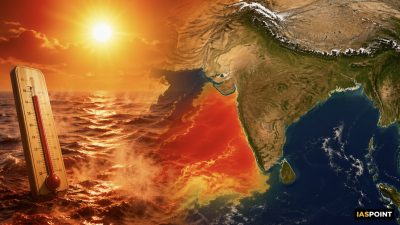
The Indian National Centre for Ocean Information Services (INCOIS) issued a marine heatwave assessment for the Arabian Sea on 23 April 2026. Marine heatwaves are periods of abnormally high sea surface temperature that persist for several days to months and are measured against climatological thresholds, often the 90th percentile of historical values.
Marine Heatwave Classification
INCOIS classified parts of the Arabian Sea into three categories on 23 April 2026. About 22% of the region was under the Watch category, 9% under Alert, and 5% under Warning. These categories are used in marine heatwave monitoring systems to denote increasing thermal stress in ocean waters.
Geographical Spread
The southeastern Arabian Sea along the Kerala coast recorded a rise in sea temperatures on 21 April 2026. The warming zone extended across parts of India’s west coast and towards Oman by 23 April 2026. Similar marine heatwave conditions were also present in the southern and western Indian Ocean, including coastal waters off South Africa, Mauritius, and Western Australia.
Ecological and Fisheries Context
Marine heatwaves affect plankton productivity, marine biodiversity, pelagic fish migration, and open-ocean productivity. Species such as sardines and mackerel are linked to temperature-sensitive marine ecosystems in the Arabian Sea. Coral reef systems and deep-sea fisheries are also exposed to thermal stress during prolonged warm-water events.
INCOIS and MAHAS
INCOIS operates Marine Heatwave Advisory Services (MAHAS) for early warning support to coastal communities, fisheries, and blue economy sectors. INCOIS is a national ocean information agency under the Ministry of Earth Sciences and is based in Hyderabad.
Long-Term Trend
A study published in June 2022 found that the Arabian Sea experienced an increase of about 20 marine heatwave days per decade between 1982 and 2019. The same study recorded 1.5 to 2 marine heatwave events per decade in the northern and southeastern Arabian Sea.
Last Modified: April 24, 2026