
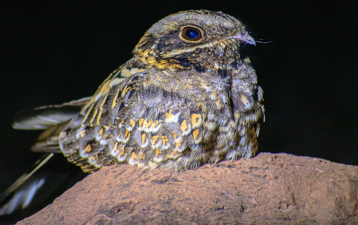
A decade-long scientific study led by the Doñana Biological Station (EBD-CSIC) and Lund University, published in May 2026, reveals that the red-necked nightjar (Caprimulgus ruficollis) synchronizes its life cycle entirely with the 29.5-day lunar cycle. Utilizing advanced multi-sensor data loggers on 74 adult birds within Spain’s Doñana National Park, researchers tracked flight activity, body temperature, and foraging success across annual cycles. The findings demonstrate that this nocturnal, visually oriented insectivore experiences a boom-and-bust energy economy directly dictated by moonlight. This dependence shapes its foraging behavior, metabolic adjustments, migratory schedules, and reproductive timing, while highlighting serious ecological risks from human-induced light pollution.
Taxonomy and Behavioral Ecology
Species Profile
The red-necked nightjar is a nocturnal migratory bird restricted primarily to the Mediterranean regions of southern Europe for breeding, while spending its wintering periods in West Africa. Unlike bats, which rely on echolocation, nightjars are visual hunters that require ambient light to detect, chase, and capture aerial insects such as moths.
Lunar Foraging Dynamics
The availability of natural lunar illumination regulates the bird’s nightly foraging efficiency and duration:
- Moonlit Phases (Full Moon): Visual performance spikes. The birds double their feeding activity, maintaining flight and hunting operations throughout the dark hours. Energy intake peaks, and birds can accumulate fat reserves at an estimated rate of 0.43 grams per day.
- Moonless Phases (New Moon): Total darkness eliminates prey visibility. Foraging is heavily restricted to brief twilight windows at dusk and dawn. Daily energy deficits can reach up to 100 kJ during these dark periods.
Physiological Adaptations to Energy Imbalances
Anatomical Specialization and Slow Digestion
To survive recurring energy shortfalls, the red-necked nightjar possesses a unique anatomical adaptation. It features one of the largest stomachs (gizzard) relative to body size among avian species, capable of holding insects equivalent to roughly 13% of its lean body mass. This enables the bird to gorge rapidly during brief twilight windows. However, this large organ leaves minimal space for the intestine, resulting in exceptionally slow digestion. A full gizzard requires approximately 6.5 hours to process, creating a physiological bottleneck that limits total food processing even when moonlight is abundant.
Facultative Hypometabolism (Torpor)
When the energy balance falls into a deficit during moonless periods, the species activates a monthly energy-saving mechanism known as facultative hypometabolism or torpor.
- Mechanism: The nightjar remains completely inactive and temporarily lowers its skin and body temperature by approximately 5°C.
- Timing: This short-term slowdown typically triggers about one hour after moonset outside of the breeding season, allowing the bird to minimize caloric expenditure until the returning moonlight restores hunting conditions.
Synchronization of Life-History Events
Migratory Adjustments
The cyclical fluctuations in body mass and fuel deposition directly regulate the timing of long-distance trans-Saharan migration:
- Spring Migration: Departures from West African wintering grounds commence approximately 13 days after a full moon, precisely when individual fat stores reach their monthly peak.
- Autumn Migration: Southern departures from European breeding grounds cluster roughly one week before a full moon, leveraging accumulated energy to sustain the initial legs of travel.
Breeding and Chick Nestling
Reproductive cycles are systematically timed to optimize hatchling survival. Egg-laying peaks roughly 10 days after a full moon. Given an incubation period of 16 to 19 days, this ensures that the chicks hatch near a subsequent full moon. This precise alignment provides parents with maximum nightly illumination to hunt and satisfy the high caloric demands of rapidly growing young. Notably, the study found that feather molting remains entirely independent of lunar influence, driven instead by internal biological rhythms.
Threats from Artificial Light Pollution
The extreme reliance of the red-necked nightjar on natural celestial cycles makes the species highly vulnerable to Anthropogenic Light Pollution or Artificial Light at Night (ALAN). Urban sprawl and artificial skyglow can override or mimic lunar cues. This disruption can trigger incorrect migratory departures, desynchronize breeding windows, and alter natural torpor cycles, pushing these birds past their fragile ecological and energetic margins.
IASPOINT Booster Facts for UPSC
- Caprimulgidae Family: The red-necked nightjar and the European nightjar (Caprimulgus europaeus) belong to this cosmopolitan family of crepuscular and nocturnal birds, characterized by long wings, short legs, and very short bills with wide gapes.
- Doñana National Park: Located in Andalusia, southern Spain, it is a UNESCO World Heritage Site and a critical wetland-forest mosaic biosphere reserve serving as a major stopover and breeding site for migratory birds on the Mediterranean-West African flyway.
- Torpor in Birds: While common in hummingbirds and caprimulgids (like the Common Poorwill), the regular monthly scheduling of torpor synchronized to lunar phases represents a rare chronobiological discovery in avian species.
- Ecological Cascades: The synchronized movement and foraging of nightjar populations create localized, cyclical predation pressure on nocturnal insects, demonstrating how celestial rhythms structure broader ecosystem food webs.