
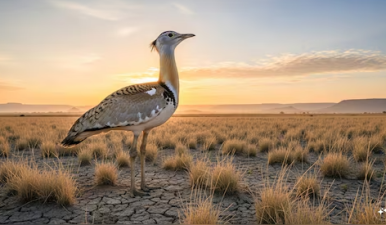
The captive breeding network for the Great Indian Bustard in Jaisalmer, Rajasthan, achieved a major milestone in May 2026. The birth of two chicks through artificial insemination pushed the total population across the Ramdevra and Sudasari breeding centres to 86 birds. These facilities have produced 26 chicks using artificial insemination techniques. This progress stands in sharp contrast to the wild population, where a recent Wildlife Institute of India census estimated only 128 birds remaining in their natural habitat, with a mere two chicks observed naturally this year.
Profile and Conservation Status of the Species
The Great Indian Bustard (Ardeotis nigriceps), locally known as Godawan, is the state bird of Rajasthan. It is one of the heaviest flying birds in the world and serves as a flagship species for the health of grassland ecosystems.
Physical and Ecological Traits
- Morphology: Large ground-dwelling bird standing about one metre tall, featuring a distinct black crown on the forehead that contrasts with a pale neck and head. Males are larger and possess a well-developed gular pouch used to produce deep resonant mating calls.
- Habitat: Arid and semi-arid grasslands, open country with thorn scrub, and tall grass interspersed with low-intensity cultivation. The species actively avoids heavily irrigated zones.
- Dietary Habits: Omnivorous, feeding on insects like beetles and grasshoppers, rodents, reptiles, grass seeds, berries, and certain agricultural crops like millets and groundnuts.
- Reproduction: Extremely slow natural reproductive cycle. Females generally lay only one egg every one to two years, which remains highly vulnerable to natural predators and extreme weather.
Legal and Protection Status
The species faces severe extinction risks, which has led to strict international and national protection statuses:
| Institution / Statute | Status / Classification |
| IUCN Red List | Critically Endangered |
| Wildlife (Protection) Act, 1972 | Schedule I (Highest protection) |
| CITES | Appendix I |
| Convention on Migratory Species (CMS) | Appendix I |
Captive Breeding Infrastructure and Techniques
The continuous decline of the wild population prompted the Ministry of Environment, Forest and Climate Change, the Rajasthan Forest Department, and the Wildlife Institute of India to establish dedicated breeding centers in Jaisalmer.
Ramdevra and Sudasari Facilities
- Ramdevra Breeding Centre: Established in 2022 near Pokhran with controlled environments and secure fencing. As of May 2026, it houses 61 birds.
- Sam/Sudasari Breeding Centre: Located within the Desert National Park, currently housing 25 birds.
- Recent Breeding Success: Out of 18 chicks born at these centres so far in 2026, 13 were produced via artificial insemination, four through natural mating in captivity, and one from an egg collected from the wild.
Role of Artificial Insemination
Artificial Insemination has emerged as the primary tool to accelerate reproduction rates. Semen is collected from male birds under controlled conditions and injected into females. This process eliminates the dependencies of natural mating, protects fragile eggs from predation, and significantly lowers the failure rate of incubation.
Conservation Initiatives and Key Threats
The core strategy for saving the species is managed under Project Great Indian Bustard. This initiative operates as a joint venture between central and state authorities alongside technical partners.
Major Institutional Programs
- Project Bustard: Launched to secure captive populations and systematically restore native grassland habitats.
- Jumpstart Conservation Approach: An inter-state initiative between Rajasthan and Gujarat. In March 2026, a captive-incubated egg from Rajasthan was transported over 770 kilometres to Kutch, Gujarat, and successfully nested by a wild female bird.
- Rewilding Tunnel Project: A massive tunnel structure built at Ramdevra designed to train captive-born chicks with minimal human contact, preparing them for future release into the wild.
Primary Threats to Survival
- Overhead Power Lines: Due to a lack of frontal vision and heavy body weight, these birds cannot spot transmission lines from a distance and are unable to maneuver quickly, leading to fatal collisions.
- Habitat Degradation: Grasslands are frequently converted into intensive agricultural lands or industrialized for renewable energy projects like wind turbines and solar farms.
- Predation: Eggs laid on open ground are frequently destroyed by feral dogs, foxes, and wild pigs.
IASPOINT Booster Facts for UPSC
- Flagship Status: The Great Indian Bustard is considered an indicator species for grassland ecology; its decline reflects the degradation of Indian dry grasslands.
- The Blind Spot Factor: The bird possesses a narrow frontal vision with extensive blind areas above its head, making it uniquely vulnerable to power lines.
- Bustard Species in India: India is home to four bustard species: the Great Indian Bustard, the Lesser Florican, the Bengal Florican, and the Macqueen’s Bustard.
- Population Concentration: Over 90% of the remaining wild population is restricted to the Thar Desert, specifically within the Desert National Park across Jaisalmer and Barmer districts.
- Supreme Court Intervention: The Supreme Court of India actively monitors conservation efforts, passing directives regarding the installation of bird-diverters and undergrounding low-voltage power lines in priority bustard habitats.