
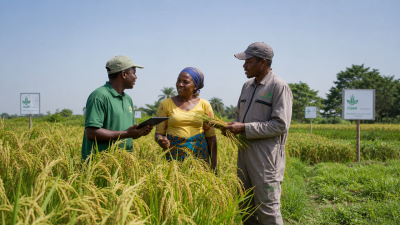
Côte d’Ivoire secured USD 50 million from the Green Climate Fund to scale proven CGIAR climate solutions to 147,000 smallholder rice, cassava and yam farmers, while the AfDB launched Phase III of TAAT and the TAAT Clearinghouse moved into CGIAR to strengthen continental scaling capacity.
Why this matters
Governance and policy
Scaling agricultural science requires alignment between research priorities, national strategies and development finance. Permanent continental assets that connect science to policy reduce transaction costs and speed national adoption.
Economy and livelihoods
Wider uptake of proven varieties and climate practices increases farm productivity, income stability and marketable surplus for smallholders. Investment flows from multilateral funds mobilise complementary public and private finance.
Environment and nutrition
Climate-adaptive practices reduce vulnerability. Biofortified crops address micronutrient deficiencies while ecosystem restoration sustains fisheries and inland water productivity.
CGIAR mandate and the Scaling for Impact programme
CGIAR is a global public research-for-development partnership for agriculture and food systems. Its Scaling for Impact programme assesses and supports expansion of proven innovations. Key instruments include the Scaling Readiness assessment and a scaling fund to strengthen partnerships, delivery mechanisms and incentives.
Key scientific innovations and examples
- Climate solutions: National rollout financed by climate funds, exemplified by Côte d’Ivoire’s USD 50 million GCF grant to bring 110,600 hectares under improved management.
- Crop resilience: Heat‑tolerant and climate‑adapted breeding targets production stability under warming trends.
- Biofortification: Zinc enrichment has been embedded in elite wheat lines to counter “hidden hunger”. CGIAR frames this as food-as-medicine for public nutrition policy.
- Digital and service innovations: Platforms for asset tracking and fisheries monitoring have been supported through scaling funds to improve delivery, market access and resource governance.
Artificial intelligence and augmented foresight
CGIAR’s “augmented foresight” proposal integrates AI into strategic foresight. Applications: faster, adaptive agricultural and economic models; near-real-time scenario analysis for policy; improved targeting of investments. Risks include model bias, data governance and capacity gaps at national level.
Institutional frameworks and multi-stakeholder partnerships
Effective scaling rests on coordinated roles:
| Stakeholder | Role |
|---|---|
| CGIAR | Generate evidence, provide breeding and technical packages, run Scaling for Impact tools. |
| Multilateral finance (GCF, AfDB) | Provide concessional and programme finance for national roll-out and to de-risk private investment. |
| National governments | Align innovations with policies, scale delivery via extension, seed systems and procurement. |
| Development agencies and NGOs | Support capacity building, pilot scaling models and finance targeted interventions. |
| Private sector | Commercialise seed, inputs and digital services; provide market linkages. |
Scaling instruments and assessment
- Scaling Readiness: Evaluates evidence base, partnerships, incentives, legitimacy and delivery structures. Useful for donor appraisal and national decision-making.
- Clearinghouses: TAAT Clearinghouse transition into CGIAR creates a permanent conduit between continental priorities, finance and private investors.
- Webinars and learning: Science of Scaling events build practitioner communities and shift focus from single-technology adoption to systems change.
Systemic change versus technology adoption
Scaling requires more than diffusion of tools. It requires market and policy adjustments, seed and input systems, extension reforms, financing mechanisms and stakeholder legitimacy. Scaling strategies must plan for institutional bottlenecks, gendered access, supply-chain constraints and regulatory adaptation.
Economic and social impacts
- Food security: Wider adoption of climate-smart practices raises yield stability and reduces hunger risk.
- Nutritional security: Biofortified staples offer a cost‑effective route to reduce micronutrient deficiencies at population scale.
- Livelihoods: Restoring inland aquatic ecosystems and improving fisheries monitoring sustain rural incomes.
- Fiscal considerations: Public investment and blended finance are needed to bridge early-stage scaling gaps and crowd in private capital.
Relevance for India
India can adapt instruments used by CGIAR: integrate scaling readiness into national schemes, fund biofortified varietal deployment through public procurement (mid-day meals, PDS), and apply augmented foresight for district-level climate and cropping decisions. The Narmada Basin workshop shows research–university–CGIAR collaboration models applicable to river basin restoration and fisheries management.
Barriers and implementation challenges
- Institutional: Fragmentation across ministries and weak delivery institutions.
- Financial: Short-term project cycles versus long-term scaling needs.
- Technical: Seed multiplication, quality control and cold chains for some products.
- Social: Gender gaps, land access and variable farmer incentives.
- Data and governance: Interoperable datasets, model transparency and local capacity for AI tools.
Policy options and way forward
- Institutionalise scaling assessments: Use Scaling Readiness in national appraisal of agri-programmes and donor projects.
- Mobilise blended finance: Combine concessional finance, outcome‑based payments and private capital for scale investments.
- Strengthen seed systems: Invest in public–private seed multiplication and certification for biofortified and climate‑adapted varieties.
- Capacity and data: Build public sector skills for AI-enabled foresight and protect data rights.
- Policy alignment: Link public procurement and safety‑nets to scaled technologies to secure demand.
Model Questions
1. Discuss the significance of scaling scientific innovations in food systems and how initiatives like CGIAR’s Scaling for Impact can address food security and climate resilience in developing countries. [GS-III: Economic Development]
Scaling scientific innovations raises productivity, stabilises yields and lowers exposure to climate shocks. CGIAR’s Scaling for Impact provides evidence, scaling assessments and financing channels to align research with national policy. Multilateral grants and blended finance reduce risk. Outcomes include increased cultivated area under improved management, greater smallholder incomes, and resilience to weather variability—subject to delivery capacity in seed systems, extension and market access.
2. Analyse the institutional and multi-stakeholder arrangements necessary for effective scaling of agricultural innovations, with reference to the CGIAR–AfDB TAAT interaction. [GS-II: Governance]
Effective scaling requires coordination across research, finance, government and private actors. CGIAR supplies science; TAAT and AfDB provide finance and continental reach; clearinghouses link national priorities to investment. National governments must mainstream innovations into extension, procurement and regulation. Development agencies and the private sector fill capacity and market roles. Clear roles, long-term financing and regulatory alignment are essential for scale.
3. Evaluate the potential of biofortification and AI-driven ‘augmented foresight’ in improving nutritional security and policy responsiveness in agriculture. [GS-III: Science & Technology]
Biofortification delivers micronutrients via staple crops at scale and fits public nutrition programmes. Embedding zinc in wheat addresses hidden hunger with low recurring cost. Augmented foresight uses AI to deliver dynamic models for cropping, shock responses and investment targeting, enabling faster policy decisions. Challenges: regulatory standards, data quality, ethics, capacity gaps and ensuring biofortified varieties reach vulnerable populations.
4. Examine why transition from technology adoption to systemic change is necessary for sustained impact, and describe tools or approaches that facilitate this transition. [GS-III: Environment & DM]
Technology adoption alone yields limited gains if supply chains, markets and institutions remain weak. Systemic change aligns seed systems, finance, extension, policy and demand. Tools include Scaling Readiness, clearinghouses to connect finance and policy, outcome‑based financing and participatory scaling funds. Learning platforms and cross‑sectoral workshops accelerate capacity building and institutional reforms required for sustainable, landscape‑level impact.
Last Modified: July 1, 2026