
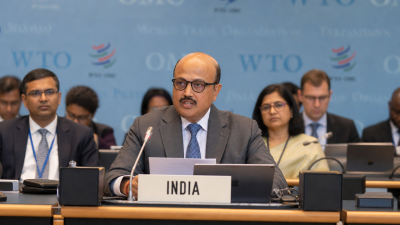
India concluded its Eighth Trade Policy Review at the WTO in Geneva on 24 July 2026, covering policy measures from 1 January 2021 to 31 December 2025. The review attracted 1,094 written questions from 44 members and interventions by 68 members, and noted India’s acceptance of the WTO Agreement on Fisheries Subsidies.
What is the issue?
The Trade Policy Review (TPR) assessed India’s trade policy settings, export performance and regulatory changes over a five-year period. The exercise involved a Government Report, a WTO Secretariat report and intensive member questioning. The TPR is a peer-review tool under Annex 3 of the Marrakesh Agreement and informs trade partners and investors about India’s policy direction.
Why it matters
- Economic governance: The TPR evaluates reforms that affect export competitiveness, trade costs and market access.
- International relations: Member queries test WTO-consistency of schemes and can trigger negotiations or disputes.
- Environment and livelihoods: Ratification of the Fisheries Subsidies Agreement links trade policy to marine sustainability and coastal livelihoods.
- National goals: Findings bear directly on India’s objective to become a developed economy under the Viksit Bharat 2047 vision.
Key factual points from the review
- Leadership: Delegation led by Commerce Secretary Rajesh Agrawal.
- Member engagement: 1,094 written questions from 44 members; 68 members intervened.
- Fisheries Subsidies: India deposited its Instrument of Acceptance on 20 July 2026 and is the 123rd ratifier; the Agreement entered into force after required ratifications on 15 September 2025.
- Export performance: Merchandise and services exports reached USD 863.1 billion in FY2025-26; this equals a compound annual growth rate of 6.3% over FY2021-22 (USD 676.5 billion).
- MSME framework: MSMEs fall under the MSMED Act, 2006; the composite criteria (investment + turnover) reform was implemented in July 2020.
Policy areas examined
- Digital Public Infrastructure (DPI): Digital payments, single-window and electronic documentation platforms were discussed as trade facilitators.
- Customs modernisation & trade facilitation: Paperless processing and risk-based controls noted as cost-reducing measures.
- MSME integration: Measures to connect small firms to global value chains were examined alongside persistent technical and compliance barriers.
- Defensive measures: Members raised questions on the Production Linked Incentive (PLI) scheme, tariff policy, Quality Control Orders (QCOs), import substitution measures and frequent use of trade remedies.
Analytical dimensions
1. Dualism: trade facilitation versus defensive protection
India presents simultaneous policies to improve trade facilitation and to protect or promote domestic industry. Facilitation reduces transaction costs and supports exports. Defensive instruments—PLI, QCOs, tariffs, trade remedies—seek domestic objectives like value addition and standards. Tension arises where defensive measures restrict market access or appear to favour domestic producers over foreign suppliers.
| Policy intent | Examples | WTO-member concern |
|---|---|---|
| Trade facilitation | Single-window, electronic filings, customs automation | Reduce trade costs; positive member response |
| Industrial promotion / protection | PLI schemes, QCOs, tariffs, trade remedies | May restrict market access; questions on subsidy treatment and non‑tariff barriers |
2. Structural bottlenecks and Viksit Bharat 2047
- Identified bottlenecks: High logistics and trade costs, regulatory complexity, infrastructure gaps, limited GVC participation.
- Impact on 2047 objective: Persistent trade-cost disadvantage will constrain manufacturing scale, export diversification and integration into advanced GVCs.
- Policy levers: Lower logistics costs, predictable tariffs, streamlined compliance, targeted infrastructure investment, labour and skill reforms, and active pursuit of market access via trade agreements.
3. Fisheries Subsidies—the trade–environment–livelihood nexus
- Agreement scope: Prohibits subsidies for illegal, unreported and unregulated fishing and for fishing of overfished stocks; excludes aquaculture and inland fisheries.
- India’s stance: Ratified and seeks long transition periods and carve-outs to protect traditional, artisanal fishers inside its EEZ.
- Policy implication: Combines global commons protection (SDG 14.6) with domestic safeguards—requires targeted social protection, fisher registries, and capacity building for small fishers.
4. MSME integration and Digital Public Infrastructure
- Digital enablers: UPI, e-invoicing, electronic certificates and single-window reduce transaction times and payment friction for MSMEs.
- Regulatory reform: The 2020 MSME composite criteria allow enterprise scaling while preserving support mechanisms.
- Remaining gaps: Technical barriers to trade, conformity assessment costs, finance access and logistics continue to limit deep GVC participation.
Implications for policy and multilateral engagement
- Design consistency: Development schemes must be WTO‑consistent. Transparency, notification and objective eligibility criteria reduce friction.
- Targeting support: Subsidies and incentives should be narrowly targeted, time-bound and conditional on capacity-building outcomes.
- Trade facilitation priority: Continued investment in customs automation, port connectivity and DPI will lower trade costs and help MSME exports.
- Negotiation strategy: Use TPR dialogue to explain domestic policy rationales; seek plurilateral safeguards only after broad consensus; pursue bilateral and regional agreements to secure market access.
- Environmental alignment: Implement fisheries commitments with measures that protect small fishers through transition assistance and co-management frameworks.
Model Questions
1. Evaluate the structural challenges identified in India’s Eighth Trade Policy Review at the WTO, and examine their impact on the Viksit Bharat 2047 vision. [GS-III: Economic Development]
Structural challenges include high logistics and trade costs, regulatory complexity, infrastructure gaps and weak GVC participation. These raise production costs, limit scale economies and constrain export diversification. For Viksit Bharat 2047 India must reduce logistics costs, simplify regulations, upgrade ports and customs, reform tariff and non‑tariff measures, invest in skills and technology, and secure market access through bilateral/regional agreements to sustain export-led growth.
2. Analyse the tension between India’s defensive trade measures (such as PLI and Quality Control Orders) and its multilateral trade facilitation commitments discussed in the Eighth TPR. [GS-II: International Relations]
Defensive measures aim to promote domestic industry and standards but can impede market access and appear protectionist. WTO members question subsidy treatment, local content and non‑tariff barriers. Reconciliation requires transparent design, objective eligibility, time limits, notification to the WTO, and alignment with WTO rules. Bilateral consultations and clearer domestic grievance procedures reduce dispute risk while preserving development objectives.
3. Discuss the implications of India’s ratification of the WTO Agreement on Fisheries Subsidies for marine ecology and the livelihoods of traditional coastal communities. [GS-III: Environment & DM]
Ratification reduces harmful subsidies that drive overfishing and stock depletion, supporting marine ecosystem recovery and long‑term fisheries productivity. To protect small-scale fishers, India seeks long transition periods and carve-outs. Policy responses must include targeted social protection, alternative livelihoods, fisher registration, capacity building, and community-based fisheries management to ensure ecological goals do not harm vulnerable coastal livelihoods.
4. Explain how India’s Digital Public Infrastructure and the 2020 MSME classification reforms facilitate integration of small enterprises into global value chains. [GS-III: Economic Development]
DPI—digital payments, e-invoicing, single-window and customs automation—reduces transaction times and payment frictions. The 2020 MSME composite criteria allow firms to scale without losing support. Together these lower compliance and transaction costs, improve traceability and credit access, and assist certification. Remaining barriers are technical standards, logistics and finance; targeted export promotion, quality labs and digital trade corridors are needed.
Last Modified: July 24, 2026