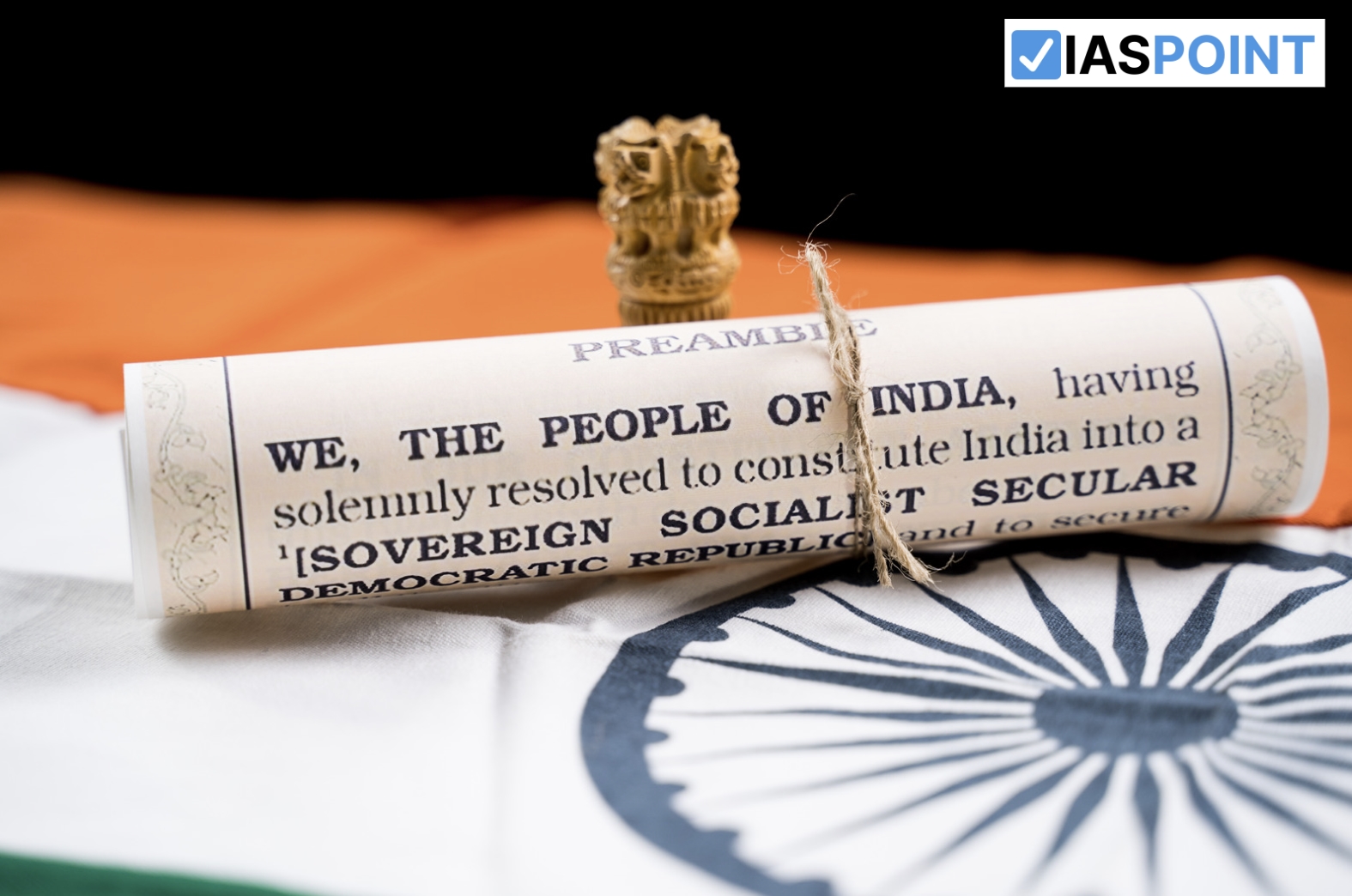
Indian Polity & Constitution for UPSC Prelims

I. Foundational Concepts of Indian Polity

  1. Evolution of Constitutional Framework
  2. Making of the Constitution
  3. Philosophy of the Constitution
  4. Key Features of the Indian Constitution
  5. Preamble: Vision and Ideals
  6. The Union and Its Territory
  7. Citizenship: Provisions and Policies

II. Fundamental Rights, Duties, and Principles

  1. Fundamental Rights: Scope and Limitations
  2. Directive Principles of State Policy
  3. Fundamental Duties of Citizens
  4. Doctrine of Basic Structure
  5. Constitutional Amendments

III. Central Government

  1. President: Powers and Functions
  2. Vice-President: Role and Responsibilities
  3. Prime Minister: Role and Powers
  4. Union Council of Ministers
  5. Cabinet Committees

IV. State Government

  1. Governor: Role and Powers
  2. Chief Minister: Executive Head of the State
  3. State Council of Ministers
  4. State Legislatures: Composition and Functions

V. Local Governance

  1. Panchayati Raj System
  2. Urban Local Bodies: Municipalities and Corporations

VI. Parliamentary System and Processes

  1. Indian Parliament: Structure and Powers
  2. Parliamentary Committees: Roles and Relevance
  3. Indian Parliamentary Group (IPG)

VII. Federalism and Inter-Governmental Relations

  1. India’s Quasi-Federal System
  2. Centre-State Relations
  3. Inter-State Relations
  4. Emergency Provisions

VIII. Judiciary

  1. Supreme Court: Powers and Jurisdiction
  2. High Courts: Role and Structure
  3. Subordinate Courts

IX. Judicial Mechanisms

  1. Judicial Review
  2. Judicial Activism
  3. Public Interest Litigation (PIL)

X. Alternative Dispute Resolution

  1. Tribunals: Scope and Authority
  2. Consumer Forums
  3. Lok Adalats and Alternative Mechanisms

XI. Union Territories and Special Provisions

  1. Administration of Union Territories
  2. Scheduled and Tribal Areas

XII. Constitutional Bodies

  1. Election Commission of India
  2. Union Public Service Commission (UPSC)
  3. State Public Service Commissions
  4. Finance Commission
  5. Goods and Services Tax (GST) Council
  6. Comptroller and Auditor General (CAG)
  7. Attorney General of India
  8. Advocate General of States

XIII. Special Commissions

  1. National Commission for Scheduled Castes
  2. National Commission for Scheduled Tribes
  3. National Commission for Backward Classes
  4. Special Officer for Linguistic Minorities

XIV. Non-Constitutional Bodies

  1. NITI Aayog: Policy Think Tank
  2. Central Vigilance Commission (CVC)
  3. Central Bureau of Investigation (CBI)
  4. Lokpal and Lokayuktas
  5. National Human Rights Commission (NHRC)
  6. State Human Rights Commissions
  7. National Commission for Women (NCW)
  8. National Commission for Protection of Child Rights
  9. National Commission on Minorities
  10. Central and State Information Commissions

XV. Political Dynamics and Elections

  1. Political Parties: National and Regional
  2. Coalition Governments: Evolution and Impact
  3. Electoral Process and Laws
  4. Electoral Reforms and Innovations
  5. Anti-Defection Law
  6. Voting Behavior and Trends
  7. EVMs and Election Technology

XVI. Societal Structures and Advocacy

  1. Pressure Groups and Their Influence
  2. Non-governmental Organizations (NGOs)

XVII. Cooperative Societies and Public Administration

  1. Cooperatives and Cooperative Movement

XVIII. Public Administration

  1. Public Services: Recruitment and Administration

XIX. Languages and Special Provisions

  1. Official Language and Regional Language Policies
  2. Special Provisions for Certain States and Classes

XX. Miscellaneous Topics

  1. National Integration and Unity
  2. Foreign Policy Principles and Challenges
  3. Landmark Judicial Verdicts
  4. Significant Doctrines in Indian Law
  5. Constitutions of Other Nations: A Comparative Study
  6. Rights and Liabilities of the Government

Historic Verdict on Triple Talaq

Historic Verdict on Triple Talaq

On August 22nd, 2017 in a historic verdict the Supreme Court verdict barred instant triple talaq, under which Muslim women have been divorced by their husbands over phone calls, sms, email etc. Interestingly, instant triple talaq is banned in 22 Muslim-majority countries, since it is considered theologically improper. ‘Instant’ triple talaq is a form of divorce under Islam. ‘Talaq-e-biddat (instant divorce) is manifestly arbitrary which allows a Muslim man to break down marriage whimsically,’ the majority view of the bench said. What it means for the country? The unanimous view is that the judgment will make a positive impact on the Muslim community.

It is not only expected to liberate Muslim women but also provide them with a sense of equality and empowerment. Muslim women can, like any other citizen of the country, report cased of mental torture and the husbands who pronounce unconstitutional triple talaq will be arrested. XV. Verdict on Right to Privacy On August 24, 2017 two days after the triple talaq verdict, the Supreme Court gave another momentous verdict on right to privacy. In a landmark verdict, the Supreme Court said that privacy is a constitutional right. The nine-judge bench were unanimous in their finding, though they cited different reasons for their conclusion. The judges concluded, “The right to privacy is protected as an intrinsic part of the right to life and personal liberty under Article 21 and as a part of the freedoms guaranteed by Part III of the Constitution”.

Key highlights and takeaways of the verdict

  1. The right to privacy- This protected as an intrinsic part of Article 21 that protects life and liberty,” the Supreme Court ruled.
  2. The order is based on an array of petitions that have challenged the mandatory use of Aadhaar cards which assign a unique 12-digit ID to every citizen. The Aadhaar database links iris scans and fingerprints to more than a billion people.
  3. The verdict does not comment on whether the government’s demand for Aadhar to be linked to all financial transactions amounts to an infringement of privacy.
  4. Legal experts say that the ruling could prompt the government to tweak its arguments in that case.
  5. The petitioners in the case had stressed that the Aadhaar database was originally presented as a purely voluntary programme that offered to provide every Indian with an identity card.
  6. Critics say the Aadhaar identity card links enough data to allow profiling because it creates a comprehensive profile of a person’s spending habits, their friends and acquaintances, the property they own, and a trove of other information.
  7. There are fears the data could be misused by a government that argues Indians have no right to privacy.
  8. The latest ruling overturns two earlier decisions by smaller benches of the Supreme Court which said privacy was not a fundamental right.
  9. The validity of Aadhaar law will be tested on the right to privacy judgment by a 3-judge bench.

Latest Constitutional Amendments

99th Constitutional Amendment Act

The amendment provides for the formation of a National Judicial Appointments Commission. 16 State assemblies out of 29 states including Goa, Rajasthan, Tripura, Gujarat and Telangana ratified the Central legislation which enabled the President to give assent to the bill. The amendment was however struck down by the Supreme Court on 16th October, 2015. 100th Constitutional Amendment Act Exchange of certain enclave territories with Bangladesh and conferment of citizenship rights to residents of enclaves consequent to signing of Land Boundary Agreement (LBA) Treaty between India and Bangladesh.

101st Constitutional Amendment Act

The Goods and Services Tax Act.

Leave a Reply

Your email address will not be published. Required fields are marked *

Archives