
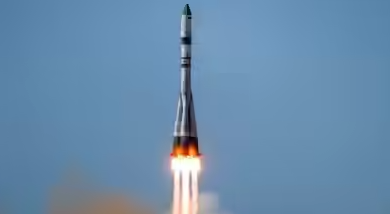
Russia conducted the first test launch of the Soyuz-5 medium-lift rocket from the Baikonur Cosmodrome in Kazakhstan on 30 April 2026. This two-stage vehicle completed a brief suborbital test flight carrying a mass simulator rather than an operational payload. Both stages operated according to the design parameters, deploying the mockup onto the calculated suborbital trajectory before its planned reentry. Managed by Russia’s civil space agency, Roscosmos, under the leadership of Dmitry Bakanov, this mission marks the debut of a homegrown launch vehicle family designed to eliminate reliance on external manufacturing components.
Technical Specifications and Capabilities
Structural Dimensions and Mass
The Soyuz-5 vehicle measures 65 meters in total length and possesses a gross liftoff mass of approximately 530 metric tonnes. The structural design features fuel tanks with a diameter of 4.1 meters. This configuration adapts tooling processes originally used for Proton rockets while allowing a higher propellant load capacity.
Propulsion Systems
The propulsion architecture relies heavily on liquid-propellant technology distributed across its staging sequence:
- First Stage: Powered by a single RD-171MV engine. This engine delivers approximately 7,250 kilonewtons of sea-level thrust, which exceeds 8,000 kilonewtons in vacuum conditions, making it the most powerful liquid-fuel rocket engine globally. It operates for approximately 179 seconds using a mixture of liquid oxygen (LOX) and RP-1 kerosene.
- Second Stage: Powered by an RD-0124MS engine cluster, featuring a four-chamber propulsion arrangement. It provides 588.6 kilonewtons of thrust in a vacuum, with a burn duration of 393 seconds.
- Optional Upper Stage: For geostationary missions, the rocket can integrate a Blok DM-03 or Fregat-SBU upper stage space tug.
Payload Lift Capacity
The rocket can deliver up to 17 metric tonnes of payload into Low Earth Orbit (LEO) when launched from Baikonur. This represents a substantial capacity upgrade over its direct technological predecessors.
Comparative Matrix of Russian Launch Vehicles
The following table contextualizes the performance parameters of the Soyuz-5 against the operational parameters of earlier Russian and Soviet-designed systems:
| Parameters | Soyuz-5 (Irtysh / Sunkar) | Zenit (Predecessor) | Soyuz-2 (Predecessor variant) |
| Developer | RKTs Progress | Yuzhnoye (Ukraine) | RKTs Progress |
| LEO Payload Capacity | 17 metric tonnes | 12 metric tonnes | 8.2 metric tonnes |
| Gross Launch Mass | 530 metric tonnes | 430 metric tonnes | 312 metric tonnes |
| Propellant Type | LOX / RP-1 Kerosene | LOX / RP-1 Kerosene | LOX / RP-1 Kerosene |
| Core Stage Propulsion | 1 x RD-171MV engine | 1 x RD-171M engine | 1 x RD-108A engine |
Geopolitical and Strategic Context
The Baiterek Project
The development of the Soyuz-5 forms the core of the bilateral Russia-Kazakhstan Baiterek project, initiated to update launch operations at Baikonur. Under this joint framework, Kazakhstan funded the modernization of the ground infrastructure at Site 45, Pad 1, which previously supported the retired Ukrainian-built Zenit launch vehicles.
Environmental Compliance
The transition to a LOX/Kerosene propellant combination fulfills a critical environmental mandate imposed by the Kazakh government. This non-toxic fuel mixture replaces the highly hazardous hypergolic propellants, such as unsymmetrical dimethylhydrazine (UDMH) and nitrogen tetroxide, utilized by older legacy vehicles like the Proton-M.
Future Super-Heavy Architecture
Beyond its role as a independent medium-lift platform, the first stage of the Soyuz-5 serves an architectural purpose. It is designed to function as the foundational booster unit for Russia’s future Yenisei super heavy-lift rocket program, which intends to assemble clusters of these liquid-fueled stages to achieve a 100-tonne LEO payload capacity.
IASPOINT Booster Facts for UPSC
- Nomenclature: The Soyuz-5 rocket is designated by multiple names depending on the regional context. It is called Irtysh in Russia (after the Irtysh River) and Sunkar in Kazakhstan (translating to Falcon).
- Historical Ancestry of the Engine: The RD-171MV engine is a direct technological descendant of the Soviet-era RD-170 engine family, originally developed in the late 1970s for the Energia super-heavy launcher program.
- Localization Drive: Unlike the older RD-171M variants that used components sourced from post-Soviet states, the RD-171MV is manufactured entirely within the Russian Federation using domestic components and updated digital control systems.
- The Baikonur Cosmodrome: Located in the desert steppe of Kazakhstan, Baikonur is the world’s first and largest operational space launch facility. It was rented by Russia from Kazakhstan under a long-term lease agreement scheduled to run until 2050.
- Competitive Landscape: In terms of lifting capability, the expendable Soyuz-5 occupies a market segment comparable to international commercial launchers like the European Ariane 6, Japan’s H3, and the American SpaceX Falcon 9, though it lacks the partial first-stage reusability of the Falcon 9.