
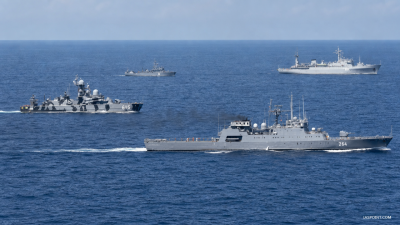
China conducted a live-fire naval exercise on 19 July 2026 inside waters Japan claims as its Exclusive Economic Zone (EEZ) near Okinotorishima. A Chinese Type 052D (Luyang III) destroyer fired live rounds about 180 km southwest of the atoll while a Russian Steregushchiy-class frigate operated nearby; Tokyo lodged a formal protest on 21 July 2026 and Beijing rejected it.
What is the immediate issue?
China’s drill inside Japan‑claimed EEZ waters and Russia’s nearby naval presence raise legal, safety and strategic tensions. The episode tests competing UNCLOS interpretations about maritime features and the permissibility of foreign military activities inside another state’s EEZ. Tokyo’s public disclosure and diplomatic protest have escalated a bilateral dispute into a wider regional security concern.
Why it matters
- Governance: UNCLOS interpretations determine sovereign rights and maritime administration.
- Security: Live‑fire drills near claimed waters increase risks of miscalculation and escalation.
- Economy: EEZ claims affect fisheries, seabed resources and freedom of navigation for trade routes.
- Diplomacy: Sino‑Russian naval coordination alters regional balance and alliance calculations.
UNCLOS legal framework and Article 121
Article 121 distinguishes three categories of maritime features: islands (generate EEZ and continental shelf), rocks (no EEZ or continental shelf if incapable of sustaining human habitation or economic life), and low‑tide elevations (no maritime zones unless within baseline). Article 56 grants coastal states sovereign rights over natural resources in the EEZ; Article 58 preserves other states’ freedoms of navigation and overflight.
Classification table: features and entitlements (Article 121)
| Feature | Condition | Maritime Entitlements |
|---|---|---|
| Island | Above high tide; sustains habitation/economic life | Territorial sea, EEZ (200 nm), continental shelf |
| Rock | Above high tide but cannot sustain habitation/economic life | Territorial sea only (12 nm) |
| Low‑tide elevation | Submerged at high tide | No entitlement unless within baseline of mainland/island |
Okinotorishima: legal and factual points
- Japan’s measures: Tokyo maintains Okinotorishima as its southernmost island and has undertaken protective works (concrete embankments, research installations) to support maritime claims.
- Chinese position: Beijing argues the feature is largely submerged at high tide and therefore cannot generate an EEZ.
- Precedent: The 2016 PCA award in Philippines v. China found several reef features did not generate EEZs; tribunal reasoning on natural character and habitability is relevant though not directly determinative for every feature.
Military activity in the EEZ: legal ambiguity and practice
UNCLOS is silent on permissibility of foreign military exercises in another state’s EEZ. Coastal states claim such activities may require consent when they affect resource rights or security. Naval powers claim freedom of navigation includes military activity. The result is legal asymmetry and recurrent diplomatic protests, as in the Okinotorishima drill where Japan protested and China rejected the claim by contesting the feature’s status.
Operational safety and confidence‑building
- Existing mechanisms: Code for Unplanned Encounters at Sea (CUES) and bilateral hotlines can reduce risks of incidents during exercises.
- Practical measures: Prior notification of live‑fire zones, safety corridors, and shared maritime situational awareness reduce collision and stray‑fire risks.
Sino‑Russian naval coordination: strategic implications
The concurrent Russian presence signals increased operational alignment in the western Pacific. Consequences include pressure on Japan’s maritime posture, incentive for allied interoperability, and a higher demand for maritime domain awareness. Joint operations complicate deterrence, raise surveillance burdens for regional navies, and may normalise third‑party support for operations challenging established maritime claims.
Implications for India and the Indo‑Pacific
- Economic stakes: Stability in Pacific sea lanes matters for India’s trade and energy supplies transiting South China Sea and adjacent waters.
- Strategic posture: A more assertive China, backed by Russian cooperation, increases the requirement for Indian maritime surveillance, force posture and forward engagement.
- Diplomatic options: India can combine legal support for rules‑based order, capacity building with partners, enhanced maritime exercises, and intelligence‑sharing platforms to protect Sea Lines of Communication (SLOCs).
Policy and legal options
- Clarify Article 121: Seek multilateral norms or authoritative dispute settlement to define “sustain human habitation or economic life” and reduce unilateral extensions of EEZs from marginal features.
- Operational rules: Promote adoption of agreed protocols for live‑fire drills, notifications and safety corridors in contested waters.
- Maritime domain awareness: Expand real‑time data sharing among like‑minded states via cooperative platforms to track exercises and reduce strategic surprise.
- Diplomatic‑legal track: Coastal states may pursue arbitration under UNCLOS or ITLOS where feasible; political costs and consent constraints affect uptake.
- Security cooperation: Strengthen regional naval exercises, logistics, and rapid response mechanisms to safeguard commerce and deter coercive behaviour.
Model Questions
1. Examine how Article 121 of UNCLOS functions as a focal point for maritime disputes in the Western Pacific, with reference to Okinotorishima. [GS-II: International Relations]
Article 121 distinguishes islands, rocks and low‑tide elevations and links entitlements to physical characteristics and habitability. Japan claims Okinotorishima yields a 200‑nm EEZ; China disputes this, calling it incapable of sustaining habitation. The legal ambiguity drives competing resource claims, diplomatic protests, and security posturing. Precedents like the 2016 PCA award inform but do not automatically resolve feature‑specific disputes.
2. Analyse why the interpretation of military activities within an EEZ remains a source of friction under UNCLOS, citing the recent West Pacific live‑fire drills. [GS-II: Governance]
UNCLOS grants coastal states resource rights in an EEZ and preserves other states’ navigation freedoms; it does not expressly regulate military operations. Coastal states argue live‑fire drills threaten safety and resource management; user states assert freedom of navigation includes military activity. This legal gap produces conflicting state practice, diplomatic protests (as with Japan’s protest), and operational risks, necessitating procedural norms and transparency for conflict avoidance.
3. Assess strategic implications of growing China‑Russia naval coordination in the Western Pacific for regional security architecture. [GS-III: Internal & External Security]
Joint operations project an alternative maritime posture that challenges US‑led security arrangements. They compel regional states to enhance surveillance, integrate allied responses, and prioritise sea‑control capabilities. Consequences include higher defence spending, increased patrols by Japan and partners, greater risk of encounters at sea, and incentive for deeper security cooperation among democracies to preserve deterrence and keep sea lanes open.
4. In view of escalating West Pacific disputes, analyse the security and economic challenges posed to India’s maritime interests and recommended policy responses. [GS-III: Economic Development]
Disputes threaten stability of SLOCs vital to India’s trade and energy. Strategic spillovers could redirect Chinese naval assets into the Indian Ocean, straining India’s defence resources. Policy responses: strengthen maritime domain awareness, deepen Quad and bilateral naval cooperation, protect logistics and basing options, support legal norms under UNCLOS, and engage in diplomatic efforts to preserve freedom of navigation and secure commerce.
Last Modified: July 21, 2026