
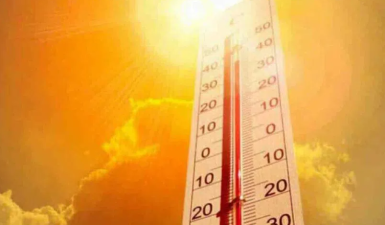
The World Meteorological Organization released its Global Annual-to-Decadal Update forecasting that global temperatures will remain at or near record highs between 2026 and 2030. The report, prepared by the United Kingdom Met Office, warns of an 86% probability that at least one year in this five-year window will eclipse 2024 as the warmest year on record. Scientists project a 91% chance that the global mean near-surface temperature will temporarily breach the critical 1.5°C warming threshold above pre-industrial levels for at least one year, signaling an accelerating climate crisis driven by greenhouse gas emissions and returning cyclical weather patterns like El Niño.
Key Temperature Projections (2026–2030)
The WMO multi-model climate ensemble provides specific probability metrics regarding near-surface temperature anomalies relative to the pre-industrial baseline (1850–1900).
- Average Temperature Range: Annual global mean near-surface temperatures are predicted to range between 1.3°C and 1.9°C above the pre-industrial average.
- Hottest Year Probability: There is an 86% chance that one year within this period will become the hottest on record, surpassing 2024 which reached 1.55°C above the baseline.
- The 1.5°C Threshold Breach: A 91% probability exists for a temporary single-year breach of 1.5°C.
- Five-Year Mean: There is a 75% chance that the entire five-year average for 2026–2030 will exceed 1.5°C above pre-industrial levels.
- The 2°C Threshold Safeguard: The report estimates an exceptionally low probability (less than 1%) that any individual year will exceed 2°C warming during this timeframe.
Regional Climate Variations and Arctic Amplification
Global warming does not manifest uniformly across the planet. The update highlights severe disparities, particularly in polar and tropical zones.
Arctic Winter Warming
- Temperature Anomaly: Arctic temperatures during the next five extended Northern Hemisphere winters (November to March) are projected to be 2.8°C warmer than the 1991–2020 baseline.
- Amplification Factor: This rate of warming is more than three and a half times the projected global average increase over the same period.
- Sea Ice Decline: Rapid warming will trigger further sea-ice concentration losses, specifically impacting the Barents Sea, Bering Sea, and Sea of Okhotsk.
Shifting Global Precipitation Patterns
The report models distinct rainfall anomalies for the May-to-September period compared to the 1991–2020 reference average:
| Region | Predicted Precipitation Anomaly | Climatic Impact |
| High Latitudes (Northern Hemisphere) | Wet Anomaly (Increased Rainfall) | Increased winter snowpack and river runoff in Alaska, Siberia, and Northern Europe |
| Africa’s Sahel Region | Wet Anomaly (Increased Rainfall) | Wetter-than-normal summer monsoon seasons |
| Subtropical Regions | Dry Anomaly (Decreased Rainfall) | Increased drought risk in the Southern Hemisphere subtropics |
| Amazon Basin | Dry Anomaly (Decreased Rainfall) | Severe moisture deficits, accelerating forest degradation |
Drivers of Accelerated Near-Term Warming
The interaction of anthropogenic emissions and natural planetary cycles drives the projected temperature spikes.
Greenhouse Gas Accumulation
Continuous tracking shows atmospheric concentrations of carbon dioxide, methane, and nitrous oxide remain at record levels, trapping heat within the troposphere.
Imminent El Niño Return
The update predicts a strong tendency toward El Niño conditions in the central tropical Pacific (Niño 3.4 region), particularly starting late 2026. This natural phenomenon warms surface waters in the equatorial Pacific, releasing massive thermal energy into the atmosphere and compounding background global warming.
Implications for the Paris Agreement
The temporary spikes detailed in the report do not equate to a permanent failure of international climate treaties.
- Paris Agreement Baseline: The 1.5°C and 2°C limits established under the 2015 Paris Agreement refer to long-term warming sustained over an extended period, typically assessed as a 20-year average.
- Climatic Warnings: Temporary exceedances are early warning signs. Passing 1.5°C even briefly increases the frequency of extreme heatwaves, intense precipitation events, wildfires, and localized ecosystem collapses.
IASPOINT Booster Facts for UPSC
- World Meteorological Organization (WMO): A specialized agency of the United Nations established in 1950. It originated from the International Meteorological Organization (IMO), founded in 1873.
- WMO Headquarters: Located in Geneva, Switzerland.
- Lead Centre for the Report: The UK Met Office acts as the WMO Lead Centre for Annual to Decadal Climate Prediction, synthesizing data from 13 different global forecasting institutes.
- Pre-Industrial Baseline: Climate science utilizes the period from 1850 to 1900 as the standard baseline approximation for pre-industrial global temperatures, prior to widespread fossil fuel combustion.
- Albedo Feedback Loop: The decline of Arctic sea ice creates a positive feedback mechanism. Replacing highly reflective ice (high albedo) with dark ocean water (low albedo) causes the ocean to absorb more solar radiation, accelerating polar warming.
- Global Producing Centres: WMO designates specific meteorological centers worldwide to generate long-range, seasonal, and decadal climate predictions using highly sophisticated ocean-atmosphere coupled models.