
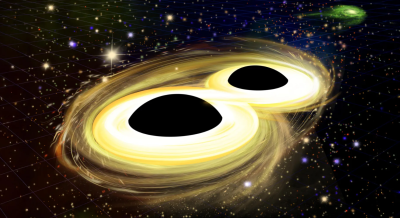
Scientists have confirmed that some of the most massive black holes in the universe originate from repeated mergers within dense star clusters. Using data from the fourth Gravitational-Wave Transient Catalog (GWTC-4), researchers analyzed 153 confirmed black hole mergers detected by the global LIGO-Virgo-KAGRA network. The study identified a distinct population of rapidly spinning black holes with random spin orientations, verifying the merger-chain formation model in crowded stellar environments. Published in Nature Astronomy in May 2026, the research also confirmed the existence of the pair-instability mass gap, highlighting the massive event GW231123, which formed a black hole of approximately 225 solar masses.
Mechanics of Hierarchical Black Hole Mergers
The Merger-Chain Hypothesis
The traditional stellar-collapse model limits the mass of a black hole formed from a single dying star. The hierarchical merger-chain model posits that black holes can grow continuously by consuming one another. This process requires a dense stellar environment where multiple black holes are packed closely together. When two black holes merge, they form a larger daughter black hole. If this new black hole remains gravitationally bound to the cluster, it can subsequently merge with another neighboring black hole, initiating a chain of successive growth.
Orbital Dynamics and Angular Momentum
The physical characteristics of merged black holes reveal their evolutionary history. The spin of a black hole is measured by its dimensionless spin parameter. Black holes formed from direct stellar collapse typically exhibit low or aligned spins. In contrast, hierarchical mergers produce daughter black holes with high spin rates, often around 0.7. Because these successive mergers occur from random directions within a crowded cluster, the resulting black holes display completely random spin orientations relative to their orbital planes.
Stellar Environments and Observational Evidence
Dense Star Clusters as Breeding Grounds
Hierarchical merger chains require high stellar densities to facilitate frequent gravitational interactions. Globular clusters and nuclear star clusters serve as primary breeding grounds. Globular clusters are ancient, tightly bound collections of up to a million stars. Nuclear star clusters sit at the centers of galaxies and exhibit even higher densities. The immense gravitational pull in these regions causes massive objects, like black holes, to sink toward the center through dynamical friction, increasing the probability of collisions.
Gravitational-Wave Transient Catalog Data
The global network of gravitational-wave observatories provides the empirical data needed to verify these merger chains. The fourth Gravitational-Wave Transient Catalog compiles data from the Laser Interferometer Gravitational-Wave Observatory (LIGO) in the United States, Virgo in Italy, and KAGRA in Japan. By analyzing the chirp signals—the rapid increase in frequency and amplitude just before a collision—scientists calculate the masses and spins of the merging entities.
The Pair-Instability Mass Gap and GW231123
Stellar Evolution Boundaries
The study provides critical evidence for the pair-instability mass gap, a theoretical mass range where no black holes should form directly from core-collapse supernovae. When very massive stars evolve, their cores become hot enough to produce electron-positron pairs. This process drops the internal radiation pressure, causing a violent contraction that triggers a thermonuclear runaway.
- Mass Range: Stars with initial masses between 65 and 130 solar masses undergo pulsational pair-instability, shedding mass before collapsing.
- The Gap: Stars with masses between 130 and 250 solar masses are entirely disrupted by pair-instability supernovae, leaving no remnant core behind. This creates a predictable mass gap where direct stellar-collapse black holes cannot exist.
- Implication: Any black hole detected with a mass falling within this gap must have formed through alternative means, such as hierarchical mergers.
The GW231123 Merging Event
The gravitational-wave event designated as GW231123 represents one of the most massive mergers ever recorded. The collision involved two high-mass black holes that merged to create a final remnant of roughly 225 solar masses. Because the final mass sits squarely within the forbidden zone of stellar evolution, it serves as a definitive case study for the merger-chain model.
Comparison of Black Hole Formation Pathways
Direct Collapse versus Hierarchical Mergers
The universe utilizes distinct mechanisms to generate black holes of varying sizes. Understanding the differences helps astrophysicists map the structural history of galaxies.
| Feature | Direct Stellar Collapse | Hierarchical Merger Chain |
| Primary Environment | Isolated binary systems, galactic fields | Dense globular and nuclear star clusters |
| Mass Limitations | Capped by the pair-instability threshold | Virtually unlimited, can cross the mass gap |
| Spin Magnitude | Generally low to moderate | High, concentrated around a value of 0.7 |
| Spin Orientation | Aligned with the binary orbital plane | Completely random and misaligned |
| Detection Method | Electromagnetic observations, X-ray binaries | Gravitational-wave interferometry |
IASPOINT Booster Facts for UPSC
- Gravitational-Wave Observatories: LIGO uses laser interferometry across 4-kilometer L-shaped arms to detect distortions in spacetime as small as a fraction of a proton’s width. LIGO India, being built in Hingoli, Maharashtra, will expand this global network to improve directional localization.
- Black Hole Classifications: Black holes are categorized by mass. Stellar-mass black holes range from 3 to 100 solar masses; intermediate-mass black holes range from 100 to 100,000 solar masses; supermassive black holes range from hundreds of thousands to billions of solar masses. GW231123 sits in the intermediate-mass category.
- Dynamical Kick: When two black holes merge anisotropically, they emit gravitational waves unevenly. This creates a gravitational recoil, or “kick,” that can launch the newly formed black hole out of its host cluster at speeds exceeding hundreds of kilometers per second, halting the merger chain.
- KAGRA Feature: Unlike LIGO and Virgo, the KAGRA observatory in Japan is built deep underground to reduce seismic noise and uses cryogenic mirrors cooled to minus 253 degrees Celsius to minimize thermal vibrations.
- The First Detection: The first direct observation of gravitational waves occurred in September 2015 (GW150914) by the LIGO detectors, confirming a key prediction of Albert Einstein’s 1915 General Theory of Relativity.