
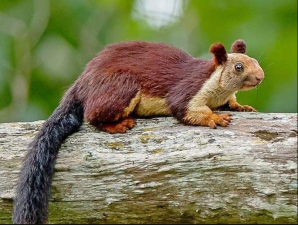
The Bhimashankar Wildlife Sanctuary in Maharashtra’s Pune district recently concluded its May 2026 population census of the Indian giant squirrel, the state animal. Guided by prominent scientist Renee Borges, the extensive survey aimed to estimate the current numbers of this elusive arboreal species and map its critical habitat hotspots within the protected area. The recent count follows the 2023 census, which recorded approximately 2,500 individuals. Conservationists rely on such surveys to monitor the health of the forest canopy, as the species depends entirely on an interconnected and undisturbed environment to meet its dietary, nesting, and survival needs.
Overview of Bhimashankar Wildlife Sanctuary
Geographical and Ecological Profile
- Geographical Location: Situated in the northern part of the Western Ghats in Maharashtra, the sanctuary spans across the Pune, Thane, and Raigad districts.
- Establishment: The area was officially notified as a wildlife sanctuary in 1985 specifically to protect the natural habitat of the Indian giant squirrel.
- Religious Importance: The sanctuary derives its name from the Bhimashankar temple, an ancient shrine recognized as one of the twelve sacred Jyotirlingas in India.
- Vegetation: The forest type is predominantly southern tropical semi-evergreen and moist deciduous, providing the thick, continuous canopy required by arboreal species.
- Co-existing Fauna: Apart from the giant squirrel, the sanctuary hosts panthers, sambar deer, mouse deer, striped hyenas, and wild boars.
Indian Giant Squirrel: Characteristics and Behavior
Biological Identity and Appearance
- Scientific Classification: The Indian giant squirrel (Ratufa indica), locally known as Shekru in Marathi, belongs to the sciuridae family of rodents.
- Physical Traits: It is one of the largest squirrel species globally, featuring a head-and-body length of up to 50 cm and a heavy, bushy tail of similar or greater length.
- Coloration: Its striking pelage typically features a dual-toned color scheme of deep red, brown, black, and pale yellow, helping it blend into the dappled sunlight of the forest canopy.
Diet and Daily Routine
- Dietary Habits: The species is strictly herbivorous. Its diet primarily consists of fruits, flowers, seeds, leaves, bark, and pith collected from the upper branches of trees.
- Activity Pattern: It is diurnal, showing maximum activity during the early morning and late evening while resting during the hot midday hours.
- Nesting Behavior: The solitary animal builds multiple large, globular nests made of twigs and leaves. These nests are strategically placed on thin branches to prevent large predators from reaching them.
- Multiple Homes: A single squirrel can build and maintain six to eight active nests simultaneously within its territory.
Ecological Role and Habitat Requirements
Canopy Dependency
- Arboreal Nature: The Indian giant squirrel is strictly arboreal, meaning it very rarely descends to the ground.
- Movement: It requires a continuous, unbroken forest canopy to leap safely from tree to tree. Breaks in the canopy restrict its movement, foraging range, and breeding opportunities.
- Territorial Marking: The animal marks its home range with a unique scent while traversing the high canopy branches to ward off competitors.
Environmental Impact
- Seed Dispersal: By consuming a vast variety of wild fruits and seeds across large areas, the squirrel acts as a crucial seed disperser, contributing directly to forest regeneration and maintaining plant diversity.
- Indicator Species: Biologists consider the species a prime indicator of forest health. A thriving population indicates a dense, undisturbed, and mature forest ecosystem.
Conservation Status and Major Threats
Population Pressures
- Habitat Fragmentation: The biggest threat to the species is the breaking of the forest canopy due to commercial logging, agriculture expansion, and linear infrastructure projects like roads and power lines.
- Human Disturbance: Increasing human habitation, noise pollution, and unregulated tourism around forest fringes lower nest density and force the shy animal into restricted core patches.
- Hunting: Historically, illegal hunting for its meat and decorative pelt wiped out entire localized populations in certain regions of India.
Protective Interventions
- Canopy Restoration: Conservation strategies focus on planting native fruiting trees to fill canopy gaps and reconnect isolated forest patches.
- Habitat Shielding: Authorities work to prevent the fragmentation of moist deciduous and evergreen forest tracts by restricting land-use changes near wildlife corridors.
IASPOINT Booster Facts for UPSC
- The Indian giant squirrel (Ratufa indica) is officially designated as the State Animal of Maharashtra.
- It is listed under Schedule I of the Wildlife (Protection) Act, 1972, providing it with the absolute highest degree of legal protection in India.
- The International Union for Conservation of Nature (IUCN) Red List categorizes the species as Least Concern, though local populations in the Western Ghats are declining due to habitat degradation.
- The species is strictly endemic to India, specifically restricted to the Western Ghats, Eastern Ghats, and the Satpura Range.
- There are multiple recognized subspecies of Ratufa indica classified primarily on the basis of distinct pelage colors across different geographical zones.
- The Ratufa indica dealbata subspecies, which possessed a pale, albinistic coat and was native to the Dangs region of Gujarat, is now considered entirely extinct due to extensive hunting.
- During population census exercises, forest officials use block counting and line-transect methods to map the density of the distinctive, high-canopy globular nests rather than attempting to directly count the highly elusive animals.
- It operates as a solitary animal that typically only comes together with others of its kind for breeding purposes.