
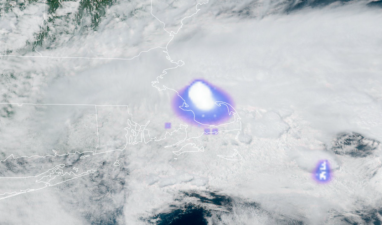
On Saturday afternoon, May 30, 2026, a sudden, powerful double explosion and ground-shaking tremors rattled residents across Eastern Massachusetts, Rhode Island, and broader Southern New England. Because the event occurred during an overcast day, there were no widespread immediate visual sightings of fire or smoke, leading many to fear an earthquake or a major industrial accident. However, the U.S. Geological Survey (USGS) detected absolutely no seismic activity on its instruments. Instead, satellite data, weather radar, and subsequent NASA tracking confirmed that the disturbance was caused by a significant bolide—an exceptionally bright meteor that enters the atmosphere at extreme speed and explodes.
Physics of a Bolide and the Sonic Boom
Atmospheric Re-entry and Friction
The space rock, confirmed by NASA to be a natural fragment of an asteroid rather than space debris, was roughly 3 to 5 feet (1 to 1.5 meters) wide. It entered Earth’s upper atmosphere at a staggering velocity of approximately 75,000 mph (120,700 km/h). As an object moves at such hypersonic speeds, the air in front of it cannot compress and move out of the way fast enough. This creates an intense pocket of high-pressure air, generating extreme friction and thermal energy that heats the meteor to thousands of degrees.
The Airburst Mechanism
The structural integrity of the small asteroid failed under this immense pressure. At an altitude of roughly 40 to 31 miles (64 to 50 km) above the Massachusetts-New Hampshire border and fanning out east of Boston, the rock underwent a catastrophic fragmentation known as an airburst. NASA estimated that the sudden breakup released an energy equivalent to detonating 230 to 300 tons of TNT. This instantaneous release of energy generated a powerful shockwave that propagated through the atmosphere, manifesting on the ground several minutes later as a dramatic double sonic boom capable of shaking windows and rattling homes.
Evidence and Satellite Detection
- Geostationary Lightning Mapper (GLM): The GLM instrument aboard the GOES-19 satellite picked up a massive, isolated optical flash east of Boston over Cape Cod Bay. Because there were no active thunderstorms or weather fronts capable of producing lightning in the region at 2:06 PM EDT, the anomalous flash signature was immediately identified by meteorologists as a bolide explosion.
- Weather Radar Integration: National Weather Service radar stations in eastern Massachusetts, Maine, and New York also tracked the falling, fragmenting debris cloud, confirming a non-terrestrial origin.
- Acoustic and Vibrational Data: While the USGS did not register actual tectonic earthquakes, it opened a temporary event tracking page due to thousands of “Did You Feel It?” submissions from citizens whose homes shook from the atmospheric blast waves.
Comparison: 2026 New England vs. 2013 Chelyabinsk
| Metric | 2026 New England Bolide | 2013 Chelyabinsk Event (Russia) |
| Object Diameter | ~3 to 5 feet (1 to 1.5 meters) | ~66 feet (20 meters) |
| Speed | ~75,000 mph (120,700 km/h) | ~42,000 mph (67,600 km/h) |
| Explosive Yield | 230 – 300 tons of TNT | ~400 – 500 kilotons of TNT |
| Altitudinal Fragmentation | 31 – 40 miles (50 – 64 km) | ~18 miles (30 km) |
| Ground Impact / Damage | Audible rumbles, minor building rattling; no structural damage or injuries. Debris likely in Cape Cod Bay. | Widespread shattered glass, collapsed factory roofs, and over 1,500 indirect injuries from the shockwave. |
IASPOINT Booster Facts for UPSC
- Definition of Terms: A meteoroid is the rock in space; a meteor is the streak of light seen as it burns; a fireball is an exceptionally bright meteor; a bolide is a fireball that ends in an explosive airburst; and a meteorite is any portion that survives the descent and impacts the ground.
- Troposphere vs. Stratosphere/Mesosphere: The New England airburst occurred high in the stratosphere/mesosphere boundary. Most smaller meteors fully vaporize here before reaching the troposphere (the lowest layer of the atmosphere).
- Near-Earth Objects (NEOs): Space agencies monitor NEOs using automated systems like ATLAS and Pan-STARRS. Objects under 5 meters, like the May 2026 bolide, are incredibly difficult to detect in advance because of their small size and rapid transit times.
- Sonic Boom Generation: Occurs when an object travels faster than the speed of sound (v > c, where c ≈ 343 m/s in dry air at 20°C). The overlapping sound waves form a single conical shockwave called a Mach cone.