
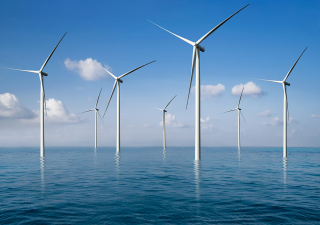
The Global Wind Energy Council’s Global Offshore Wind Report (13 June 2026) projects global offshore wind capacity to rise from 92.5 GW in 2025 to 420 GW by 2035, while about 25 GW of ready‑to‑build projects outside China remain stalled.
Global trajectory and market concentration
- Decadal projections: 10% average annual growth; ~327 GW of new capacity over the next ten years; annual installations expected to exceed 50 GW by 2035.
- Market concentration: Five markets account for 90.3% of capacity; China 48.4 GW (~52%); Europe >38 GW (~42%); Taiwan and South Korea emerging in Asia‑Pacific (ex‑China).
Primary structural barriers
- Grid and transmission: Shortage of subsea transmission and onshore grid reinforcement; long lead times for HVDC converter platforms.
- Auction and procurement failures: Only 11.4 GW awarded via auctions globally, ≈20% of prior procurement volume; un‑bankable auction frameworks and contract cancellations.
- Financing pressures: Project CAPEX up 40–60% due to inflation, supply‑chain disruption and higher interest rates; FIDs stalled for ~25 GW.
Technical and financial differences vs onshore
- Turbine scale: Offshore units up to 15 MW per turbine.
- Utilisation: Offshore capacity utilisation ~40–55%; onshore ~25–35%.
- Logistics & CAPEX: Requires heavy‑lift installation vessels and subsea cabling; higher marine structural costs.
Policy measures advocated
- Critical infrastructure status: Shortens permitting, reduces perceived project risk and financing costs.
- Index‑linked CfDs: Provide price certainty and inflation protection to improve bankability.
IASPOINT Booster Facts
- Nodal agencies (India): MNRE is nodal ministry; NIWE handles resource assessment and seabed block allocation.
- Technical potential & targets: NIWE estimates 71 GW offshore potential (Gujarat 36 GW; Tamil Nadu 35 GW); national target 30 GW by 2030.
- Support and procurement: VGF ₹7,453 crore for initial 1 GW (500 MW each for Gujarat and Tamil Nadu); earlier 4.5 GW tender cancelled and rebid as Model‑A/B/C; FOWIND and FOWPI provided early feasibility and metocean studies.