
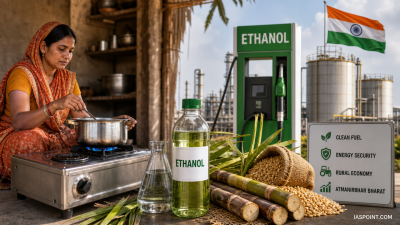
India is preparing a policy to introduce ethanol as a mainstream household cooking fuel alongside LPG. The Ministry of Petroleum and Natural Gas aims to finalise a framework by September 2026. India has E20 nationwide and a usable ethanol surplus of about 7 billion litres for domestic cooking use.
What is the current issue
Policy to shift part of household cooking demand from imported LPG to domestically produced ethanol. Key facts:
- Policy status: Framework under preparation; expected by September 2026.
- Production capacity: >20 billion litres annual capacity; +4 billion litres projected this financial year.
- Utilisation: E20 blending uses ~11 billion litres; industry ~3–3.5 billion litres; estimated surplus ~7 billion litres for households.
- Operational work: OMCs (IOCL, BPCL, HPCL) are developing ethanol stoves and testing dispensing points (‘ethanol ATMs’).
- Incentives signalled: One‑time capital support for stoves and potential recurring fiscal benefits for consumers.
Why it matters
- Energy security: Reduces LPG import dependence and exposure to maritime chokepoints such as the Strait of Hormuz.
- Economic: Uses domestic agricultural value chains and reduces import bill volatility.
- Environment & agriculture: Raises trade‑offs between water use, land use, and food availability; 2G options remain critical.
- Technology & safety: Requires new stove designs, standards and safe handling protocols for volatile alcohol fuels.
Geopolitical security & energy diversification
India imports a large share of household LPG. Shipments traverse strategic chokepoints; disruptions raise supply and price risk. Substituting a portion of household cooking demand with domestic ethanol lowers import dependence. Deploying about 7 billion litres to households could meaningfully reduce LPG volumes imported, stabilise domestic energy prices, and provide resilience against supply shocks.
Infrastructure, technology and safety
Feedstock and production
Primary feedstocks are sugarcane juice, molasses and damaged foodgrains. Long‑term strategy must scale 2G ethanol from crop residues and bagasse to avoid food‑fuel conflict.
Stoves, dispensing and distribution
- Stove R&D: OMCs are prototyping ethanol stoves. Requirements: efficient combustion, low indoor emissions, robust valves and canister interfaces.
- Dispensing network: ‘Ethanol ATMs’ at fuel stations are under evaluation. Decentralised refills and last‑mile logistics will be essential for rural reach.
- Canister model: Refillable, certified canisters with tamper‑proof valves needed to ensure safe household handling and reverse logistics.
Safety and standardisation
Ethanol has a low flash point and is more volatile than LPG when leaked. Mandatory standards, testing labs and certification are required. Agencies: BIS for standards, PESO for fuel handling rules, and OMC testing cells for field trials.
Policy framework and fiscal measures
- Legal basis: National Policy on Biofuels, 2018 provides the policy foundation for expanding biofuel use to cooking.
- Anticipated instruments: One‑time capital subsidy for ethanol stoves; recurring fiscal incentives or price support to achieve parity with subsidised LPG; possible direct benefit transfer to targeted households.
- Institutional coordination: Ministry of Petroleum & Natural Gas to lead policy design with MNRE, Ministry of Agriculture, Ministry of Rural Development and state governments for distribution networks.
- Targeting: Prioritise low‑income and remote households while protecting benefits under existing LPG schemes such as PM Ujjwala.
- Regulation: Standards for fuel quality, stove performance, canister design and retail dispensing to be codified; safety training and awareness campaigns required.
Environmental and agricultural implications
- Water use: Sugarcane is water‑intensive. Scaling 1G ethanol risks worsening groundwater stress in producing states such as Uttar Pradesh and Maharashtra.
- Food security: Use of damaged foodgrains or diversion of cropland can affect supplies and prices. Policy must restrict edible food diversion and set clear feedstock priorities.
- 2G transition: Policy incentives and capital support for 2G plants using lignocellulosic residues will reduce food‑fuel trade‑offs and improve lifecycle GHG performance.
- Emissions: Ethanol stoves can lower particulate emissions versus traditional biomass. Lifecycle emissions depend on feedstock and production practices.
| Dimension | LPG | Ethanol (household) |
|---|---|---|
| Source | Fossil (domestic + imports) | Domestic biofeedstocks (sugarcane, residues) |
| Import dependence | High | Low |
| Price volatility | Linked to global markets | Linked to domestic agricultural cycles |
| Storage & safety | High pressure cylinders; regulated | Liquid fuel; needs certified canisters and leak prevention |
| Environmental risk | Fossil emissions | Depends on feedstock and water use |
Implementation risks and mitigation
- Risk: Unsafe household handling. Mitigation: Mandatory canister standards, user training, regulated refill networks.
- Risk: Food‑fuel competition. Mitigation: Prioritise 2G feedstocks; restrict edible grain use to emergency cases only.
- Risk: Water stress. Mitigation: Incentivise less water‑intensive feedstocks and agronomic best practices; regional sourcing policies.
- Risk: Price non‑competitiveness with subsidised LPG. Mitigation: Time‑limited fiscal support, DBT to consumers, and market development grants for producers.
Model Questions
1. Evaluate how diverting a portion of household cooking demand from imported LPG to domestic ethanol can strengthen India’s energy security in the face of maritime vulnerabilities. [GS-III: Internal & External Security]
India’s ethanol shift lowers LPG import volumes and reduces exposure to supply disruptions via chokepoints such as the Strait of Hormuz. Domestic ethanol uses local feedstocks and stabilises supply chains. Using the estimated 7 billion litres surplus for cooking can cut import bills, reduce price volatility, and increase resilience. Implementation requires assured feedstock supply, distribution networks and fiscal measures to maintain affordability for vulnerable households.
2. Analyse the structural and technological challenges in deploying ethanol as a household cooking fuel and propose practical solutions. [GS-III: Science & Technology]
Challenges: stove efficiency, indoor emissions, volatile fuel handling, canister design, and last‑mile dispensing. Solutions: standardised ethanol stoves with controlled combustion, certified refillable canisters, field trials by OMCs, decentralised ethanol ATMs, BIS/PESO standards and accredited testing labs. Invest in training for retailers and users, and pilot programmes in varied climatic and rural settings before large‑scale rollout.
3. Examine the policy measures that should be included under the National Policy on Biofuels to ensure an equitable transition from LPG to ethanol for household cooking. [GS-II: Governance]
Policy must include one‑time capital subsidies for ethanol stoves, recurring fiscal support to match subsidised LPG prices, and DBT for eligible households. Institutional coordination among MoPNG, MNRE, Agriculture and state governments is needed for supply, distribution and targeting. Regulatory measures should mandate safety and quality standards, and time‑bound incentives must promote 2G feedstocks to prevent food‑fuel conflicts.
4. Discuss the ecological and agricultural implications of scaling ethanol production for household cooking and outline mitigation measures. [GS-III: Environment & DM]
Scaling 1G ethanol increases water demand and risks groundwater depletion in sugarcane areas; diverting foodgrains can threaten food security and raise prices. Mitigation: prioritise 2G ethanol from residues, enforce restrictions on edible grain use, promote water‑efficient crops and irrigation, adopt sustainable sourcing criteria, and provide incentives for residue collection and decentralised 2G plants to reduce environmental strain.
Last Modified: July 20, 2026