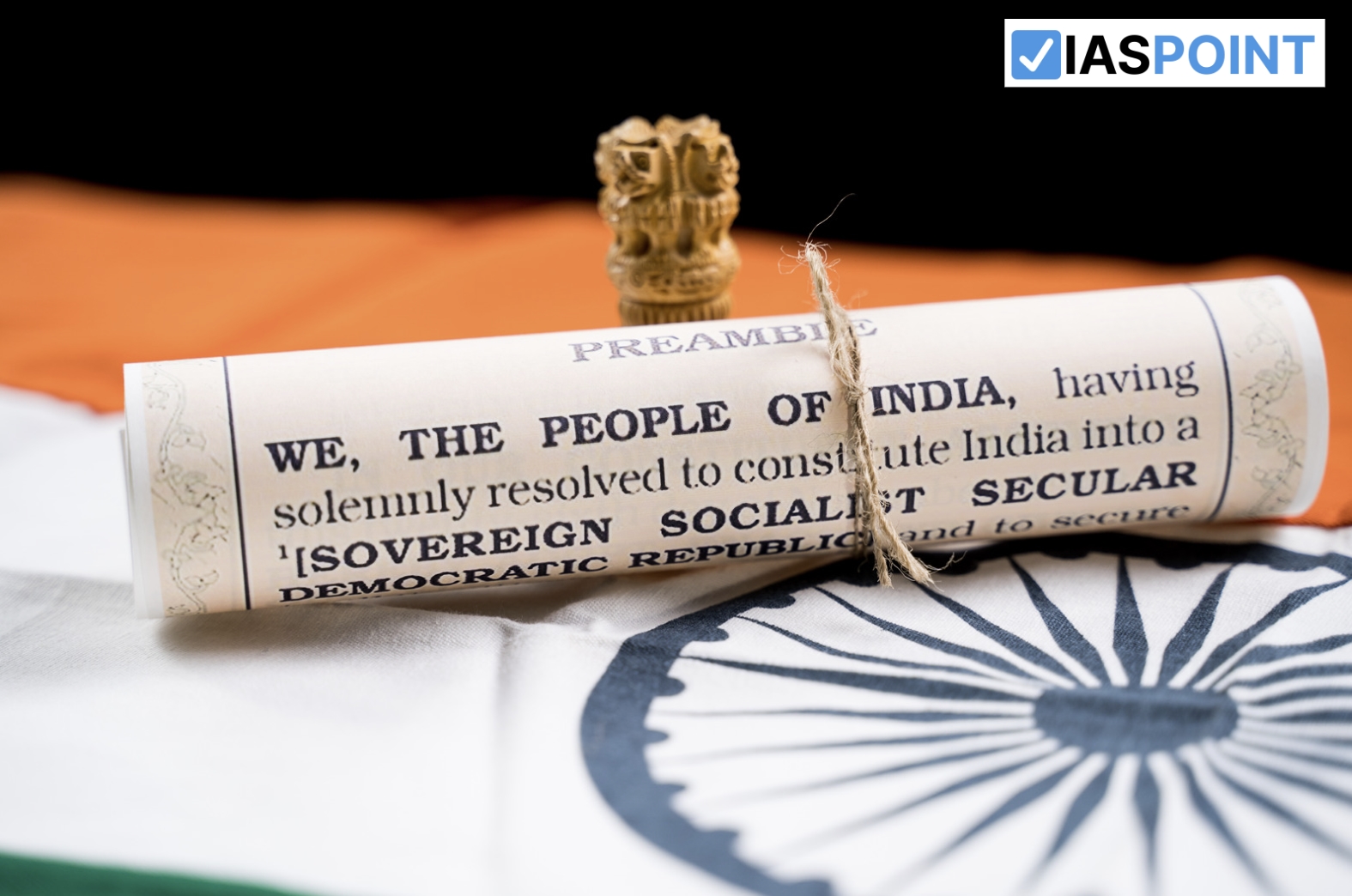
Indian Polity & Constitution for UPSC Prelims

I. Foundational Concepts of Indian Polity

  1. Evolution of Constitutional Framework
  2. Making of the Constitution
  3. Philosophy of the Constitution
  4. Key Features of the Indian Constitution
  5. Preamble: Vision and Ideals
  6. The Union and Its Territory
  7. Citizenship: Provisions and Policies

II. Fundamental Rights, Duties, and Principles

  1. Fundamental Rights: Scope and Limitations
  2. Directive Principles of State Policy
  3. Fundamental Duties of Citizens
  4. Doctrine of Basic Structure
  5. Constitutional Amendments

III. Central Government

  1. President: Powers and Functions
  2. Vice-President: Role and Responsibilities
  3. Prime Minister: Role and Powers
  4. Union Council of Ministers
  5. Cabinet Committees

IV. State Government

  1. Governor: Role and Powers
  2. Chief Minister: Executive Head of the State
  3. State Council of Ministers
  4. State Legislatures: Composition and Functions

V. Local Governance

  1. Panchayati Raj System
  2. Urban Local Bodies: Municipalities and Corporations

VI. Parliamentary System and Processes

  1. Indian Parliament: Structure and Powers
  2. Parliamentary Committees: Roles and Relevance
  3. Indian Parliamentary Group (IPG)

VII. Federalism and Inter-Governmental Relations

  1. India’s Quasi-Federal System
  2. Centre-State Relations
  3. Inter-State Relations
  4. Emergency Provisions

VIII. Judiciary

  1. Supreme Court: Powers and Jurisdiction
  2. High Courts: Role and Structure
  3. Subordinate Courts

IX. Judicial Mechanisms

  1. Judicial Review
  2. Judicial Activism
  3. Public Interest Litigation (PIL)

X. Alternative Dispute Resolution

  1. Tribunals: Scope and Authority
  2. Consumer Forums
  3. Lok Adalats and Alternative Mechanisms

XI. Union Territories and Special Provisions

  1. Administration of Union Territories
  2. Scheduled and Tribal Areas

XII. Constitutional Bodies

  1. Election Commission of India
  2. Union Public Service Commission (UPSC)
  3. State Public Service Commissions
  4. Finance Commission
  5. Goods and Services Tax (GST) Council
  6. Comptroller and Auditor General (CAG)
  7. Attorney General of India
  8. Advocate General of States

XIII. Special Commissions

  1. National Commission for Scheduled Castes
  2. National Commission for Scheduled Tribes
  3. National Commission for Backward Classes
  4. Special Officer for Linguistic Minorities

XIV. Non-Constitutional Bodies

  1. NITI Aayog: Policy Think Tank
  2. Central Vigilance Commission (CVC)
  3. Central Bureau of Investigation (CBI)
  4. Lokpal and Lokayuktas
  5. National Human Rights Commission (NHRC)
  6. State Human Rights Commissions
  7. National Commission for Women (NCW)
  8. National Commission for Protection of Child Rights
  9. National Commission on Minorities
  10. Central and State Information Commissions

XV. Political Dynamics and Elections

  1. Political Parties: National and Regional
  2. Coalition Governments: Evolution and Impact
  3. Electoral Process and Laws
  4. Electoral Reforms and Innovations
  5. Anti-Defection Law
  6. Voting Behavior and Trends
  7. EVMs and Election Technology

XVI. Societal Structures and Advocacy

  1. Pressure Groups and Their Influence
  2. Non-governmental Organizations (NGOs)

XVII. Cooperative Societies and Public Administration

  1. Cooperatives and Cooperative Movement

XVIII. Public Administration

  1. Public Services: Recruitment and Administration

XIX. Languages and Special Provisions

  1. Official Language and Regional Language Policies
  2. Special Provisions for Certain States and Classes

XX. Miscellaneous Topics

  1. National Integration and Unity
  2. Foreign Policy Principles and Challenges
  3. Landmark Judicial Verdicts
  4. Significant Doctrines in Indian Law
  5. Constitutions of Other Nations: A Comparative Study
  6. Rights and Liabilities of the Government

Right to property and Constitutional Remedies

Right to property and Constitutional Remedies

Article 31 of the Constitution which was a fundamental right to property is now a constitutional right to be regulated by ordinary law. Article 31(A) provides for the saving of laws which relate to acquisition of estates while Article 31 (B) validates the Acts and Regulations mentioned in Ninth Schedule to the Constitution. Article 31(C) saves these laws which give effect to certain directive principles while Article 31(D) has been repealed by the Forty-third Amendment Act 1977.

Right to constitutional remedies

Article 32 relates to the conferment of rights enshrined in Part III. “The right to move the Supreme Court is guaranteed by Article 32(1). “The Supreme Court, in turn, has the power to issue directions or orders or writs (Article 32(2)). “Theclause 3 of Article 32 empowers the Parliament to confer the enforcement of the rights under Part III to any other court within local limits. Article 32(4) ensures that the right to constitutional remedies would not be suspended except as provided by the Constitution.

“The types of writs are:

(i) Habeas Corpus: Literally (from Latin term) it means ‘to have the body of ‘. “This writ may be issued against both public authorities and individuals for protecting their liberty (See Ummu Sabeena v State of Kerala, 2011). It is not issued where (a) the detention is lawful, (b) the proceedings are for contempt of a legislature or a court, (c) the detention is by a competent court, and (d) the detention is outside the jurisdiction of the court.

(ii) Mandamus: Literally it means ‘we command’. “This writ is issued (a) against a private individual or a body; (b) to enforce departmental instruction that does not possess statutory force; (c) when the duty is discretionary and not mandatory; ((d) to enforce a contractual obligation; (e) against the President of India or state governors).

(iii) Prohibition: Literally, it means ‘to forbid’. “This writ can be issued only against judicial and quasi-judicial authorities. It is not available against administrative authorities, legislative bodies, and private individuals or bodies.

(iv) Certiorari: Literally, it means ‘to be certified’ or ‘ to be informed’. It is issued by a higher court to a lower court or a tribunal or to an administrative authority (since 1991), either to transfer a case pending with the latter itself or to quash the order of the latter in a case. It is used on the grounds of excess of jurisdiction or lack of jurisdiction or error of law. “Thus, unlike prohibition, which is only preventive, certiorari is both preventive as well as curative.

(v) Quo Warranto: It means ‘by what authority or warrant’. It is issued by the court to inquire into the legality of claim of a person to a public office. Hence, it prevents illegal usurpation of public office by a person. Mere infringement or its threat suffices the issue of the writs (Simranjit Singh v. Union of India’1973).

Leave a Reply

Your email address will not be published. Required fields are marked *

Archives