
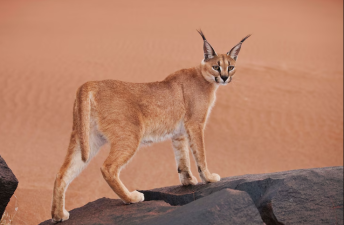
Wildlife officials confirmed the presence of the rare Asiatic caracal (Caracal caracal schmitzi) in the Thar Desert near the India-Pakistan border in Jaisalmer, Rajasthan. Field teams from the Rajasthan Forest Department and the Wildlife Institute of India tracked at least three distinct individuals, including a male and a female, utilizing motion-sensing camera traps and radio-collaring data in the Ramgarh-Shahgarh landscape. This population assessment provides verifiable proof of active breeding within the extreme arid ecosystem. The species faces severe localized threats, with wild populations in India estimated at fewer than 50 to 100 individuals, triggering targeted landscape restoration and multi-agency protection frameworks.
Ecological Profile and Distribution
The caracal is a medium-sized, elusive wild cat adapted to arid environments. The sub-species native to the Indian subcontinent displays specialized physiological traits suitable for survival in low-moisture zones.
Anatomical and Behavioral Adaptations
- Distinct Features: The animal features iconic long black ear tufts, a reddish-brown (rufous) coat that serves as camouflage in sandy scrublands, and elongated canine teeth.
- Hunting Mechanics: Strong, elongated hind legs allow the cat to leap several feet into the air to capture birds in flight. It also feeds extensively on desert rodents, hares, and small reptiles.
- Nocturnal Pattern: The caracal is primarily a solitary and nocturnal predator, resting in burrows or dense desert scrub during the peak heat of the day to minimize water loss.
Habitat and Geographic Range
The global distribution of the caracal spans Africa, the Middle East, Central Asia, and northwestern India. Within India, the geographic range has shrunk by over 95% since the mid-20th century. The current wild population is localized within dry grasslands, semi-arid scrub forests, and ravine ecosystems across two states:
- Rajasthan: Chiefly found in the Thar Desert (Jaisalmer district) and the semi-arid scrub fringes of Ranthambore, Dholpur, and Karauli.
- Gujarat: Fragmented pockets within the seasonal salt marshes and grasslands of the Kutch region.
- Madhya Pradesh: Historical presence exists, with rare sporadic individual sightings documented in areas like the Gandhi Sagar Wildlife Sanctuary.
Conservation Status and Legal Safeguards
The legal classification of the caracal varies globally and nationally, reflecting its extreme scarcity within the Indian ecosystem.
| Institutional Framework | Conservation Category / Legal Provision | Implications for Enforcement |
| Wild Life (Protection) Act, 1972 (India) | Schedule I | Grants the highest degree of legal protection; mandates maximum penalties for hunting or trade. |
| IUCN Red List of Threatened Species | Globally: Least Concern / India: Critically Endangered | Globally secure across Africa, but facing immediate threat of regional extinction in India. |
| Integrated Development of Wildlife Habitats (IDWH) | Listed under the Species Recovery Programme | Eligible for direct central funding to carry out targeted habitat restoration and monitoring. |
| CITES | Appendix I (Asian populations) | Bans commercial international trade in specimens or derivatives of the Asian sub-species. |
Threat Matrix and Mitigation Strategies
The rapid decline of the caracal in northwestern India stems from a mix of anthropogenic pressures and ecosystem imbalances.
Primary Drivers of Population Decline
- Habitat Fragmentation: The conversion of semi-arid open scrublands into agricultural fields and industrial setups isolates breeding pairs, restricting natural male dispersal.
- The “Wasteland” Classification: Official land-use classification often marks desert scrublands as non-productive wastelands, clearing the way for large-scale infrastructure projects that degrade the cat’s primary hunting grounds.
- Feral Dog Aggression: Packs of feral dogs thriving near human garbage dumps directly compete with caracals for small prey and pose a fatal predation risk to young wild cats.
- Retaliatory Killings: Pastoral communities occasionally target small carnivores to protect sheep and goat kids from predation.
Modern Conservation Responses
- Radio-Telemetry Tracking: The installation of radio collars allows researchers to map territorial boundaries, migratory corridors, and interactions with human infrastructure.
- The “Goat Bank” Model: Managed by the Wildlife Institute of India, this community-based program compensates pastoralists for verified livestock losses by providing a replacement animal from a community-managed pool, preventing retaliatory poisonings.
- National Masterplan Corridors: A national conservation blueprint outlines two major protection zones: the Thar-Kutch desert corridor to allow genetic exchange across state lines, and the Greater Ranthambore landscape which features lower large-predator density.
IASPOINT Booster Facts for UPSC
- Historical Nomenclature: The term ‘caracal’ comes from the Turkish word karakulak, which translates to ‘black ear’. In Persian, the animal is known as Siyahgosh, sharing the same definition.
- Medieval Hunting Companion: During the Tughlaq and Mughal eras, caracals were captured, tamed, and trained to hunt small game and birds. Historical texts like the Akbarnama record these practices.
- Species Recovery Programme: Run as a centrally sponsored component of the Integrated Development of Wildlife Habitats (IDWH), this program covers 22 critically endangered species, including the Great Indian Bustard, Dugong, and Caracal.
- Shahgarh Bulge Landscape: Located in Jaisalmer along the international border, this terrain consists of stabilized sand dunes and open grasslands. It was previously evaluated as a prospective site for the cheetah reintroduction project before Kuno National Park was selected.
- Ecosystem Indicator: The presence of a breeding caracal population serves as a key indicator of a healthy, intact grassland food web, proving the availability of ample rodent and small prey populations.