
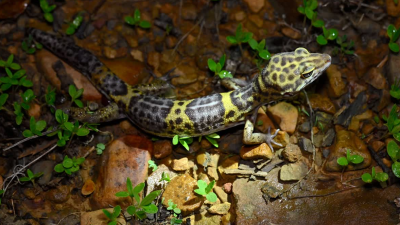
Scientists from the Zoological Survey of India recently discovered a new species of leopard gecko named Jhuma’s leopard gecko (Eublepharis jhuma) in the rocky terrain of the Kaimur hills in Bihar. This medium-sized lizard represents a unique evolutionary lineage that diverged millions of years ago. The researchers named the species in honor of Dr. Dhriti Banerjee, the first female director of the Zoological Survey of India. The discovery highlights the Kaimur Plateau as a major understudied biodiversity hotspot that faces immediate conservation threats from habitat destruction and the illegal exotic pet trade.
Taxonomy and Evolution of Eublepharis jhuma
Genus Classification
The new species belongs to the genus Eublepharis, which comprises the leopard geckos. Unlike most other geckos, members of this genus possess movable eyelids and lack adhesive toe pads, meaning they cannot climb smooth vertical surfaces.
Evolutionary Lineage
Genetic analysis shows that Eublepharis jhuma is a distinct evolutionary branch. It separated from its closest relatives millions of years ago due to the geographical isolation of the Kaimur Plateau.
Physical Characteristics and Morphological Traits
Distinct Features
Eublepharis jhuma is a medium-sized gecko with a robust body. It displays a unique pattern of dark spots and bands across its yellowish-grey skin.
Comparative Morphology
The table below contrasts Eublepharis jhuma with other prominent leopard gecko species found in the Indian subcontinent.
| Feature / Species | Eublepharis jhuma (Jhuma’s Gecko) | Eublepharis macularius (Common Leopard Gecko) | Eublepharis ananthi (Ananth’s Gecko) |
| Primary Habitat | Kaimur Hills, Bihar | Arid regions of Northwest India, Pakistan | Western Ghats, Karnataka |
| Color Pattern | Alternating dark bands with irregular spotting | Dense black spots on a bright yellow base | Distinct broad dark bands, minimal spotting |
| Body Size | Medium | Large | Medium to Large |
| Eyelids | Movable | Movable | Movable |
Habitat and Geographical Distribution
Kaimur Wildlife Sanctuary
The species is currently known only from the rocky outcrops and dry deciduous forest patches near the Kaimur Wildlife Sanctuary in Bihar. This region forms the easternmost extension of the Vindhya Mountain Range.
Ecological Niche
Eublepharis jhuma is nocturnal and terrestrial. It hides under large rocks, boulders, and deep crevices during the day to avoid high temperatures and emerges at night to hunt for insects and small invertebrates.
Threats and Conservation Status
Habitat Loss
Expansion of agricultural land, stone quarrying, and mining activities on the Kaimur Plateau fragment the rocky habitats essential for the survival of this gecko.
Illegal Wildlife Trade
Leopard geckos are highly sought after in the international exotic pet market due to their docile nature and striking appearance. This makes the newly discovered species vulnerable to illegal poaching.
Conservation Attention
The species has not yet been evaluated by the International Union for Conservation of Nature (IUCN) for a Red List status. It requires immediate local protection and inclusion under the Wildlife (Protection) Act of India.
IASPOINT Booster Facts for UPSC
- Zoological Survey of India (ZSI): Established in 1916, ZSI is a premier organization under the Ministry of Environment, Forest and Climate Change. It matches taxonomic research with wildlife monitoring. Dr. Dhriti Banerjee became its first female director in 2021.
- Kaimur Wildlife Sanctuary: Located in the Kaimur and Rohtas districts of Bihar, it is the largest wildlife sanctuary in the state. The landscape features waterfalls like Telhar Kund and Karkat Garh, and contains ancient rock paintings.
- Gecko Eyelids: The family Eublepharidae is unique among geckos because they have fully functional, blinking eyelids, whereas most other geckos have a transparent membrane that they clean with their tongues.
- Vindhya Range Ecology: The Kaimur hills represent a transitional zone between the Gangetic plains and the Deccan plateau, creating a unique microclimate that promotes endemism in reptiles and amphibians.