
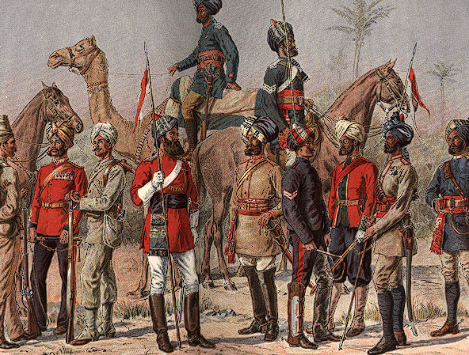
The Indian Rebellion of 1857, often termed the First War of Independence, exposed the administrative failures and military vulnerabilities of the East India Company. In response, the British Parliament enacted the Government of India Act 1858, which dissolved the Company and transferred the governance of India directly to the British Crown. This marked the end of the Company Rule and inaugurated the era of the British Raj, characterized by institutional formalization, partial decentralization, and gradual legislative devolution.
Government of India Act 1858 (Act for the Better Government of India)
Passed on August 2, 1858, this act declared that India was to be governed directly by and in the name of Her Majesty, Queen Victoria. It was primarily an administrative piece of legislation designed to improve the machinery of government at home and tighten imperial grip over India.
Key Constitutional Provisions
- Liquidation of Company Rule: The East India Company was stripped of its administrative powers. The Court of Directors and the Board of Control were abolished, ending the Dual Government system established by Pitt’s India Act of 1784.
- Creation of the Secretary of State: A new cabinet post, the Secretary of State for India (SoS), was created in London. The SoS was a member of the British Cabinet, responsible to the British Parliament, and vested with complete authority and control over the Indian administration.
- Establishment of the Council of India: To assist the SoS, a 15-member advisory body called the Council of India was established in London. It was an advisory body, and the SoS held overriding powers over most decisions.
- Redesignation of Governor-General: The Governor-General of India was given the title of Viceroy when acting as the direct representative of the British Crown to the princely states.
Core Historical Facts & Trivia
- Lord Canning became the first Viceroy of British India.
- Charles Wood served as one of the earliest prominent Secretaries of State for India.
- Queen Victoria’s Proclamation, read by Lord Canning at the Allahabad Durbar on November 1, 1858, assured Indian princely states that their territories would not be annexed further, effectively abandoning the Doctrine of Lapse.
Indian Councils Act of 1861
This act is a landmark in the constitutional history of India because it initiated the policy of association, bringing Indians into the law-making process, and began the process of legislative decentralization.
Key Constitutional Provisions
- Introduction of Portfolio System: It institutionalized the portfolio system introduced by Lord Canning in 1859. Under this system, members of the Viceroy’s Executive Council were made heads of specific administrative departments, laying the foundation of modern cabinet government in India.
- Expansion of Legislative Council: For legislative purposes, the Viceroy’s Executive Council was expanded to include between 6 and 12 additional members, nominated by the Viceroy for a two-year term. At least half of these additional members were required to be non-officials (either Indian or European).
- Restoration of Legislative Powers: The act reversed the centralization trend peak of 1833 by restoring legislative powers to the Bombay and Madras Presidencies.
- Ordinance-Making Power: The Viceroy was empowered to issue ordinances without the concurrence of the Legislative Council during emergencies. These ordinances had a life span of six months.
Core Historical Facts & Trivia
- In 1862, Lord Canning nominated three Indians to his legislative council: Raja Benaras, the Maharaja of Patiala, and Sir Dinkar Rao.
- This act established new legislative councils for Bengal (1862), the North-Western Provinces (1886), and Punjab (1897) to further devolution.
Indian Councils Act of 1892
Triggered by the formation of the Indian National Congress (INC) in 1885 and its subsequent demands for administrative and legislative reforms, this act expanded the size and functions of the legislative councils.
Key Constitutional Provisions
- Expansion of Councils: The number of additional (non-official) members in the Central Legislative Council was increased to a minimum of 10 and a maximum of 16. Provincial legislative councils also saw an increase in members.
- Introduction of the Election Principle: Though the word “election” was carefully avoided in the text of the act, it introduced an indirect method of election. Non-official members were nominated based on recommendations from bodies like university senates, district boards, municipalities, zamindars, and chambers of commerce.
- Enhanced Council Functions: The powers of the legislative councils were expanded. Members were given the right to discuss the annual financial statement (the Budget) and ask questions to the executive, though they could not vote on resolutions or ask supplementary questions.
Indian Councils Act of 1909 (Morley-Minto Reforms)
Named after John Morley (Secretary of State) and Lord Minto (Viceroy), this act attempted to placate moderate nationalists while driving a political wedge between different communities.
Key Constitutional Provisions
- Drastic Increase in Council Size: The number of additional members in the Central Legislative Council was raised from 16 to 60. Provincial councils also saw their numbers increased non-uniformly.
- Official vs. Non-Official Majorities: The Central Legislative Council retained an official majority. However, provincial legislative councils were allowed to have non-official majorities.
- Expansion of Legislative Powers: The deliberative functions of the legislative councils were enlarged. Members were permitted to ask supplementary questions, move resolutions on the budget, and vote on specific items (excluding matters like defense, foreign affairs, and political relations).
- Indian Representation in Executive Councils: For the first time, provision was made for the association of Indians with the Executive Councils of the Viceroy and Governors.
- Introduction of Communal Electorates: The act introduced a system of separate electorates for Muslims. Under this system, Muslim members could only be elected by Muslim voters, legally institutionalizing communalism.
Core Historical Facts & Trivia
- Satyendra Prasad Sinha became the first Indian to join the Viceroy’s Executive Council. He was appointed as the Law Member.
- Lord Minto came to be known as the “Father of Communal Electorate” due to the divisive nature of the separate electorate provision.
Government of India Act 1919 (Montagu-Chelmsford Reforms)
Based on the Montagu Declaration of August 1917, which promised the gradual development of self-governing institutions, this act sought to introduce responsible government in the provinces.
Key Constitutional Provisions
- Introduction of Diarchy in Provinces: The provincial subjects of administration were divided into two distinct categories:
- Transferred Subjects: Administered by the Governor with the aid of ministers responsible to the Legislative Council (e.g., Education, Health, Local Self-Government).
- Reserved Subjects: Administered by the Governor and his Executive Council without any responsibility to the legislature (e.g., Law and Order, Finance, Land Revenue).
- Bicameralism at the Center: The Indian Legislative Council was replaced by a bicameral legislature consisting of an Upper House (Council of State) and a Lower House (Legislative Assembly).
- Direct Elections: The act introduced direct elections in the country for the first time, though the franchise was highly restricted based on property, tax, and education qualifications.
- Expansion of Separate Electorates: The communal electorate system was extended to include Sikhs, Indian Christians, Anglo-Indians, and Europeans.
- Devolution of Authority: Separation of central and provincial subjects was formalized through separate central and provincial budgets, giving provinces control over their own revenue generation.
- Establishment of a Public Service Commission: It provided for the establishment of a Central Public Service Commission to recruit civil servants.
Core Historical Facts & Trivia
- The Central Public Service Commission was set up in 1926 based on the recommendations of the Lee Commission (1923–24).
- The act mandated that a statutory commission be appointed ten years from its passage to inquire into the working of the system, which led to the premature appointment of the Simon Commission in 1927.
Government of India Act 1935
The most detailed and voluminous constitutional document passed by the British Parliament, this act was a product of the Simon Commission Report, the Round Table Conferences, and a White Paper published in 1933. It served as a major blueprint for the Constitution of India, 1950.
Key Constitutional Provisions
- Proposed All-India Federation: The act provided for the establishment of an All-India Federation consisting of British Indian Provinces and Princely States as units. The federation never came into existence because the princely states refused to join.
- Division of Legislative Powers: It divided legislative powers between the Center and the provinces through three distinct lists:
- Federal List: 59 items (e.g., Defense, External Affairs, Currency).
- Provincial List: 54 items (e.g., Police, Provincial Public Services, Public Health).
- Concurrent List: 36 items (e.g., Civil Procedure, Marriage, Labor Welfare).
- Residuary Powers: Vested directly in the Viceroy.
- Abolition of Provincial Diarchy: Diarchy in the provinces was abolished, and “Provincial Autonomy” was introduced. Provinces were recognized as autonomous units of administration, operating under responsible ministries.
- Introduction of Federal Diarchy: Diarchy was introduced at the federal executive level. Federal subjects were divided into Reserved (Defense, External Affairs, Ecclesiastical affairs, Tribal areas) and Transferred subjects.
- Establishment of a Federal Court: It provided for the creation of a Federal Court to resolve disputes between provinces and between the center and provinces.
- Further Franchise Expansion: Extended separate electorates to depressed classes (Scheduled Castes), women, and labor. It extended the franchise to about 10 percent of the total population.
- Abolition of the Council of India: The 15-member Council of India established in 1858 was abolished.
Core Historical Facts & Trivia
- The Federal Court was established in Federal Court of India in Delhi in 1937, with Sir Maurice Gwyer serving as its first Chief Justice. This court was the precursor to the Supreme Court of India.
- The Burma Act of 1935, attached to this legislation, separated Burma (Myanmar) from British India, effective April 1, 1937.
- Reserve Bank of India (RBI) was established in 1935 under a separate act to control the currency and credit of the country, fulfilling a structural need highlighted during the drafting of this act.
Indian Independence Act of 1947
Based on the Mountbatten Plan of June 3, 1947, this act marked the formal end of the constitutional evolution under the British Crown and the transfer of absolute sovereignty to the people of India.
Key Constitutional Provisions
- Creation of Two Dominions: It declared the termination of British rule in India from August 15, 1947, and created two independent dominions: India and Pakistan.
- Abolition of Imperial Offices: The offices of Viceroy and Secretary of State for India were abolished. A Governor-General was appointed for each dominion, acting on the advice of the dominion cabinet.
- Sovereignty of Constituent Assemblies: The Constituent Assemblies of both dominions were granted full legislative sovereignty, empowering them to frame and adopt any constitution and repeal any act of the British Parliament, including the Independence Act itself.
- Lapse of Princely Suzerainty: British suzerainty over the Indian princely states lapsed. All treaties and agreements between the Crown and tribal areas terminated, leaving princely states free to join either dominion or remain independent.
- Interim Governance Framework: Until new constitutions were framed, the assemblies were empowered to govern their respective dominions using the Government of India Act 1935 as an interim framework, modified to remove imperial oversight.
Summary of Structural Changes under Crown Rule (1858–1947)
| Act | Executive Nature | Legislative Structure | Distribution of Power |
| Government of India Act, 1858 | Viceroy in India; Secretary of State + 15-member Council in London. | Unicameral; Imperial Legislative Council under the Viceroy. | Complete centralization of authority in the Crown. |
| Indian Councils Act, 1861 | Viceroy’s Executive Council expanded; Portfolio system formalized. | Non-official members added; Legislative powers restored to Bombay and Madras. | Commenced legislative decentralization. |
| Indian Councils Act, 1909 | Satyendra Prasad Sinha joined Viceroy’s Executive Council as first Indian member. | Imperial Legislative Council expanded to 60 additional members; separate electorates introduced. | Retention of official central majority with provincial non-official concessions. |
| Government of India Act, 1919 | Diarchy introduced in provincial executive (Transferred vs. Reserved). | Bicameral legislature at center; direct elections introduced. | Separation of central and provincial subjects. |
| Government of India Act, 1935 | Provincial autonomy introduced; Diarchy proposed at federal level. | Bicameralism extended to 6 out of 11 provinces. | Formal division into Federal, Provincial, and Concurrent Lists. |
| Indian Independence Act, 1947 | Office of Viceroy abolished; Governor-General became constitutional head. | Constituent Assembly assumed sovereign legislative authority. | Complete transfer of power and sovereignty to independent dominions. |