
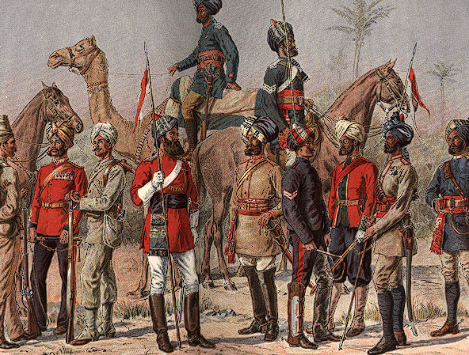
The Anglo-Nepalese relations in the early 19th century were defined by a clash of two expanding empires on the Indian subcontinent: the British East India Company and the Gorkha Kingdom of Nepal. Under the leadership of Prithvi Narayan Shah and subsequent regents like Bhimsen Thapa, the Gorkhas consolidated the Himalayan region and aggressively expanded their borders southward into the fertile Terai plains (the lowlands between the Himalayas and the Indo-Gangetic Plain). Concurrently, the British East India Company was expanding northward from Bengal and Awadh. The immediate cause of friction was a territorial dispute over the border districts of Gorakhpur, Butwal, and Sheoraj, where Gorkha expansions directly encroached upon territories protected or administered by the British. This territorial overlap led to the Anglo-Nepalese War (1814–1816), launched under the Governor-Generalship of Lord Hastings (the Marquess of Hastings).
The Anglo-Nepalese War (1814–1816)
The war was fought across a rugged, mountainous terrain stretching over a thousand miles from the Sutlej River to the Teesta River.
Initial British Reversals
The British initially underestimated the military prowess and guerrilla tactics of the Gorkhas. Early British campaigns led by Generals Marley, Wood, and Gillespie suffered severe defeats. General Gillespie was killed during the siege of the Nalapani fort (near Dehradun), which was defended by a small Gorkha force under Balbhadra Singh Thapa.
British Turnaround
The tide of the war turned due to the superior financial resources, heavy artillery, and strategic planning of General David Ochterlony. Ochterlony successfully outmaneuvered the brilliant Gorkha commander Amar Singh Thapa at the Malaon Fort in the western hills, forcing Nepal to sue for peace.
The Treaty of Sugauli (1816)
The Anglo-Nepalese War was formally concluded by the ratification of the Treaty of Sugauli in March 1816. This treaty established the foundational framework for Anglo-Nepalese relations throughout the period of British Paramountcy.
Major Provisions of the Treaty
- Territorial Cessions: Nepal surrendered approximately one-third of its total territory. It ceded the western hill districts of Kumaon and Garhwal to the British, effectively pushing Nepal’s western border back to the Sharda (Mahakali) River.
- The Terai Cession: Nepal relinquished all claims to the fertile Terai lowlands, though the British later restored portions of it in exchange for financial adjustments.
- Eastern Border Alignment: Nepal evacuated Sikkim and ceded territories up to the Mechi River, which became its permanent eastern boundary. The British restored Sikkim to its native ruler as a buffer state.
- The British Residency: Nepal agreed to accept a permanent British Resident at the court of Kathmandu. Edward Gardner was appointed as the first British Resident.
- Foreign Policy Restrictions: Nepal was prohibited from employing any British, European, or American nationals without the explicit consent of the British Government, effectively isolating Nepal from forming external anti-British alliances.
Evolution of Policy Under Paramountcy
Following the Treaty of Sugauli, British policy toward Nepal shifted from military confrontation to strategic stabilization and integration within the broader network of frontier buffer states.
The Strategy of a Protected Buffer State
Unlike other major Indian powers, the British chose not to annex Nepal entirely. The mountainous terrain made direct administration financially unviable. Instead, the British applied the principles of Paramountcy to transform Nepal into an independent but highly controlled buffer state that insulated northern British India from the Qing Empire of China.
The Rise of Jung Bahadur Rana (1846)
The internal politics of Nepal underwent a radical transformation with the Kot Massacre of 1846, engineered by Jung Bahadur Rana. He established the hereditary line of Rana Prime Ministers, reducing the King (the Maharajadhiraja) to a nominal figurehead. Jung Bahadur reversed the traditional anti-British stance of the Nepalese court and initiated a policy of absolute cooperation with the British Raj.
Collaboration During the Revolt of 1857
The strategic dividend of this alliance was realized during the Indian Revolt of 1857. Jung Bahadur Rana personally led a contingent of over 10,000 Gorkha troops to assist the British in suppressing the rebellion. They played a critical role in the recapture of Lucknow and Gorakhpur from the Indian revolutionaries.
Territorial Reward
In gratitude for Nepal’s loyalty during the 1857 crisis, the British restored a significant tract of the western Terai lowlands (districts of Banke, Bardiya, Kailali, and Kanchanpur) to Nepal in 1860. These lands became known as the “Naya Muluk” (New Country).
The Gorkha Recruitment System
One of the most enduring legacies of Anglo-Nepalese relations under Paramountcy was the formal institutionalization of Gorkha recruitment into the British Indian Army.
Origins
During the War of 1814–1816, British officers, particularly David Ochterlony, were highly impressed by the bravery, discipline, and martial skills of the Gorkha soldiers. Even before the war officially ended, the British began raising the first Gorkha battalions (such as the Nusseree Battalion, later the 1st King George’s Own Gurkha Rifles) from prisoners of war and volunteers.
Imperial Integration
Under the Rana regime, recruitment was formalized and expanded. Gorkha regiments became the backbone of British imperial military operations, serving in the Second Anglo-Sikh War, the Afghan Wars, the Boxer Rebellion in China, and extensively on both the European and Middle Eastern fronts during World War I and World War II. This system provided Nepal with a steady influx of capital through military pensions and remittances, cementing its economic dependence on the British Empire.
The Treaty of Kathmandu (1923)
The final formalization of Anglo-Nepalese relations during the colonial era occurred with the signing of the Treaty of Kathmandu on December 21, 1923, signed by Prime Minister Chandra Shumsher Jang Bahadur Rana and British Envoy Residency chief William O’Connor.
Key Outcomes of the 1923 Treaty
- Absolute Independence: The British formally recognized the complete internal and external independence of Nepal, upgrading the status of the British Resident to an Envoy.
- Replacement of Sugauli Restrictions: The restrictive clauses of the 1816 treaty regarding foreign policy were legally superseded, granting Nepal the right to import arms and ammunition freely through British Indian ports.
- Perpetual Friendship: The treaty re-emphasized the military alliance, ensuring the continued flow of Gorkha recruits to the British army up until the independence and partition of India in 1947.
Key Structural Summary
| Dimension | Policy / Event | Year | Geopolitical Significance for British India |
| Military | Anglo-Nepalese War | 1814–1816 | Neutralized the expansionist Gorkha Empire; secured hill stations like Shimla, Mussoorie, and Nainital. |
| Territorial | Treaty of Sugauli | 1816 | Defined modern Indo-Nepal borders; acquired strategic Kumaon and Garhwal links to Central Asia. |
| Strategic | Buffer State Doctrine | 1816–1947 | Created a mountainous firewall between British India and Tibet/China. |
| Political | Rana Alliance | 1846–1947 | Ensured a hyper-loyal regime in Kathmandu; secured military aid during the 1857 Revolt. |
| Defense | Gorkha Recruitment | 1815–Present | Provided the British Empire with elite infantry units funded primarily out of Indian revenues. |