
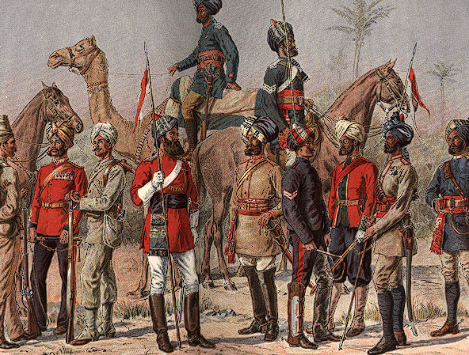
Before 1947, the Indian subcontinent was divided into British Indian Provinces (under direct colonial administration) and nearly 565 semi-autonomous Princely States. These states covered two-fifths of the land area and housed one-third of India’s population. They were governed by native hereditary rulers (Princes, Nawabs, and Maharajas) who recognized the Paramountcy of the British Crown through individual treaties. While the British controlled their foreign affairs, defense, and communications, the internal administration remained purely autocratic.
The Socio-Economic Divide
Residents of British Provinces gradually received limited constitutional concessions, political liberties, and legislative participation through the Government of India Acts of 1919 and 1935. Conversely, subjects of Princely States faced complete political subjugation, absolute lack of civil liberties, and extreme economic exploitation.
Primary Causes of Public Discontent
- Feudal Oppression: Exorbitant land revenue demands, arbitrary eviction, and agrarian distress.
- Forced Labor: Institutionalized practices of unpaid forced labor known as Bethi or Begar.
- Absence of Fundamental Rights: Complete denial of freedom of speech, expression, press, and assembly.
- Extravagant Expenditure: State revenues were funneled into the luxurious lifestyles of the rulers, while public healthcare, education, and infrastructure were systematically neglected.
Evolution and Ideological Framework
Genesis of Popular Resistance
The nationalist awakening in British India during the Non-Cooperation and Khilafat Movements (1920–1922) breached the borders of the princely territories. Revolutionary nationalists and local intelligentsia began organizing the urban middle class, peasants, and tribal groups into local people’s committees. These grassroots organizations were called Praja Mandals (People’s Associations) or Lok Parishads.
Key Objectives of the Praja Mandals
- Demand for democratic representative governance and responsible ministries.
- Protection of fundamental civil liberties and human rights.
- Abolition of feudal levies, illegal cesses, and the Begar system.
- Integration of local grievances with the broader anti-imperialist Indian National Movement.
- Implementation of constructive programs including the promotion of Khiladi, native cottage industries, and anti-untouchability campaigns.
All India States People’s Conference (AISPC)
Institutional Coalescence
To provide a unified national direction to independent regional Praja Mandals, the All India States People’s Conference (AISPC) was founded on December 17, 1927, in Bombay (Mumbai). The inaugural session was attended by over 1,500 delegates representing more than 70 princely states.
Core Framework of AISPC
| Parameter | Historical Facts & Details |
| Inaugural President | Dewan Bahadur Ramachandra Rao |
| Key Founders & Organizers | Balwantrai Mehta, Maniklal Kothari, and G.R. Abhayankar |
| Foundational Principle | Substitution of autocratic princely privileges with constitutional governance accountable to the popular will. |
| Constitutional Formalization | The official AISPC constitution was formally adopted on June 27, 1939. |
| Merger and Legacy | Dissolved on April 25, 1948, merging its constituent units into the Indian National Congress (with the exception of the J&K National Conference). |
Shift in Indian National Congress (INC) Policy
Phase of Non-Interference (1920–1935)
Initially, the INC maintained a strict policy of non-intervention in the internal political affairs of the princely states.
- Nagpur Session (1920): Passed a symbolic resolution calling upon princely rulers to grant responsible government, but restricted direct political actions in the name of the Congress.
- Strategic Rationale: Mahatma Gandhi and other senior leaders aimed to avoid fighting on two fronts simultaneously (against the British and the Princes) and hoped to win over the rulers through moral persuasion.
Transition and Radicalization (1936–1939)
- Lucknow Session (1936): The INC declared that the inhabitants of princely states possessed the identical right to self-determination as the rest of India.
- Haripura Session (1938): Presided over by Subhas Chandra Bose, the Congress explicitly included the Princely States within its vision of Purna Swaraj (Complete Independence). However, direct agitations in the name of the Congress were still restrained.
- Tripuri Session (1939): Marked a decisive paradigm shift. The Congress lifted all self-imposed operational restraints, fully merging the state peoples’ struggles with the national movement.
Institutional Integration
Jawaharlal Nehru was invited to lead the AISPC, serving as its President from 1939 to 1946. This institutional bridge firmly unified the Indian National Congress with the Praja Mandal movements. During the Quit India Movement (1942), the call to “Do or Die” was officially extended to the subjects of the princely states.
Major Regional Praja Mandal Movements
Rajasthan (Rajputana States)
The region witnessed intense mobilization against feudal land configurations and arbitrary princely rule.
- Jaipur Praja Mandal: Formed in 1931 and reorganized in 1936–1937 under the leadership of Jamnalal Bajaj and Hiralal Shastri.
- Mewar Praja Mandal: Established in 1938 by Manikya Lal Verma; it led massive peasant mobilizations against unfair agrarian extractions.
- Marwar Praja Mandal: Founded in Jodhpur (1934) by Jai Narayan Vyas to protest administrative corruption and the lack of civil liberties.
Punjab (PEPSU Region)
- Punjab Riyasti Praja Mandal: Founded in 1928 under the leadership of Sewa Singh Thikriwala.
- Key Demands: Focused its agitations against the autocratic excesses of Maharaja Bhupinder Singh of Patiala, demanding the abolition of begar, reduction of excessive land taxes, and introduction of judicial reforms.
Odisha (Garjat States)
- Garjat Praja Mandal: Active throughout the 1930s across the internal princely enclaves of Odisha, led by figures like Sarangadhar Das, Harekrushna Mahatab, and Nabakrushna Choudhury.
- Historical Event: The Talcher and Dhenkanal movements mobilized tribal communities and peasants against forced labor. During a brutal state crackdown in Dhenkanal in 1938, a 12-year-old boatboy named Baji Rout was shot dead by state police for refusing to ferry troops, becoming the youngest martyr of the Indian freedom struggle.
Himachal Pradesh (Himalayan Hill States)
- Himalayan Riyasti Praja Mandal: Conceptualized during the 1939 Ludhiana session of the AISPC to coordinate protests in the hill states of Sirmaur, Mandi, Dhami, and Chamba under leaders like Bhagmal Sautha.
- Dhami Satyagraha (1939): A peaceful delegation led by Bhagmal Sautha marching to present a charter of administrative demands to Rana Dalip Singh was fired upon by the state police at the Dhami border, resulting in multiple fatalities. This led to the formation of the Lala Duni Chand Enquiry Committee by Jawaharlal Nehru.
- Pajhota Movement (1942): An offshoot agrarian rebellion organized by the Sirmaur Praja Mandal under Vaid Surat Singh, which adopted the non-cooperation slogan “Bhai Do Na Pai Do” (Do not provide men for wartime recruitment, do not pay taxes).
Southern States (Hyderabad, Mysore, and Travancore)
- Hyderabad State Congress: Established in 1938, it faced an immediate ban by the Nizam’s administration. Swami Ramanand Tirth led the Satyagraha for civil rights, which later coalesced with the violent anti-feudal Telangana Peasant Armed Rebellion.
- Mysore Chalo Movement (1947): Launched post-independence by the local Praja Mandals and Congress leaders like K. Chengalaraya Reddy to force the Maharaja of Mysore to accede to the Indian Union and establish a responsible government.
Comprehensive Fact Sheet: Major Praja Mandals
| Praja Mandal / State | Year of Formation | Primary Leaders | Key Agitations & Unique Facts |
| Jaipur Praja Mandal | 1931 | Jamnalal Bajaj, Hiralal Shastri | Reorganized in 1936; launched civil disobedience for registration rights. |
| Punjab Riyasti Praja Mandal | 1928 | Sewa Singh Thikriwala, Bhagwan Singh Longowalia | Specifically targeted the oppressive administrative policies of the Patiala state. |
| Mewar Praja Mandal | 1938 | Manikya Lal Verma | Mobilized the Bijolia and Begun peasant groups against agrarian levies. |
| Dhami Praja Mandal | 1939 | Bhagmal Sautha, Pandit Sita Ram | Scene of the tragic 1939 Dhami firing incident over tax-reduction demands. |
| Travancore State Congress | 1938 | Pattom Thanu Pillai, Accamma Cherian | Fought against the autocratic Dewan C.P. Ramaswami Iyer and his “Independent Travancore” proposal. |
| Kashmir (National Conference) | 1939 | Sheikh Muhammad Abdullah | Converted from the Muslim Conference into the secular National Conference to align with the AISPC framework. |
Historical Significance and Outcomes
Political Awakening of the Masses
The Praja Mandal movement democratized the national movement by breaking down the artificial political wall separating British India from the Princely States. It successfully politicized millions of peasants, artisans, and tribal groups living under backward feudal setups.
Elimination of Feudal Institutional Practices
The consistent pressure from the Praja Mandals forced multiple native durbars to implement basic statutory reforms, lower agrarian tax thresholds, institute state councils, and legally abolish forced labor systems like Bethi and Begar.
Facilitation of Post-Independence Territorial Integration
The parallel internal democratization of the states undermined the traditional authority of the native rulers. When independence was declared in 1947, the widespread organizational network of the Praja Mandals provided the essential grassroots support needed by Sardar Vallabhbhai Patel and the Ministry of States. This effectively neutralized the balkanization plans of autocratic rulers, ensuring the rapid administrative integration of the princely territories into the democratic fabric of the Republic of India.
Last Modified: June 15, 2026