
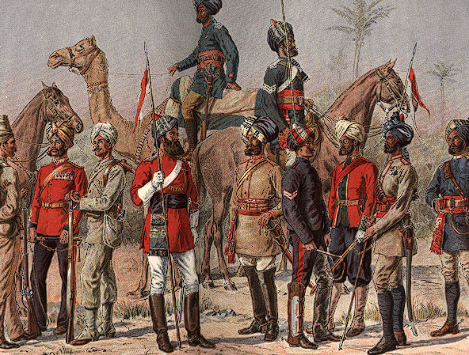
The Hur Movement (historically spanning from the 1890s to 1940s) represents a highly organized, militant, and spiritual-political resistance movement against British colonial rule. While traditionally contextualized within the broader framework of anti-colonial and tribal movements in undivided India, the Hur movement was concentrated in the desert terrain of Sindh (now in Pakistan). The term Hur translates to “free man” or “independent,” a spiritual title bestowed by the Sufi saints of the Rashdi dynasty upon their loyal followers. The movement evolved from a localized socio-religious community into a highly disciplined, parallel revolutionary army that resisted British administrative, fiscal, and martial interventions.
Structural and Material Triggers
Imposition of Colonial Administrative Control
Following the British annexation of Sindh in 1843 under Sir Charles Napier, the colonial government sought to dismantle the traditional, autonomous socio-religious networks of the region. The British viewed the absolute loyalty of the Hurs to their spiritual leader, the Pir Pagaro, as a direct threat to imperial sovereignty.
Agrarian Reforms and Water Distribution Disputes
The introduction of British land tenure systems and the commercialization of irrigation channels disrupted the traditional agrarian patterns of the Hur pastoralists and cultivators. Customary land rights were altered, and heavy water taxes were levied, fueling economic discontent.
Criminalization of the Hur Community
The British Raj applied the discriminatory Criminal Tribes Act to the Hur population. Entire clans were subjected to mandatory registration, restricted local mobility, arbitrary surveillance, and forced confinement in settlement camps, transforming a spiritual brotherhood into a rebellious underclass.
Subjugation of the Pir Pagaro Dynasty
The immediate political catalyst for successive uprisings was the systematic harassment, exile, and eventual execution of the spiritual heads of the movement, particularly Sibghatullah Shah Rashdi II, by the British administration.
Chronology and Phased Evolution of the Movement
The Hur movement progressed through distinct operational phases, transitioning from defensive localized clashes to a sophisticated asymmetric guerrilla war during World War II.
Phase I (1890s–1900s): The First Hur Rebellion
Triggered by early British attempts to restrict the influence of the Pir Pagaro dynasty. Hur groups organized armed bands, retreated into the Makhi Forest and the Thar Desert, and executed hit-and-run tactics against colonial communication networks and police posts.
Phase II (1941–1943): The Great Uprising (Manyam Fituri Analogy)
The movement reached its peak during World War II under the leadership of Pir Sibghatullah Shah Rashdi II. He launched a formal “Ghazwa” (holy war) against British imperialism, establishing a parallel revolutionary government (Hur Raj). The Hurs successfully paralyzed the colonial administration across Upper Sindh by sabotaging railway lines, cutting telegraph wires, and raiding British military supplies.
Phase III (1943–1946): Martial Law and Suppression
Alarmed by the sabotage during the war, the British government declared Martial Law in Sindh in June 1942. The colonial state deployed regular military infantry, armored vehicles, and air support to systematically clear Hur strongholds.
Key Leadership Matrix
The movement combined absolute spiritual allegiance to a centralized head with a highly decentralized, clan-based field command.
| Leader | Operational Designation | Key Historical Contribution |
| Pir Sibghatullah Shah Rashdi II (Soreh Badshah) | Supreme Spiritual & Military Commander | Conceptualized the anti-colonial struggle; founded the Ghazazi guerrilla army; executed by the British in 1943. |
| Bachoo Khaskheli | Chief Field General | Commanded the primary Hur guerrilla columns in the Makhi Lagoon area; specialized in asymmetric warfare. |
| Pir Ali Mohammad Rashdi | Political Strategist | Handled external communications and ideological dissemination among non-Hur populations in Sindh. |
| Allu Khasikheli | Tactical Commander | Organized strategic railway sabotages, including the derailment of the Lahore-Karachi mail train in 1942. |
Nature of Guerrilla Warfare and Strategic Tactics
The Ghazazi Parallel Army
Pir Sibghatullah Shah II organized his most loyal followers into a secret, standing paramilitary wing known as the Ghazazis. These fighters took oaths of martyrdom, maintained a strict military hierarchy, and wore distinctive dark green uniforms.
Utilization of the Makhi Forest and Desert Topography
The Hurs leveraged their intimate knowledge of the impenetrable Makhi Forest, its surrounding swamps (dhands), and the sand dunes of the Thar Desert. They constructed hidden underground bunkers (ghars) to store arms and food, enabling them to evade conventional British infantry.
Strategic Sabotage Infrastructure
During the 1942 offensive, the Hurs shifted from traditional weaponry to sophisticated industrial sabotage. They used advanced tools to dismantle railway tracks, ambushed military transport steamers on the Indus River, and raided British police armories to procure modern firearms.
Colonial Suppression and Administrative Consequences
Execution of Soreh Badshah (1943)
Pir Sibghatullah Shah II was arrested by British forces, tried by a closed military court under martial regulations for waging war against the King-Emperor, and executed by hanging in the Central Jail of Hyderabad, Sindh, on March 20, 1943.
The Hur Suppression Act Framework
To permanently neutralize the resistance, the British administration enacted specialized punitive legislation. Hur properties were systematically confiscated, their families were placed in barbed-wire concentration camps, and the spiritual headquarters of the Pir Pagaro at Pir Jo Goth was completely demolished by military explosives.
Destruction of Legal Record Traditions
The British authorities ordered the complete destruction or classification of all contemporary Hur literature, spiritual poetry, and parallel administrative records to prevent the creation of local revolutionary folklore.
Key Historical Trivia for UPSC Prelims
The Title Soreh Badshah
Pir Sibghatullah Shah II is popularly remembered in regional history and folk traditions as Soreh Badshah, which translates to “The Victorious King” or “The Brave King,” due to his absolute refusal to submit to British colonial authority.
The Secret Burial Site
Fearing that his grave would become a shrine and a permanent rallying point for future anti-colonial rebellions, the British administration buried Pir Sibghatullah Shah II at an undisclosed, secret location, a historical mystery that remains unresolved.
The Loralai Concentration Camps
During the post-1943 pacification campaign, the British relocated thousands of Hur children and women to specialized penal settlements in distant, arid regions like Loralai (Balochistan) to completely sever their connection with the Sindhi terrain.
Last Modified: June 13, 2026