
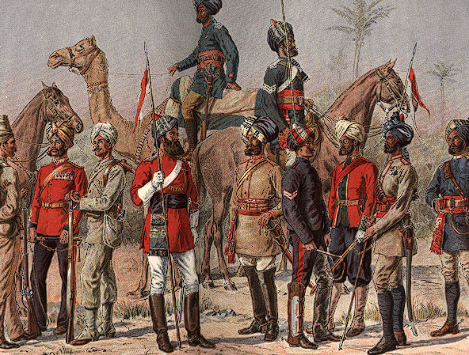
Before 1947, the Princely State of Jammu and Kashmir was the largest princely state in India by land area, governed by the hereditary Hindu Dogra dynasty under British Paramountcy. The state exhibited a unique demographic paradox: a Muslim-majority population exceeding 75% ruled by a regional Dogra elite. The internal administration was centralized around absolute monarchical authority, leaving the masses politically disenfranchised and economically exploited.
Primary Grievances of the State Subjects
- Agrarian Oppression: The state claimed absolute ownership over all land under the Khalsa land system. Peasants were reduced to mere tenants-at-will, subjected to exorbitant land revenue and arbitrary evictions.
- Institutionalized Forced Labor: The practice of Begar was widespread, forcing poor peasants to transport military supplies across high-altitude mountain passes without compensation or adequate clothing.
- Administrative Exclusion: High-ranking positions within the civil services and the state military were systematically monopolized by Dogra Rajputs and Kashmiri Pandits, effectively alienating educated Muslim youth.
- Monopolistic Taxation: Heavy state taxes were levied on basic commodities, including salt, matching cloth, and the traditional silk and wool weaving industries.
The 1931 Agitation and the Glancy Commission
Widespread discontent culminated in the historic July 13, 1931 agitation, when state forces fired upon a crowd protesting the arrest of activist Abdul Qadeer outside the Central Jail in Srinagar, killing 21 people. This incident marked the formal beginning of the mass political awakening in Kashmir. To contain the fallout, Maharaja Hari Singh appointed the Glancy Commission (headed by British official B.J. Glancy) to investigate public grievances. The commission’s 1932 report validated the protestors’ complaints, recommending the restoration of religious places, expansion of educational facilities, abolition of forced labor, and introduction of a legislative assembly.
Evolution from Muslim Conference to National Conference
Foundation of the All Jammu and Kashmir Muslim Conference (1932)
Following the 1931 agitation, educated youth led by Sheikh Muhammad Abdullah and Mirwaiz Yusuf Shah formally established the All Jammu and Kashmir Muslim Conference in October 1932 at the Pather Masjid in Srinagar. Sheikh Abdullah was elected its inaugural President. The party’s initial focus was securing civil rights, employment representation, and educational access for the state’s Muslim majority.
Secularization and Shift in Ideology
Sheikh Abdullah soon realized that an exclusively communal platform could not secure a democratic future for the entire state, as poor peasants and laborers crossed religious boundaries. Influenced by nationalist leaders in British India like Jawaharlal Nehru and Khan Abdul Ghaffar Khan, Abdullah advocated for a secular alternative. He successfully convinced his party to align with the All India States People’s Conference (AISPC), the pan-India umbrella body for democratic movements in princely states.
The Formal Transition (1939)
On June 11, 1939, during a historic convention led by Sheikh Abdullah, the party passed a resolution to officially change its nomenclature to the All Jammu and Kashmir National Conference (NC). This transition opened the party membership to all citizens of the state regardless of creed or caste, drawing prominent non-Muslim progressive leaders like Prem Nath Bazaz, Kashyap Bandhu, and Sardar Budh Singh into its core decision-making echelons.
The “Naya Kashmir” Manifesto (1944)
A Socialist Blueprint for Governance
In 1944, the National Conference formally adopted its constitutional and socio-economic blueprint titled the Naya Kashmir (New Kashmir) Manifesto. Drafted primarily by left-wing intellectual B.P.L. Bedi, the manifesto was heavily inspired by socialist principles and Soviet planning models, representing the most progressive political program presented by any Praja Mandal movement in India.
Key Structural Objectives of Naya Kashmir
- Constitutional Monarchy to Republic: Proposed a democratic system where the Maharaja would remain only as a symbolic, constitutional head, with real executive power resting in a unicameral legislature elected via universal adult suffrage.
- Nationalization of Key Sectors: Advocated for state control over heavy industries, transport, banking, and forests to prevent capitalist exploitation.
- Comprehensive Land Reforms: Aimed for the total abolition of landlordism (Jagirdari and Chakdari systems) and the redistribution of land to the actual tillers without paying compensation to landlords.
- Women’s Charter: Included a radical, dedicated charter guaranteeing equal political, economic, and legal rights for women, including state-funded maternity benefits and equal pay for equal work.
The “Quit Kashmir” Movement (1946)
Direct Challenge to the Dogra Dynasty
Unlike the moderate reformist approach of other regional Praja Mandals that demanded responsible government under the aegis of native rulers, the National Conference launched a radical direct action campaign known as the Quit Kashmir Movement in May 1946.
Strategic Rationale and Execution
Sheikh Abdullah openly challenged the legal and moral validity of the Treaty of Amritsar (1846), through which the British East India Company had sold the territory of Kashmir to Gulab Singh for 7.5 million Nanakshahi rupees. Abdullah demanded that the Dogra dynasty surrender absolute sovereignty and leave the state entirely. The state administration reacted with martial law, arresting Sheikh Abdullah and launching a brutal crackdown on National Conference volunteers. Jawaharlal Nehru attempted to enter Kashmir to legally defend Abdullah but was arrested at the Kohala border by state forces, an event that elevated the Kashmiri struggle to the forefront of the pan-Indian freedom movement.
Comprehensive Reference Matrix of the Movement
| Phase / Landmark Event | Year | Key Personalities | Core Significance & Political Outcomes |
| Srinagar Jail Firing | 1931 | Abdul Qadeer, Maharaja Hari Singh | Initial spark of political mobilization; led to the formation of the Glancy Commission. |
| Muslim Conference Foundation | 1932 | Sheikh Abdullah, Mirwaiz Yusuf Shah | First organized political party in the state focusing on Muslim representation. |
| National Conference Transition | 1939 | Sheikh Abdullah, Prem Nath Bazaz | Secularization of the movement; official alignment with the All India States People’s Conference (AISPC). |
| Naya Kashmir Manifesto | 1944 | B.P.L. Bedi, Sheikh Abdullah | Socio-economic socialist blueprint; pioneered radical land reforms and women’s rights. |
| Quit Kashmir Movement | 1946 | Sheikh Abdullah, Jawaharlal Nehru | Direct challenge to the Treaty of Amritsar; demanded total termination of the Dogra monarchy. |
| Emergency Administration | 1947 | Sheikh Abdullah, Mehr Chand Mahajan | Abdullah appointed Head of Emergency Administration following tribal incursions and signing of the Instrument of Accession. |
Partition, Accession, and Integration (1947–1948)
Rejection of the Two-Nation Theory
As the partition of British India approached in 1947, the National Conference consistently rejected the communal Two-Nation Theory championed by Mohammed Ali Jinnah and the Muslim League. Jinnah traveled to Srinagar to win over the Kashmiri leadership, but Sheikh Abdullah maintained his alignment with the secular, democratic vision of the Indian National Congress.
The Tribal Invasion and Mobilization
When Maharaja Hari Singh hesitated to join either India or Pakistan, Pakistani tribal militias backed by regular army troops invaded Jammu and Kashmir in October 1947. While the Maharaja fled Srinagar, the National Conference mobilized its local volunteers into a civil defense militia known as the Peace Brigade or National Militia. Armed with minimal weaponry, these secular volunteers, including prominent martyrs like Maqbool Sherwani, held the defense lines around Srinagar and protected minority communities from communal violence until Indian troops arrived.
Accession and Transition to Power
Maharaja Hari Singh signed the formal Instrument of Accession on October 26, 1947, legally joining the Dominion of India. On October 31, 1947, the Maharaja appointed Sheikh Muhammad Abdullah as the Head of the Emergency Administration of the state. In March 1948, this interim arrangement was regularized when Sheikh Abdullah was sworn in as the first Prime Minister of Jammu and Kashmir, bringing a definitive end to centennial Dogra autocracy and establishing a democratic administration aligned with the Union of India.
Last Modified: June 15, 2026