
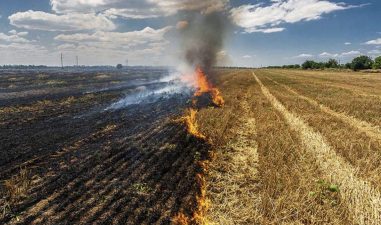
As of April 2026, Madhya Pradesh has recorded nearly 72% of India’s wheat stubble burning incidents in the season. Between 1 April and 17 April 2026, the state reported over 16,000 incidents, with Hoshangabad, Vidisha, Raisen, Ujjain, Seoni and Indore among the affected districts.
Wheat Stubble Burning
Wheat stubble burning is the open-field burning of crop residue left after harvest. In north and central India, it is linked to the short gap between wheat harvesting and the sowing of the next crop.
Reasons for Residue Burning
- Summer moong cultivation after wheat harvest leaves farmers about 10–15 days to clear fields before the next sowing cycle.
- Combine harvesters often leave 10–15 cm of standing stubble in the field.
- Wheat straw, also called bhusa, has lower market demand in areas with a shift towards crossbred cattle and green silage.
- Wheat straw prices often fall below labour and storage costs, which makes residue removal less economical for many farmers.
District Pattern in Madhya Pradesh
Hoshangabad, also known as Narmadapuram, has recorded the highest number of cases in the state. Vidisha and Raisen are major hotspots because of intensive wheat and moong cultivation, while Ujjain, Seoni and Indore also report seasonal fire incidents.
Legal Framework and Penalties
Stubble burning is banned in Madhya Pradesh under the Air (Prevention and Control of Pollution) Act, 1981. The state penalty structure is based on landholding size, with fines of ₹2,500 for up to 2 acres, ₹5,000 for 2–5 acres, and ₹15,000 for holdings above 5 acres.
Crop Residue Management Tools
Crop Residue Management, or CRM, includes machines such as Happy Seeders and balers. A Happy Seeder is a tractor-mounted machine that sows wheat directly into fields with standing residue, and a baler compresses straw into bundles for transport and storage. Subsidy support for CRM equipment in Madhya Pradesh is generally 40–50%, while Punjab provides subsidies of up to 80% for similar machinery. Stubble burning is a major source of particulate pollution in the Indo-Gangetic Plain during the post-harvest season.
Last Modified: April 23, 2026