Indian Polity & Constitution for UPSC Prelims

I. Foundational Concepts of Indian Polity

  1. Evolution of Constitutional Framework
  2. Making of the Constitution
  3. Philosophy of the Constitution
  4. Key Features of the Indian Constitution
  5. Preamble: Vision and Ideals
  6. The Union and Its Territory
  7. Citizenship: Provisions and Policies

II. Fundamental Rights, Duties, and Principles

  1. Fundamental Rights: Scope and Limitations
  2. Directive Principles of State Policy
  3. Fundamental Duties of Citizens
  4. Doctrine of Basic Structure
  5. Constitutional Amendments

III. Central Government

  1. President: Powers and Functions
  2. Vice-President: Role and Responsibilities
  3. Prime Minister: Role and Powers
  4. Union Council of Ministers
  5. Cabinet Committees

IV. State Government

  1. Governor: Role and Powers
  2. Chief Minister: Executive Head of the State
  3. State Council of Ministers
  4. State Legislatures: Composition and Functions

V. Local Governance

  1. Panchayati Raj System
  2. Urban Local Bodies: Municipalities and Corporations

VI. Parliamentary System and Processes

  1. Indian Parliament: Structure and Powers
  2. Parliamentary Committees: Roles and Relevance
  3. Indian Parliamentary Group (IPG)

VII. Federalism and Inter-Governmental Relations

  1. India’s Quasi-Federal System
  2. Centre-State Relations
  3. Inter-State Relations
  4. Emergency Provisions

VIII. Judiciary

  1. Supreme Court: Powers and Jurisdiction
  2. High Courts: Role and Structure
  3. Subordinate Courts

IX. Judicial Mechanisms

  1. Judicial Review
  2. Judicial Activism
  3. Public Interest Litigation (PIL)

X. Alternative Dispute Resolution

  1. Tribunals: Scope and Authority
  2. Consumer Forums
  3. Lok Adalats and Alternative Mechanisms

XI. Union Territories and Special Provisions

  1. Administration of Union Territories
  2. Scheduled and Tribal Areas

XII. Constitutional Bodies

  1. Election Commission of India
  2. Union Public Service Commission (UPSC)
  3. State Public Service Commissions
  4. Finance Commission
  5. Goods and Services Tax (GST) Council
  6. Comptroller and Auditor General (CAG)
  7. Attorney General of India
  8. Advocate General of States

XIII. Special Commissions

  1. National Commission for Scheduled Castes
  2. National Commission for Scheduled Tribes
  3. National Commission for Backward Classes
  4. Special Officer for Linguistic Minorities

XIV. Non-Constitutional Bodies

  1. NITI Aayog: Policy Think Tank
  2. Central Vigilance Commission (CVC)
  3. Central Bureau of Investigation (CBI)
  4. Lokpal and Lokayuktas
  5. National Human Rights Commission (NHRC)
  6. State Human Rights Commissions
  7. National Commission for Women (NCW)
  8. National Commission for Protection of Child Rights
  9. National Commission on Minorities
  10. Central and State Information Commissions

XV. Political Dynamics and Elections

  1. Political Parties: National and Regional
  2. Coalition Governments: Evolution and Impact
  3. Electoral Process and Laws
  4. Electoral Reforms and Innovations
  5. Anti-Defection Law
  6. Voting Behavior and Trends
  7. EVMs and Election Technology

XVI. Societal Structures and Advocacy

  1. Pressure Groups and Their Influence
  2. Non-governmental Organizations (NGOs)

XVII. Cooperative Societies and Public Administration

  1. Cooperatives and Cooperative Movement

XVIII. Public Administration

  1. Public Services: Recruitment and Administration

XIX. Languages and Special Provisions

  1. Official Language and Regional Language Policies
  2. Special Provisions for Certain States and Classes

XX. Miscellaneous Topics

  1. National Integration and Unity
  2. Foreign Policy Principles and Challenges
  3. Landmark Judicial Verdicts
  4. Significant Doctrines in Indian Law
  5. Constitutions of Other Nations: A Comparative Study
  6. Rights and Liabilities of the Government

The Preamble

The Preamble

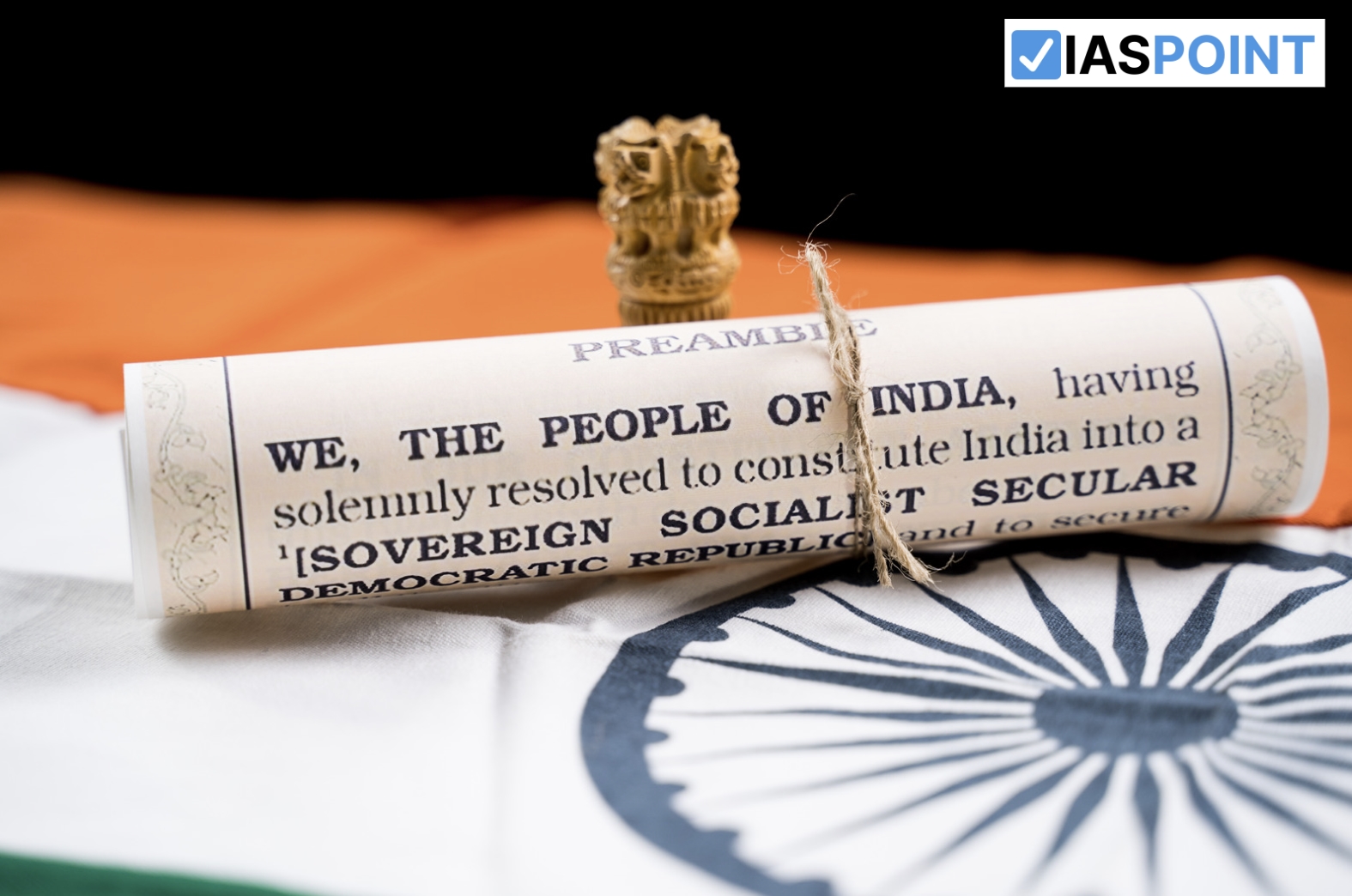
The American Constitution was the first to begin with a Preamble; India adopted this practice. The term “Preamble” refers to the introduction or preface to the Constitution. N. A. Palkhivala, an eminent jurist, described the Preamble as the “identity card of the Constitution.”

The Indian Preamble is based on the “Objectives Resolution,” drafted by Pandit Nehru and adopted by the Constituent Assembly. The Preamble was amended in 1976 by the 42nd Constitutional Amendment Act to include the words “socialist,” “secular,” and “integrity.”

Content of the Preamble

Declares India to be a “Sovereign Socialist Secular Democratic Republic.”

  • Aims to secure for its citizens:
  • Justice: Social, economic, and political.
  • Liberty: Thought, expression, belief, faith, and worship.
  • Equality: Status and opportunity.
  • Fraternity: Assuring dignity of the individual and unity and integrity of the nation.

Key Features of the Preamble

  • Source of Authority: The Constitution derives its authority from the people of India.
  • Nature of the State: India is a sovereign, socialist, secular, democratic, and republican polity.
  • Objectives:
    • Justice: Social, economic, and political.
    • Liberty: Thought, expression, belief, faith, and worship.
    • Equality: Status and opportunity.
    • Fraternity: Dignity of the individual and unity/integrity of the nation.
  • Date of Adoption: November 26, 1949.

Explanations of Key Terms

  • Sovereign:
    • India is independent, free to conduct internal and external affairs.
    • Membership in the Commonwealth and United Nations does not affect sovereignty.
  • Socialist:
    • Initially implicit; made explicit by the 42nd Amendment.
    • Indian socialism follows “democratic socialism” (mixed economy) rather than “state socialism.”
    • Economic reforms (1991) diluted socialist elements.
  • Secular:
    • Added by the 42nd Amendment.
    • India provides equal status and support to all religions without endorsing any.
  • Democratic:
    • Based on popular sovereignty.
    • India practices indirect parliamentary democracy with universal adult franchise, periodic elections, and rule of law.
    • Includes social, economic, and political democracy.
  • Republic:
    • The head of state (President) is elected, not hereditary.
    • Ensures sovereignty resides with the people and the absence of privileged classes.
  • Justice:
    • Three forms: Social, economic, and political.
    • Derived from the Russian Revolution (1917).
  • Liberty:
    • Ensures freedom of thought, expression, belief, faith, and worship.
    • Inspired by the French Revolution (1789-1799).
  • Equality:
    • Guarantees the absence of special privileges and provision of opportunities.
    • Civic, political, and economic equality ensured through Articles 14-18, 325-326, and Directive Principles.
  • Fraternity:
    • Promotes a sense of brotherhood through single citizenship and Fundamental Duties (Article 51A).
    • Ensures dignity of individuals and national unity/integrity.

Significance of the Preamble

  • Embodies the philosophy and values of the Constitution.
  • Sir Alladi Krishnaswami Iyer described it as expressing the dreams of the framers.
  • M. Munshi called it the “horoscope of our sovereign democratic republic.”
  • Sir Ernest Barker praised it as the “key-note” of the Constitution.
  • Hidayatullah described it as the “soul” of the Constitution, more than a declaration.

Preamble as Part of the Constitution

  • Initially, in the Berubari Union case (1960), the Supreme Court opined that the Preamble is not a part of the Constitution.
  • In the Kesavananda Bharati case (1973), the Court held that the Preamble is an integral part of the Constitution.
  • In LIC of India case (1995), the Court reaffirmed its status as part of the Constitution.
  • The Preamble is non-justiciable and cannot confer power or impose prohibitions.

Amendability of the Preamble

  • In Kesavananda Bharati (1973), the Court ruled that the Preamble can be amended, provided basic features are not altered.
  • The 42nd Amendment (1976) is the only instance where the Preamble was amended.

Inspirations for the Preamble

  • The ideals of justice are inspired by the Russian Revolution.
  • Liberty, equality, and fraternity are inspired by the French Revolution.

Leave a Reply

Your email address will not be published. Required fields are marked *

Archives