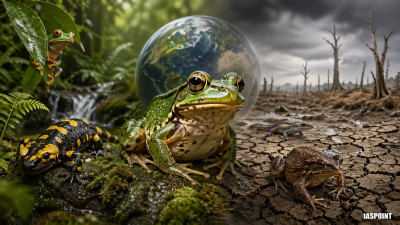
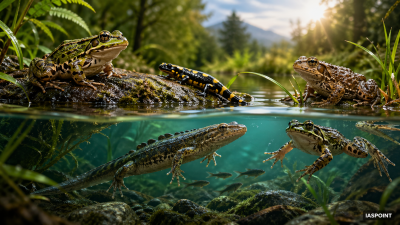
Amphibians are currently the most threatened group of vertebrates globally. According to the IUCN, approximately 41% of all amphibian species are threatened with extinction. Their conservation is vital...
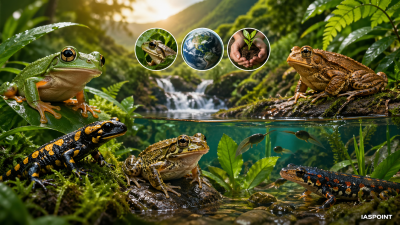
Amphibians are integral components of global biodiversity, serving as vital links in the food chain and providing significant services to both the environment and human society. 1. Ecological...
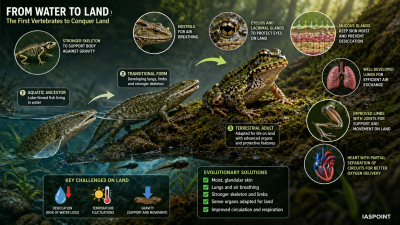
Amphibians are the first group of vertebrates to venture onto land, requiring significant evolutionary modifications. These adaptations allow them to survive the transition from an aquatic environment to...
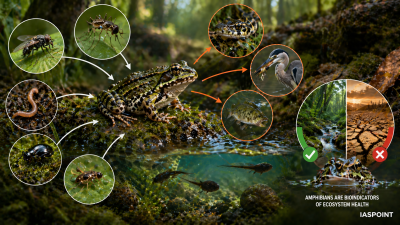
Amphibians occupy a unique ecological position as "mid-level" consumers, acting as both predators of invertebrates and prey for larger vertebrates. Their survival is intricately tied to the availability...
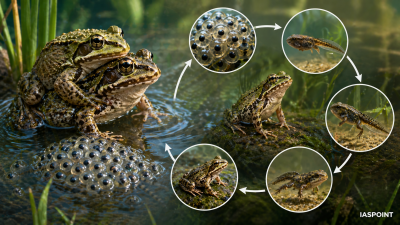
Reproduction in amphibians is characterized by a strong dependence on moist or aquatic environments. Most species exhibit Indirect Development, passing through a distinct larval stage that undergoes metamorphosis...
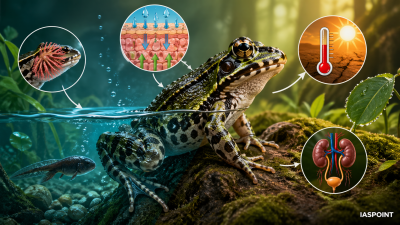
The physiology of amphibians is defined by their "double life," requiring systems that function effectively in both aquatic and terrestrial environments. Their survival depends on high skin permeability,...
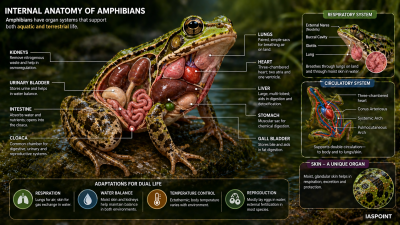
The internal anatomy of amphibians reflects their evolutionary transition from water to land. Their systems are designed to accommodate a dual lifestyle, featuring organs that handle both aquatic...
The external anatomy of amphibians is a result of evolutionary adaptation to a "dual life." Their structure must facilitate locomotion and protection on land while maintaining physiological functions...
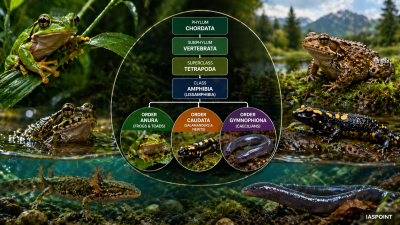
Amphibians belong to the Phylum Chordata, Subphylum Vertebrata, and Superclass Tetrapoda. Within the Class Amphibia, modern species (Lissamphibia) are categorized into three distinct Orders based on their morphological...
Amphibians are ectothermic (cold-blooded) vertebrates belonging to the Class Amphibia within the Superclass Tetrapoda. They represent an evolutionary bridge between aquatic fish and terrestrial reptiles. The term is...