

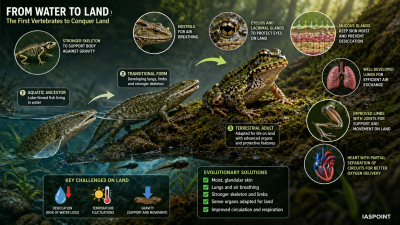
Amphibians are the first group of vertebrates to venture onto land, requiring significant evolutionary modifications. These adaptations allow them to survive the transition from an aquatic environment to a terrestrial one while managing the challenges of gravity, desiccation, and temperature fluctuations.
1. Morphological Adaptations for Terrestrial Life
- Skeletal Modifications: Unlike fish, amphibians have a strengthened vertebral column to support body weight against gravity. The development of a pelvic and pectoral girdle allows for the attachment of limbs, enabling movement on land.
- Pentadactyl Limbs: Most amphibians possess four limbs (tetrapods) with five digits (though many have four on the forelimbs). These are adapted for walking, leaping (Anurans), or burrowing.
- Neck Development: The presence of an atlas vertebra allows the head to move independently of the body, aiding in prey detection and predator avoidance.
2. Respiratory Adaptations (Tri-modal Respiration)
To survive in environments where oxygen availability varies, amphibians utilize three distinct surfaces:
- Cutaneous Respiration: The skin is highly vascularized and permeable, allowing oxygen absorption directly from water or moist air.
- Buccal Pumping: They lack a diaphragm; instead, they use the floor of the mouth to “pump” air into the lungs—a process known as Positive Pressure Breathing.
- Pulmonary Adaptation: While primitive, the lungs provide essential oxygen during high-metabolic activities like hopping or mating calls.
3. Hydric Adaptations (Water Conservation)
Since amphibian skin is permeable, they face a constant risk of dehydration (desiccation).
- Mucus Secretion: Specialized glands produce a coating that traps moisture against the skin.
- Pelvic Patch: A highly vascularized area on the ventral (belly) side of many frogs and toads that acts like a sponge to “drink” water from damp soil or dew.
- Nocturnal Behavior: Most amphibians are active at night when humidity is higher and the risk of drying out is lower.
4. Defensive and Protective Adaptations
- Aposematism (Warning Coloration): Bright colors in species like Poison Dart Frogs warn predators of their chemical toxicity.
- Cryptic Coloration (Camouflage): Many species match their surroundings (leaf litter, moss, or bark) to remain invisible to predators.
- Chemical Defense: Toads possess Parotoid Glands behind the eyes that secrete “bufotoxins,” which can be irritating or lethal to predators.
- Mimicry: Non-toxic species sometimes evolve the color patterns of toxic species to gain protection.
5. Sensory Adaptations
- Nictitating Membrane: A transparent third eyelid that protects the eye and keeps it moist on land while acting as “goggles” underwater.
- Tympanum: An external eardrum that detects airborne sound waves, essential for communication and detecting land-based predators.
- Vomeronasal (Jacobson’s) Organ: Enhanced chemoreception to “smell” prey and pheromones, particularly important for burrowing caecilians.
6. Reproductive and Developmental Adaptations
- Amplexus: A specialized mating embrace that ensures the male is in close proximity to the female when eggs are released, maximizing fertilization success in water.
- Gelatinous Egg Mass: The jelly coating protects embryos from physical damage and helps retain heat, speeding up development in cold water.
- Neoteny: Some species (e.g., Axolotl) adapt to permanent water bodies by retaining larval features (like gills) as adults, bypassing the need for a terrestrial stage.
Comparison of Adaptations Across Environments
| Environmental Challenge | Aquatic Adaptation | Terrestrial Adaptation |
| Locomotion | Tail fins, Webbed feet | Muscular limbs, Pelvic girdle |
| Respiration | Gills, Cutaneous exchange | Lungs, Buccal pumping |
| Sense Organs | Lateral line system (in larvae) | Tympanum, Eyelids |
| Excretion | Ammonia (requires water) | Urea (conserves water) |
UPSC Prelims Facts: Specialized Adaptations
- The Wood Frog: Adapted to sub-zero temperatures by producing high levels of glucose in its blood, acting as a natural cryoprotectant to prevent ice crystals from damaging cells.
- The Desert Rain Frog: Survives in arid environments by spending the day in deep, moist sand burrows and emerging only at night to feed on the moisture-laden surface.
- Gliding Adaptations: The Malabar Gliding Frog has oversized webbed feet that act as parachutes, allowing it to “glide” between trees in the Western Ghats to escape predators or reach breeding pools.