

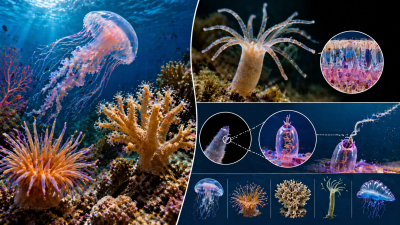
Phylum Cnidaria, also known as Coelenterata, represents a significant evolutionary step from the cellular level of Porifera to the tissue level of organization. The name ‘Cnidaria’ is derived from cnidoblasts or cnidocytes, specialized stinging cells that are the hallmark of this phylum.
General Characteristics
- Level of Organization: Tissue level; cells are organized into functional tissues.
- Symmetry: Primarily radial symmetry, which allows them to sense and capture food from any direction.
- Germ Layers: Diploblastic (consisting of an outer ectoderm and an inner endoderm, with a non-cellular mesoglea in between).
- Body Cavity: They possess a central gastro-vascular cavity called the coelenteron, with a single opening (mouth) on the hypostome.
- Digestion: Both extracellular (in the coelenteron) and intracellular.
Specialized Biological Features
Cnidoblasts (Stinging Cells)
These are specialized cells located mostly on the tentacles and the body.
- Function: Used for anchorage, defense, and the capture of prey.
- Mechanism: They contain stinging capsules called nematocysts that inject toxins into the prey or predator.
Polymorphism: Polyp and Medusa
Cnidarians exhibit two basic body forms, a phenomenon known as polymorphism.
- Polyp: A sessile, cylindrical form. Examples: Hydra, Adamsia (Sea anemone).
- Medusa: An umbrella-shaped, free-swimming form. Example: Aurelia (Jellyfish).
Metagenesis (Alternation of Generation)
Certain cnidarians, like Obelia, exhibit both forms in their life cycle.
- Process: Polyps produce medusae asexually, and medusae form polyps sexually.
Classification of Cnidaria
The phylum is divided into three main classes based on the dominance of the polyp or medusa stage.
| Class | Dominant Form | Characteristics | Examples |
| Hydrozoa | Both (usually) | Often colonial; exhibit metagenesis. | Hydra, Obelia, Physalia. |
| Scyphozoa | Medusa | “True Jellyfish”; polyp stage is reduced or absent. | Aurelia. |
| Anthozoa | Polyp only | No medusa stage; includes corals and sea anemones. | Adamsia, Meandrina. |
Important Examples for UPSC Prelims
- Physalia: Known as the Portuguese Man-of-War. It is not a single organism but a colony of specialized individuals (zooids).
- Adamsia: Commonly called the Sea Anemone; often found in a symbiotic relationship with hermit crabs.
- Pennatula: Known as the Sea-pen.
- Gorgonia: Known as the Sea-fan.
- Meandrina: Known as the Brain Coral.
- Hydra: A unique freshwater cnidarian that lacks a medusa stage and is famous for its regenerative capabilities.
Physiological Systems
- Nervous System: Primitive; consists of a non-polarized nerve net. They lack a brain or centralized nerve cord.
- Excretion and Respiration: Occur via simple diffusion through the body surface.
- Skeletal System: Some cnidarians, particularly corals, have skeletons composed of calcium carbonate (CaCO3).
Evolutionary Significance
- Cnidarians are the first animals to develop a nervous system and organized tissues.
- The development of the gastro-vascular cavity allowed for the ingestion of larger prey compared to the filter-feeding sponges.
- They serve as the foundation for coral reef ecosystems, which are vital for global marine biodiversity.
Facts and Trivia for Quick Revision
- Nematocyst Poison: The toxin in some cnidarians (like the Box Jellyfish) is among the most potent in the animal kingdom and can be fatal to humans.
- Immortality: Turritopsis dohrnii, the “immortal jellyfish,” can revert its cells to their earliest form (polyp) after reaching sexual maturity, theoretically allowing it to live forever.
- No Anus: Since they have only one opening for both ingestion and egestion, their digestive system is considered “incomplete.”
- Blind Sac Plan: The body plan where there is a single external opening is called the blind sac body plan.