

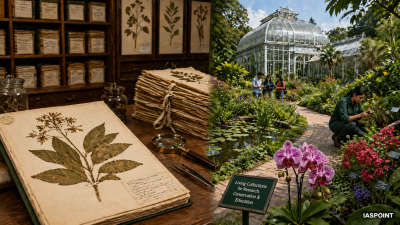
In the study of taxonomy, Herbaria and Botanical Gardens serve as fundamental repositories of biological information. While herbaria focus on preserved, dried specimens for long-term record-keeping, botanical gardens maintain living collections for research, conservation, and education.
Herbaria: Preserved Botanical Records
A herbarium is a storehouse of collected plant specimens that are dried, pressed, and preserved on sheets. These sheets are arranged according to a universally accepted system of classification (most commonly the Bentham and Hooker system).
Key Functions of a Herbarium
- Quick Referral System: Serves as a primary resource for the correct identification of plants.
- Repository of Type Specimens: Holds the “Holotypes” used to describe new species.
- Historical Data: Provides information on the local flora of a region and changes in plant distribution over time.
Major Herbaria of the World and India
Botanical Gardens: Living Taxonomic Collections
Botanical gardens are specialized gardens containing collections of living plants, labeled with their botanical names and family for identification and reference.
Key Functions of Botanical Gardens
- Ex-situ Conservation: Protection of rare and endangered species outside their natural habitat.
- Educational Hubs: Providing public awareness regarding plant diversity and ecology.
- Scientific Research: Sites for studying plant physiology, hybridization, and acclimatization of exotic species.
Prominent Botanical Gardens in India
Key Figures and Trivia for Prelims
Historical Milestones
- William Roxburgh: Known as the “Father of Indian Botany”. He was the first superintendent of the Royal Botanic Garden, Calcutta (now AJC Bose Garden).
- Robert Kyd: An Army officer who originally proposed the establishment of the Calcutta Garden in 1787 to grow teak for ships and spices for trade.
- First University Botanical Garden: Established in Padua, Italy in 1545.
Technical Terms
- Arboretum: A specialized botanical garden or a section of one devoted primarily to trees (woody plants).
- Pinetum: An arboretum specifically focused on conifers (pines, cedars, etc.).
- BSI (Botanical Survey of India): Established in 1890, it is the apex body under the Ministry of Environment, Forest and Climate Change that manages major Indian herbaria and gardens.