

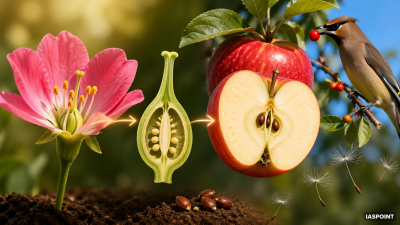
In Angiosperms, the fruit is a mature or ripened ovary, developed after fertilization. The primary biological function of a fruit is to protect the developing seeds and aid in their dispersal.
The Process of Transformation
Following double fertilization, hormonal changes (primarily involving auxins and gibberellins) trigger the transformation of floral parts.
- Ovary: Develops into the Fruit.
- Ovule: Develops into the Seed.
- Ovary Wall: Develops into the Pericarp (fruit wall).
Structure of the Fruit (Pericarp)
In fleshy fruits, the pericarp is typically divided into three distinct layers:
- Epicarp: The outermost skin or rind.
- Mesocarp: The middle, usually fleshy or fibrous layer (the edible part in many fruits).
- Endocarp: The innermost layer, which can be membranous (citrus), stony (mango), or fleshy (grape).
Classification based on Origin
1. True Fruits (Eucarpic)
These fruits develop exclusively from the ovary of the flower. Other floral parts wither and fall off.
- Examples: Mango, Pea, Maize, Tomato.
2. False Fruits (Pseudocarpic)
In these plants, the thalamus (receptacle) or other floral parts contribute to the formation of the fruit alongside the ovary.
- Examples: Apple, Pear, Strawberry, Cashew nut. In an apple, the fleshy part we eat is the enlarged thalamus.
3. Parthenocarpic Fruits
These fruits develop without fertilization. Consequently, they are naturally seedless. Parthenocarpy can be induced through the application of growth hormones.
- Examples: Banana, Grapes (certain varieties), Pineapple.
Types of Fruits based on Composition
| Type | Description | Key Examples |
| Simple Fruits | Develop from a single ovary of a single flower. | Pea, Tomato, Mango |
| Aggregate Fruits | Develop from a multicarpellary, apocarpous (free carpels) gynoecium. | Strawberry, Custard Apple |
| Multiple Fruits | Develop from an entire inflorescence (group of flowers). | Pineapple, Jackfruit, Fig |
Specialized Fruit Categories for UPSC
Drupes (Stony Fruits)
In drupes, the endocarp is hard and stony.
- Mango: The mesocarp is fleshy and edible, while the endocarp is the hard stone.
- Coconut: The mesocarp is fibrous (used for coir), and the endocarp is the hard shell. The edible part is the cellular and liquid endosperm (seed).
Pomes
Fruits where the edible part is the fleshy thalamus, typical of the Rosaceae family.
- Example: Apple, Pear.
Seed and Fruit Dispersal Mechanisms
Plants have evolved diverse fruit structures to ensure seeds are carried away from the parent plant to reduce competition.
- Anemochory (Wind): Fruits with wings (Maple) or hairy outgrowths (Dandelion).
- Zoochory (Animals): Fleshy fruits eaten by animals (Mango) or hooks/barbs that stick to fur (Xanthium).
- Hydrochory (Water): Fibrous husks that float. Example: Coconut.
- Autochory (Self-explosion): Fruits that burst open with force. Example: Balsam, Pea pods.
UPSC Prelims Trivia: Fact Check
- Edible Parts: In a Litchi, the edible part is neither the pericarp nor the seed, but a fleshy outgrowth of the seed called the Aril.
- Coconut Water: The water in a tender coconut is free-nuclear endosperm (thousands of nuclei), and the white kernel is the cellular endosperm.
- Strawberry: It is an aggregate fruit where the “seeds” on the surface are actually individual true fruits called achenes, and the red fleshy part is the thalamus.