

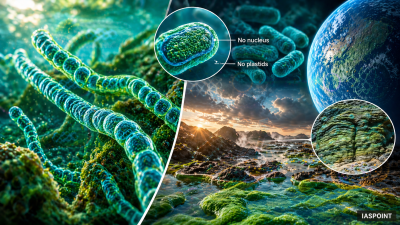
Cyanobacteria, commonly referred to as Blue-green algae (BGA), are a group of photosynthetic, nitrogen-fixing Gram-negative bacteria. Despite the “algae” in their common name, they are prokaryotes and lack a membrane-bound nucleus and plastids. They represent one of the oldest life forms on Earth, dating back approximately 3.5 billion years.
Structural Characteristics
- Cellular Organization: They can be unicellular, colonial, or filamentous.
- Pigmentation: They contain Chlorophyll-a (similar to green plants), Carotenoids, and Phycobilins. The specific blue pigment is Phycocyanin, and the red pigment is Phycoerythrin.
- Cell Wall: Composed of peptidoglycan, often surrounded by a gelatinous or mucilaginous sheath that helps retain moisture and provides protection.
- Storage Product: Food is stored as Cyanophycean starch, which is structurally similar to glycogen.
Ecological and Biological Importance
Photosynthesis and Oxygen Evolution
Cyanobacteria were the first organisms to perform oxygenic photosynthesis (splitting water to release oxygen). They are credited with the “Great Oxidation Event” that transformed Earth’s anaerobic atmosphere into an aerobic one, enabling the evolution of complex life.
Nitrogen Fixation
Many cyanobacteria can convert atmospheric nitrogen (N2) into ammonia (NH3).
- Heterocysts: Specialized, thick-walled, pale-yellow cells that provide an anaerobic environment required for the enzyme Nitrogenase to function.
- Common Nitrogen-Fixers: Nostoc, Anabaena, and Aulosira.
- Agricultural Utility: They are extensively used as biofertilizers in paddy (rice) fields to enhance soil fertility.
Key Genera and Examples
| Genus | Distinguishing Feature | Ecological Role |
| Nostoc | Filamentous, “Moon spit” or “Star jelly” | Nitrogen fixation in soil and water |
| Anabaena | Filamentous, symbiotic association | Fixes nitrogen in the leaves of Azolla (water fern) |
| Spirulina | Spiral-shaped, high protein content | Used as a Single Cell Protein (SCP) supplement |
| Oscillatoria | Filamentous, exhibits oscillating movement | Found in polluted waters; indicator of organic pollution |
Cyanobacterial Blooms (Red Tides and Water Blooms)
When nutrient levels (phosphorus and nitrogen) increase in water bodies—a process called Eutrophication—cyanobacteria undergo rapid multiplication.
- Algal Blooms: These blooms deplete dissolved oxygen, leading to the death of aquatic fauna (hypoxia).
- Cyanotoxins: Certain species like Microcystis produce toxins (e.g., Microcystins) that are harmful to livestock and humans if ingested.
- Trivia: The Red Sea owes its name to the occasional blooms of the red-pigmented cyanobacterium Trichodesmium erythraeum.
Symbiotic Associations
Cyanobacteria form various mutualistic relationships:
- Lichens: A symbiotic association between a fungus and a cyanobacterium (or green algae).
- Azolla-Anabaena: Anabaena azollae lives in the cavities of the aquatic fern Azolla. This duo is a potent biofertilizer in Asian rice cultivation.
- Coralloid Roots: Found in Cycas (a Gymnosperm), these specialized roots host Nostoc and Anabaena for nitrogen fixation.
Fact-Sheet for UPSC Prelims
- Evolutionary Role: According to the Endosymbiotic Theory, chloroplasts in modern plants evolved from ancient endosymbiotic cyanobacteria.
- Smallest Cyanobacterium: Prochlorococcus is considered the most abundant photosynthetic organism on the planet, contributing significantly to global oxygen production.
- Movement: They lack flagella. Movement is achieved through gliding or via gas vacuoles that regulate buoyancy in water columns.
- Reproduction: Strictly asexual, primarily through binary fission, fragmentation (hormogonia), or the formation of resting spores called Akinetes.