

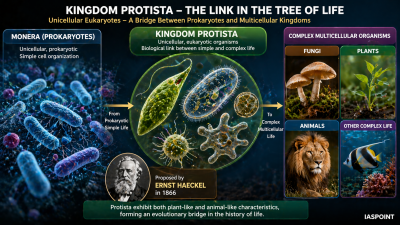
Kingdom Protista serves as a biological link between prokaryotic Monera and complex multicellular organisms like Fungi, Plants, and Animals. Proposed by Ernst Haeckel in 1866, this kingdom encompasses all unicellular eukaryotic organisms.
General Features and Cellular Organization
- Cellular Structure: All protists are eukaryotes, possessing a well-defined nucleus with a nuclear membrane and membrane-bound organelles (mitochondria, Golgi bodies, etc.).
- Habitat: Primarily aquatic, found in freshwater, marine environments, and damp soil.
- Locomotion: Movement occurs via pseudopodia (e.g., Amoeba), flagella (e.g., Euglena), or cilia (e.g., Paramecium).
- Reproduction: They reproduce both asexually (cell fusion/binary fission) and sexually (zygote formation).
Major Groups of Protists
Kingdom Protista is broadly categorized into five functional groups based on their nutrition and mobility.
1. Chrysophytes (Diatoms and Desmids)
Found in both freshwater and marine environments, these are microscopic photosynthetic organisms.
- Diatoms: Known as the “Chief Producers in the Oceans.” Their cell walls form two thin overlapping shells (frustules) embedded with silica.
- Diatomaceous Earth: Accumulated cell wall deposits over millions of years create a gritty soil used in polishing and filtration of oils and syrups.
2. Dianoflagellates
Mostly marine and photosynthetic, appearing yellow, green, brown, blue, or red depending on the pigments.
- Structure: Cell walls have stiff cellulose plates on the outer surface. Most possess two flagella—one longitudinal and one transverse.
- Red Tides: Rapid multiplication of red dinoflagellates like Gonyaulax makes the sea appear red. They release toxins that can kill marine animals like fish.
3. Euglenoids
Mostly freshwater organisms found in stagnant water. They exhibit a “mixotrophic” nutritional strategy.
- Pellicle: Instead of a cell wall, they have a protein-rich layer called a pellicle, which makes their body flexible.
- Nutrition: Photosynthetic in the presence of sunlight; however, when deprived of light, they behave as heterotrophs by predating on smaller organisms.
- Example: Euglena.
4. Slime Moulds (Saprophytic Protists)
These are decomposers that move along decaying twigs and leaves, engulfing organic material.
- Plasmodium: Under favorable conditions, they form an aggregation called plasmodium.
- Fruiting Bodies: Under unfavorable conditions, the plasmodium differentiates to form fruiting bodies bearing spores at their tips. Spores possess true walls and are extremely resistant to adverse conditions.
5. Protozoans
All protozoans are heterotrophs and live as predators or parasites. They are considered primitive relatives of animals.
| Group | Locomotory Organelle | Key Facts | Examples |
| Amoeboid | Pseudopodia (False feet) | Found in fresh/sea water; some are parasites. | Amoeba, Entamoeba |
| Flagellated | Flagella | Often parasitic; cause significant human diseases. | Trypanosoma (Sleeping sickness) |
| Ciliated | Cilia | Aquatic; use coordinated cilia movement to steer food. | Paramecium |
| Sporozoans | None | Have an infectious spore-like stage in their life cycle. | Plasmodium (Malarial parasite) |
Comparative Analysis: Algae vs. Protists vs. Fungi
While the UPSC syllabus often groups these together, their biological boundaries are distinct:
- Photosynthetic Protists (Algae-like): Diatoms and Dinoflagellates provide the bulk of oxygen in aquatic ecosystems. Unlike true plants (Algae), they are strictly unicellular.
- Consumer Protists (Fungi-like): Slime moulds resemble fungi in their saprophytic nature but differ in cell wall composition (cellulose in some stages vs. chitin in Fungi).
UPSC Prelims Facts and Trivia
Biological Significance
- Endosymbiotic Theory: Protists provide the primary evidence for endosymbiosis, where mitochondria and chloroplasts are believed to have evolved from engulfed prokaryotes.
- Bioluminescence: Certain dinoflagellates (Noctiluca) are responsible for the “milky sea” effect or phosphorescence in oceans.
Pathogenic Protists and Diseases
- Entamoeba histolytica: Causes Amoebic dysentery in humans.
- Plasmodium falciparum: The most malignant variety of malaria-causing protozoa.
- Leishmania donovani: Causes Kala-azar (Leishmaniasis), transmitted by the sandfly.
- Trypanosoma gambiense: Causes African Sleeping Sickness, transmitted by the tsetse fly.
Economic and Ecological Importance
- Carbon Sequestration: Diatoms are responsible for approximately 20-25% of all organic carbon fixation on Earth.
- Food Chain: They form the foundational level of the aquatic food web, supporting zooplankton and subsequently larger marine life.