

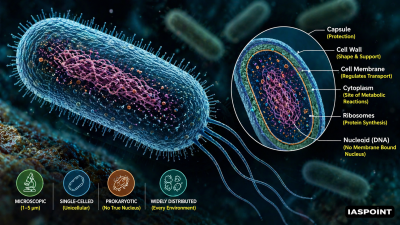
Bacteria are microscopic, single-celled prokaryotic organisms that lack a membrane-bound nucleus.
Coccus (Spherical)
These are bacteria with a round or oval shape. Based on their cellular arrangement, they are subdivided into:
- Monococcus: Occur as single isolated cells.
- Diplococcus: Cells remain in pairs after division (e.g., Neisseria meningitidis).
- Streptococcus: Cells form a chain-like structure (e.g., Streptococcus pyogenes, causing strep throat).
- Staphylococcus: Cells form irregular, grape-like clusters (e.g., Staphylococcus aureus).
- Sarcina: Cells are arranged in cubical packets of eight or more.
Bacillus (Rod-shaped)
Bacilli are cylindrical or rod-like. They represent some of the most common pathogens and industrial bacteria.
- Single Bacillus: A single rod (e.g., Escherichia coli).
- Diplobacilli: Rods appearing in pairs.
- Streptobacilli: Rods arranged in chains (e.g., Bacillus anthracis).
- Coccobacillus: These are short and blunt, appearing as an intermediate between cocci and bacilli (e.g., Haemophilus influenzae).
Spirillum and Spirochete (Spiral)
These bacteria possess one or more twists and are never straight.
- Spirillum: Rigid spiral structures often possessing external flagella for motility (e.g., Spirillum volutans).
- Spirochete: Flexible, corkscrew-shaped bacteria that move via axial filaments (e.g., Treponema pallidum, the causative agent of Syphilis).
Vibrio (Comma-shaped)
These bacteria resemble a curved rod or a comma. A prominent example is Vibrio cholerae, which causes the water-borne disease Cholera.
Comparative Overview of Bacterial Shapes
| Shape Type | Technical Name | Typical Arrangement | Notable Example |
| Spherical | Coccus | Clusters/Chains | Staphylococcus aureus |
| Rod-shaped | Bacillus | Single/Chains | Bacillus anthracis |
| Comma-shaped | Vibrio | Single curved rod | Vibrio cholerae |
| Spiral/Rigid | Spirillum | Spiral | Spirillum minus |
| Spiral/Flexible | Spirochete | Corkscrew | Treponema pallidum |
Classification Based on Flagellar Arrangement
Flagella are hair-like appendages used for locomotion. UPSC Prelims often tests the terminology associated with their distribution:
- Atrichous: Bacteria lacking flagella entirely.
- Monotrichous: A single flagellum at one end (e.g., Vibrio cholerae).
- Amphitrichous: A single flagellum at both ends.
- Lophotrichous: A tuft of flagella at one or both ends.
- Peritrichous: Flagella distributed all over the cell surface (e.g., Salmonella typhi).
Classification Based on Gram Staining
Developed by Hans Christian Gram, this is the most critical biochemical classification for medical and biological studies.
Gram-Positive Bacteria
- Cell Wall Structure: Possess a thick layer of Peptidoglycan (50-90% of the cell wall).
- Stain Retention: Retain the crystal violet (purple/blue) stain even after washing with alcohol.
- Examples: Lactobacillus, Streptococcus, Actinomyces.
Gram-Negative Bacteria
- Cell Wall Structure: Possess a thin layer of Peptidoglycan (approx. 10%) and an outer lipid membrane.
- Stain Retention: Lose the crystal violet stain and take up the counterstain (Safranin), appearing red or pink.
- Pathogenicity: Generally more resistant to antibiotics due to their outer membrane.
- Examples: E. coli, Rhizobium, Pseudomonas.
Specialized Types and Ecological Variants
Archaebacteria (Ancient Bacteria)
These are considered the “oldest living fossils” and thrive in extreme environments.
- Methanogens: Found in marshy areas and the gut of ruminants; they produce methane gas.
- Halophiles: Thrive in extremely salty environments like the Dead Sea.
- Thermoacidophiles: Survive in hot sulfur springs with temperatures up to 80°C and low pH.
Eubacteria (True Bacteria)
- Cyanobacteria (Blue-Green Algae): Photosynthetic autotrophs that played a key role in oxygenating the Earth’s atmosphere. They contain chlorophyll-a and can fix atmospheric nitrogen in specialized cells called heterocysts (e.g., Nostoc, Anabaena).
- Mycoplasma: The smallest known living cells. They completely lack a cell wall and can survive without oxygen. They are pathogenic to both plants and animals.
Fact-Sheet for UPSC Prelims
- Size: Bacteria typically range from 0.2 to 10 microns. Mycoplasma is the smallest at approx. 0.1 to 0.3 microns.
- Reproduction: Primarily via binary fission. Under unfavorable conditions, they produce highly resistant endospores.
- Genetic Recombination: They do not undergo sexual reproduction but exchange DNA via Transformation, Transduction, and Conjugation.
- Nutritional Diversity: Bacteria exhibit the most extensive metabolic diversity, ranging from photoautotrophs and chemoautotrophs to saprophytes and parasites.
- Economic Importance: Rhizobium (nitrogen fixation), Lactobacillus (curd formation), Streptomyces (antibiotic production).