

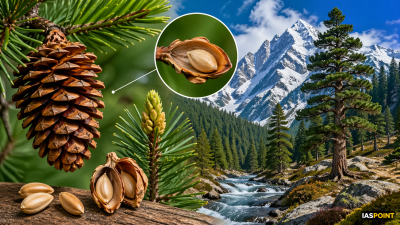
Gymnosperms (from Greek: gymnos = naked, sperma = seeds) represent the first group of plants to evolve the seed habit. Unlike Pteridophytes, which are seedless vascular plants, Gymnosperms produce seeds that are not enclosed by an ovary wall. They occupied a dominant position during the Mesozoic Era and remain ecologically vital in cold and high-altitude regions today.
Core Features for UPSC Prelims
Gymnosperms are characterized by their “naked seeds,” meaning the ovules are exposed both before and after fertilization.
- Vascular Anatomy: They possess well-developed vascular tissues. However, similar to Pteridophytes, the xylem lacks true vessels (except in Gnetales like Gnetum) and the phloem lacks companion cells.
- Root System: Generally possess a taproot system.
- Mycorrhiza: Fungal association found in Pinus roots for nutrient absorption.
- Coralloid Roots: Specialized roots in Cycas associated with N2-fixing cyanobacteria (Anabaena).
- Leaf Adaptations: Leaves are well-adapted to withstand extreme temperature, humidity, and wind. In conifers, needle-like leaves reduce surface area, and thick cuticles with sunken stomata help reduce water loss.
- Size Diversity: Ranges from the giant redwood tree (Sequoia sempervirens), one of the tallest tree species, to small shrubs.
Classification and Types
Gymnosperms are broadly categorized into four main groups, each with distinct morphological features:
| Group | Key Characteristics | Examples |
| Cycadopsida (Cycads) | Palm-like appearance; unbranched stems; large pinnate leaves. | Cycas |
| Coniferopsida (Conifers) | Cone-bearing; needle-like leaves; mostly evergreen; branched stems. | Pinus, Cedrus (Deodar), Sequoia |
| Ginkgopsida | Fan-shaped leaves; only one living species remains. | Ginkgo biloba (Living fossil) |
| Gnetopsida | Most advanced gymnosperms; possess vessel elements in xylem. | Gnetum, Ephedra, Welwitschia |
The Life Cycle: Dominant Sporophyte
Gymnosperms are heterosporous, producing haploid microspores and megaspores.
Strobili or Cones
The spores are produced within sporangia that are arranged spirally along an axis to form compact strobili or cones.
- Male Strobili (Pollen Cones): Bear microsporophylls and microsporangia. Microspores develop into a highly reduced male gametophyte called a pollen grain.
- Female Strobili (Seed Cones): Bear megasporophylls with ovules (megasporangia).
Pollination and Fertilization
- Anemophily: Pollination occurs primarily through wind. Pollen grains are released and carried by air currents to the opening of the ovules.
- Gametophyte Dependency: Unlike Bryophytes and Pteridophytes, the male and female gametophytes in gymnosperms do not have an independent free-living existence. They remain within the sporangia retained on the sporophyte.
- Zygote Development: Following fertilization, the zygote develops into an embryo and the ovules develop into seeds. These seeds are “naked” because they are not covered by a fruit (which develops from an ovary).
Comparative Analysis for UPSC
| Feature | Pteridophytes | Gymnosperms |
| Seed Formation | Seedless (Precursor habit only) | Naked Seeds present |
| Pollination | Water-dependent | Wind-dependent (Anemophilous) |
| Vessels in Xylem | Absent | Absent (except Gnetales) |
| Gametophyte | Independent (Prothallus) | Dependent (Retained on sporophyte) |
Notable Trivia and Economic Facts
- Living Fossil: Ginkgo biloba is termed a living fossil because it has remained virtually unchanged for millions of years and has no close living relatives.
- Tallest Tree: Sequoia sempervirens (Redwood) can reach heights of over 110 meters.
- Chilgoza Pine: The seeds of Pinus gerardiana are edible and known as “Chilgoza,” a significant dry fruit in the Himalayan region.
- Sago: A starch known as Sago is obtained from the stem of Cycas revoluta.
- Resins and Turpentine: Pinus species are major sources of turpentine, resins, and wood pulp used in the paper industry.
- Taxol: An anti-cancer drug, Taxol, is extracted from the bark of the Yew tree (Taxus).