

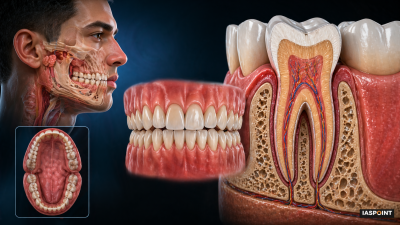
In the context of the human digestive system, teeth are specialized mineralized structures rooted in the alveolar processes of the jaws.
Classification Based on Attachment and Life Cycle
Thecodont Dentition
Each tooth is embedded in a deep socket of the jawbone (mandible or maxilla). This type of attachment provides the necessary structural integrity for the mechanical mastication of tough food materials.
Diphyodont Dentition
Majority of mammals, including humans, form two sets of teeth during their lifetime:
- Deciduous (Milk/Temporary) Teeth: The first set, consisting of 20 teeth. They lack molars (only premolars are absent in the primary set, but the total count is lower).
- Permanent (Adult) Teeth: The second set that replaces the milk teeth, consisting of 32 teeth in a full adult set.
Heterodont Dentition
Humans possess different types of teeth that vary in shape, size, and function. These are categorized into four types:
- Incisors (I): Chisel-shaped teeth at the front, used for cutting and biting.
- Canines (C): Dagger-shaped or pointed teeth, used for tearing food (prominent in carnivores).
- Premolars (PM): Have two cusps (bicuspid) and are used for crushing and grinding.
- Molars (M): Largest teeth with broad surfaces for heavy grinding.
The Human Dental Formula
The dental formula represents the number and arrangement of teeth in each half of the upper and lower jaw.
- Adult Human Formula: 2123/2123
- 2 Incisors, 1 Canine, 2 Premolars, 3 Molars (per half jaw).
- Total: (8 + 8) × 2 = 32.
- Child (Milk Teeth) Formula: 2102/2102
- Note: Premolars are completely absent in the temporary set.
- Total: (5 + 5) × 2 = 20.
Anatomy of a Tooth
The tooth is composed of the hardest substances in the human body, organized into three anatomical regions: the Crown (visible part), the Neck (covered by gums), and the Root (embedded in bone).
| Layer | Characteristics |
| Enamel | The hardest substance in the body; covers the crown. It is ectodermal in origin and aids in the mastication of food. |
| Dentin | The bulk of the tooth, mineralized tissue harder than bone but softer than enamel. It is mesodermal in origin. |
| Pulp Cavity | The central part containing living tissue, blood vessels, and nerves. |
| Cementum | A bone-like substance that anchors the root of the tooth to the periodontal ligament. |
Functional Summary and Distribution
| Tooth Type | Number (Adult) | Function | Key Feature |
| Incisors | 8 | Cutting | Sharp edges |
| Canines | 4 | Tearing | Single pointed cusp |
| Premolars | 8 | Grinding/Crushing | Absent in milk dentition |
| Molars | 12 | Vigorous Grinding | Includes “Wisdom Teeth” |
UPSC Prelims Trivia
- Wisdom Teeth: These are the third molars. They are considered vestigial in many modern humans and usually erupt between the ages of 17 and 25.
- Fluorosis: Excessive intake of fluoride leads to the mottling of tooth enamel, a common health issue discussed in General Science and Environment.
- Odontology: The scientific study of the structure and diseases of teeth.
- Gum Disease (Gingivitis): Inflammation of the gums which, if left untreated, leads to Periodontitis, affecting the bone supporting the teeth.