

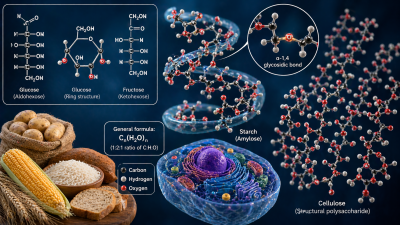
Carbohydrates are organic compounds consisting of Carbon, Hydrogen, and Oxygen, generally in the ratio of 1:2:1, following the empirical formula Cn(H2O)n. Biologically, they are defined as polyhydroxy aldehydes or polyhydroxy ketones. They serve as the primary source of metabolic energy and provide structural integrity to cells.
Classification of Carbohydrates
Carbohydrates are classified based on the number of sugar units (saccharides) they contain upon hydrolysis.
Monosaccharides (Simple Sugars)
These are the simplest carbohydrates that cannot be hydrolyzed into smaller units.
- Trioses (C3): Glyceraldehyde (intermediate in glycolysis).
- Pentoses (C5): Ribose (in RNA) and Deoxyribose (in DNA).
- Hexoses (C6): * Glucose: The “universal fuel” or blood sugar.
- Fructose: Known as fruit sugar; it is the sweetest naturally occurring sugar.
- Galactose: Component of milk sugar.
Oligosaccharides
These consist of 2 to 10 monosaccharide units joined by glycosidic bonds.
- Sucrose (Table Sugar): Glucose + Fructose. It is a non-reducing sugar.
- Lactose (Milk Sugar): Glucose + Galactose. Found naturally in mammalian milk.
- Maltose (Malt Sugar): Glucose + Glucose. Produced during the digestion of starch.
Polysaccharides (Complex Carbohydrates)
These are long chains (polymers) of monosaccharides. They are not sweet and are insoluble in water.
- Homopolysaccharides: Composed of only one type of monosaccharide (e.g., Starch, Cellulose, Glycogen).
- Heteropolysaccharides: Composed of different types of monosaccharides or their derivatives (e.g., Peptidoglycan in bacterial cell walls, Heparin).
Storage and Structural Polysaccharides
| Type | Molecule | Source/Function | Key Fact |
| Storage | Starch | Plants (Tubers, Seeds) | Consists of Amylose (linear) and Amylopectin (branched). Turns blue-black with Iodine. |
| Storage | Glycogen | Animals (Liver, Muscles) | Highly branched structure. Known as “Animal Starch.” |
| Structural | Cellulose | Plant Cell Walls | Linear polymer of glucose. Most abundant organic polymer on Earth. Humans cannot digest it (lacks cellulase). |
| Structural | Chitin | Fungi/Arthropods | Found in fungal cell walls and insect exoskeletons. Contains Nitrogen (N-acetylglucosamine). |
Key Biochemical Tests for Carbohydrates
- Benedict’s Test: Used to detect Reducing Sugars (e.g., Glucose, Lactose). A positive result changes the solution from blue to brick-red.
- Iodine Test: Specifically used to detect Starch. Iodine trapped in the helical structure of starch produces a characteristic deep blue color.
- Fehling’s Test: Similar to Benedict’s, used to identify reducing sugars.
Physiological Importance
- Instant Energy: Glucose is oxidized during cellular respiration to produce ATP (Adenosine Triphosphate).
- Structural Framework: Cellulose provides rigidity to plants; Deoxyribose and Ribose form the backbone of nucleic acids (DNA/RNA).
- Fat Sparing: Adequate carbohydrate intake prevents the body from breaking down proteins for energy (Gluconeogenesis).
- Fiber (Roughage): Cellulose, though indigestible, adds bulk to stools and aids in peristalsis, preventing constipation.
UPSC Prelims Trivia
- Non-Reducing Sugar: Sucrose is the most prominent example of a non-reducing sugar because its reducing groups (aldehyde/ketone) are involved in the glycosidic bond.
- Inulin: A polymer of fructose (not to be confused with Insulin) found in Dahlias. It is used to test kidney function (Glomerular Filtration Rate).
- Artificial Sweeteners: Aspartame and Saccharin provide sweetness without the caloric value of carbohydrates, though they are not biochemically classified as sugars.
- Dextrin: An intermediate product of starch hydrolysis, often used as an adhesive or thickening agent.