

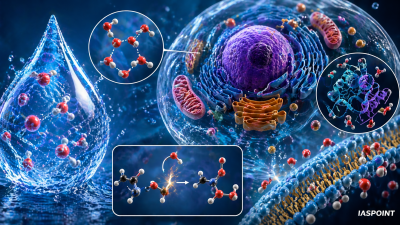
Water is the most abundant substance in living organisms, typically accounting for 70–90% of the total cellular mass. In biochemistry, water is not merely a solvent but a proactive participant in metabolic reactions and a structural determinant for biomolecules.
Physico-Chemical Properties of Water
The unique biological roles of water stem from its molecular structure. Water (H2O) is a polar molecule where oxygen carries a partial negative charge and hydrogen carries a partial positive charge.
- Hydrogen Bonding: This polarity allows water molecules to form hydrogen bonds with each other and with other polar solutes. This property is responsible for water’s high cohesiveness.
- High Specific Heat: Water can absorb or lose large amounts of heat with minimal changes in its own temperature. This acts as a thermal buffer, protecting organisms from abrupt environmental temperature fluctuations.
- High Latent Heat of Vaporization: This property facilitates “evaporative cooling” (e.g., sweating in mammals and transpiration in plants), which is critical for thermoregulation.
- Universal Solvent: Due to its high dielectric constant, water can dissolve a wide range of inorganic salts and organic compounds (like sugars and alcohols), making it the ideal medium for chemical transport.
Water as a Reactant and Metabolite
Water is chemically active in various biochemical pathways:
- Hydrolysis: Many catabolic reactions involve the breaking of bonds by adding water. For example, the conversion of ATP to ADP and the digestion of complex carbohydrates into monosaccharides.
- Dehydration Synthesis: Conversely, during the synthesis of proteins or nucleic acids, a water molecule is released as a byproduct when peptide or phosphodiester bonds form.
- Photosynthesis: In plants, water serves as the electron donor in the light-dependent reactions, leading to the release of molecular Oxygen (O2).
Structural Role in Biomolecules
Water influences the shape and stability of the “acid-insoluble fraction” (biomacromolecules).
- Hydrophobic Interactions: Water forces non-polar molecules (like lipids) to cluster together. This is the fundamental principle behind the formation of the phospholipid bilayer in cell membranes.
- Protein Folding: The 3D conformation (tertiary structure) of proteins is largely driven by the tendency of hydrophobic amino acid side chains to hide from water in the protein interior.
- Turgor Pressure: In plant cells, water fills the large central vacuole, creating turgor pressure against the cell wall. This provides mechanical support and maintains the upright structure of non-woody plants.
Transport and Lubrication
Water serves as the primary vehicle for the movement of nutrients and waste.
- Circulatory Medium: In humans, blood plasma is approximately 92% water, facilitating the transport of hormones, nutrients, and CO2.
- Xylem and Phloem: In plants, water moves minerals from roots to leaves (Xylem) and translocates photosynthates (Phloem) via osmotic gradients.
- Lubrication: Water-based fluids (like synovial fluid in joints, mucus in the digestive tract, and tears in the eyes) reduce friction and protect tissues from mechanical damage.
Comparative Content of Water in Different Systems
| Entity | Approximate Water Content |
| Human Body (Adult) | 60–65% |
| Human Brain | 75–85% |
| Blood Plasma | 90–92% |
| Bone Tissue | 20–25% |
| Watermelon | 92% |
| Dry Seeds | 10–15% |
Trivia for Prelims
- Heavy Water (D2O): While chemically similar to H2O, heavy water is toxic to most higher organisms as it slows down biochemical reaction rates due to the “kinetic isotope effect.”
- Metabolic Water: Some desert animals, like the Kangaroo Rat, rarely drink liquid water. They meet their water requirements through the internal oxidation of fats, which produces water as a metabolic byproduct.
- Maximum Density: Water is most dense at 4°C. This ensures that ice forms at the surface of water bodies, acting as an insulating layer that allows aquatic life to survive in the liquid water beneath during winters.