

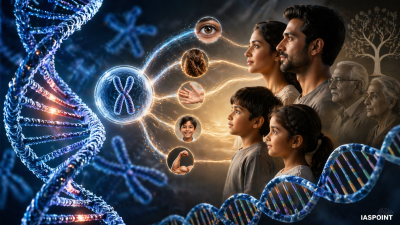
Heredity is the process by which specific traits and characteristics are passed from parents to offspring through genes.
Genetic Material and Inheritance
DNA: The Blueprint of Life
Deoxyribonucleic acid (RNA in some viruses) is the chemical basis of heredity. DNA molecules are packaged into thread-like structures called chromosomes located within the nucleus of eukaryotic cells.
- Genes: These are specific sequences of DNA that act as instructions to make molecules called proteins.
- Locus: The specific fixed position on a chromosome where a particular gene or genetic marker is located.
- Genome: The complete set of genetic material in an organism.
Chromosomes in Humans
Humans typically have 23 pairs of chromosomes, totaling 46.
- Autosomes: The first 22 pairs are identical in both males and females.
- Sex Chromosomes: The 23rd pair (Allosomes) determines the biological sex (XX for females, XY for males).
Mendelian Laws of Inheritance
Gregor Mendel formulated the foundational laws of heredity based on his experiments with pea plants. These laws explain how “factors” (now known as genes) are transmitted.
The Three Laws
- Law of Dominance: In a cross of parents that are pure for contrasting traits, only one form of the trait (the dominant one) will appear in the next generation. The hidden trait is called recessive.
- Law of Segregation: During the formation of gametes (eggs or sperm), the two alleles for a trait separate so that each gamete receives only one allele.
- Law of Independent Assortment: Genes for different traits (e.g., height and seed color) are inherited independently of each other.
Patterns of Inheritance
Inheritance does not always follow simple Mendelian rules. Variations include:
| Pattern | Description | Example |
| Incomplete Dominance | The phenotype of the offspring is a blend of the parents. | Pink flowers from Red and White parents. |
| Co-dominance | Both alleles are expressed equally in the phenotype. | AB Blood Group in humans. |
| Polygenic Inheritance | Multiple genes determine a single trait. | Human skin color and height. |
| Sex-linked Inheritance | Traits controlled by genes located on sex chromosomes. | Color blindness and Haemophilia. |
Genetic Variations and Mutations
Variation is the degree by which progeny differ from their parents. It is the raw material for evolution.
Causes of Variation
- Reshuffling of Genes: Occurs during crossing over in meiosis.
- Recombination: The rearrangement of genetic material.
- Mutations: Stable and inheritable changes in the DNA sequence.
Types of Mutations
- Point Mutation: Change in a single base pair of DNA (e.g., Sickle-cell anaemia).
- Frame-shift Mutation: Insertion or deletion of base pairs that alters the reading frame of the genetic code.
Hereditary Disorders and UPSC Relevance
Understanding hereditary diseases is vital for questions related to public health and social issues.
Common Genetic Disorders
- Thalassemia: An autosomal recessive blood disorder leading to abnormal hemoglobin production.
- Cystic Fibrosis: Affects the cells that produce mucus, sweat, and digestive juices.
- Achondroplasia: A form of short-limbed dwarfism inherited as an autosomal dominant trait.
Important Facts and Trivia for Prelims
- Mitochondrial DNA (mtDNA): Unlike nuclear DNA, mtDNA is inherited exclusively from the mother. This is used in tracing maternal lineages and “Three-Parent Baby” technology (Mitochondrial Replacement Therapy).
- Cytogenetics: The study of chromosomes and their role in heredity.
- Consanguinity: Genetic term for “blood relation.” Offspring of consanguineous marriages have a higher risk of inheriting recessive genetic disorders.
- Epigenetics: The study of how behaviors and environment can cause changes that affect the way genes work without changing the DNA sequence itself.