

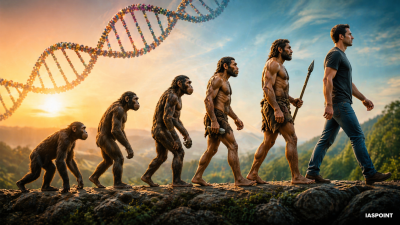
Evolution is the process of gradual and continuous change in the inherited traits of a population over successive generations.
Lamarckism: Theory of Inheritance of Acquired Characters
Proposed by Jean-Baptiste Lamarck in his book Philosophie Zoologique (1809), this was the first logical theory of evolution.
- Internal Vital Force: All living things and their component parts are continually increased by an internal vital force.
- Theory of Use and Disuse: Organs that are used frequently become stronger and more developed, while those not used undergo degeneration.
- Inheritance of Acquired Characters: Modifications acquired by an individual during its lifetime due to environmental influence are transmitted to the next generation.
- Classic Example: The long neck of the giraffe evolved because ancestors stretched their necks to reach leaves on high trees.
- Criticism: August Weismann’s “Germ Plasm Theory” disproved Lamarckism by showing that changes in somatic cells (body cells) are not inherited; only changes in germ cells (sperm/egg) are passed on.
Darwinism: Theory of Natural Selection
Charles Darwin, influenced by T.R. Malthus’s essay on population, proposed this theory in his book On the Origin of Species (1859).
Key Postulates of Darwinism
- Overproduction: Organisms produce more offspring than can survive.
- Struggle for Existence: Competition for limited resources (food, space, mates).
- Variations: No two individuals are exactly alike; variations exist in every population.
- Survival of the Fittest: Individuals with favorable variations survive and reproduce more successfully.
- Natural Selection: Nature selects those individuals who are best adapted to the environment.
Mutation Theory of Evolution
Proposed by Hugo de Vries in 1901 based on his experiments on the evening primrose (Oenothera lamarckiana).
- Saltation: Evolution is a jerky process where new species emerge from single, large, discrete mutations rather than gradual changes.
- Directionless: Unlike Darwinian variations which are small and directional, mutations are random and directionless.
- Key Concept: Mutation is the ultimate source of all genetic variation.
Modern Synthetic Theory (Neo-Darwinism)
This is the most accepted theory today. It reconciles Darwin’s theory of natural selection with Mendelian genetics and molecular biology.
Factors Contributing to Evolution
| Factor | Role in Evolution |
| Genetic Variation | Arises from mutations, genetic recombination during meiosis, and gene flow. |
| Natural Selection | Acts on the variations to increase the frequency of adaptive genes. |
| Genetic Drift | Random changes in gene frequency in small populations (e.g., Founder Effect, Bottleneck Effect). |
| Isolation | Reproductive isolation prevents interbreeding between populations, leading to speciation. |
Concepts of Speciation and Adaptation
- Adaptive Radiation: The process of evolution of different species in a given geographical area starting from a point and literally radiating to other areas of geography (e.g., Darwin’s Finches, Australian Marsupials).
- Convergent Evolution: Independent evolution of similar features in species of different lineages (e.g., wings of butterflies and birds).
- Divergent Evolution: Process by which groups from the same common ancestor evolve and accumulate differences, resulting in the formation of new species (e.g., vertebrate hearts or brains).
Evidence for Evolution
- Homologous Organs: Organs with similar structure and origin but different functions (e.g., forelimbs of whales, bats, and humans). Indicates common ancestry.
- Analogous Organs: Organs with different structures but similar functions (e.g., wings of insects and birds). Indicates convergent evolution.
- Vestigial Organs: Organs that are non-functional in the possessor but were functional in ancestors (e.g., vermiform appendix, wisdom teeth, nictitating membrane).
- Atavism: The reappearance of an ancestral trait in an individual (e.g., a human baby born with a small tail).
Important Evolution Trivia for Prelims
- The Anthropocene: A proposed geological epoch dating from the commencement of significant human impact on Earth’s geology and ecosystems.
- Co-evolution: When two or more species reciprocally affect each other’s evolution (e.g., flowering plants and their pollinators).
- Hardy-Weinberg Equilibrium: Describes a non-evolving population where allele frequencies remain constant. Evolution occurs when this equilibrium is disturbed.
- Missing Links: Organisms showing characters of two different groups (e.g., Archaeopteryx is a missing link between reptiles and birds).