

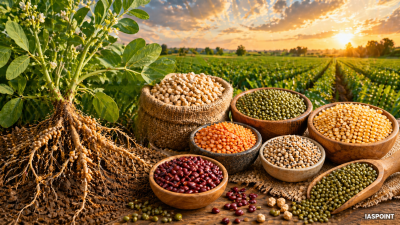
Pulses belong to the family Fabaceae (formerly Leguminosae) and the subfamily Papilionoideae. They are characterized by their ability to fix atmospheric nitrogen through a symbiotic relationship with Rhizobium bacteria located in their root nodules, making them essential for soil fertility and crop rotation.
Key Botanical Features
- Nitrogen Fixation: Legumes convert atmospheric nitrogen into nitrates, reducing the need for chemical fertilizers.
- Protein Content: Pulses contain 20% to 25% protein, which is double the protein content of wheat and triple that of rice.
- Amino Acid Profile: They are rich in Lysine but generally deficient in sulfur-containing amino acids like Methionine and Cysteine (the opposite of cereals, which is why a cereal-pulse diet is nutritionally balanced).
- Fruit Type: The fruit is botanically defined as a Legume or Pod.
Major Pulse Crops in India
Cajanus cajan (Pigeon Pea / Arhar / Tur)
- Origin: Africa or India.
- Significance: The second most important pulse crop in India. It is a woody perennial shrub but usually grown as an annual.
- Climate: Highly drought-resistant due to a deep taproot system.
- Usage: Primarily used as ‘Dal’; stalks are used for fuel and basket making.
Cicer arietinum (Chickpea / Gram)
- Origin: South-West Asia (Turkey/Afghanistan).
- Significance: The most important pulse crop in India (occupies the largest area and production).
- Types:
- Desi (Brown Gram): Small, dark seeds with a rough coat; high fiber.
- Kabuli (Garbanzo): Large, beige seeds with a smooth coat; lower fiber.
- Fact: The leaves contain Malic and Oxalic acids, which give them a sour taste and act as a natural pest repellent.
Vigna radiata (Green Gram / Moong)
- Origin: India.
- Characteristics: A short-duration crop (60-75 days), making it ideal for catch-cropping or intercropping between Kharif and Rabi seasons.
- Nutritional Fact: It is the most easily digestible pulse, often recommended for patients.
Vigna mungo (Black Gram / Urad)
- Origin: India.
- Significance: High phosphoric acid content. It possesses a unique mucilaginous substance that provides the “stickiness” required for preparing South Indian dishes like Idli and Dosa.
Lens culinaris (Lentil / Masur)
- Origin: Mediterranean region.
- Significance: One of the oldest cultivated crops. It is a small, lens-shaped seed.
- Climate: Grown primarily as a Rabi (winter) crop in North India.
Comparative Overview of Common Pulses
| Common Name | Botanical Name | Season | Key Feature |
| Pigeon Pea | Cajanus cajan | Kharif | Deep-rooted, drought tolerant |
| Chickpea | Cicer arietinum | Rabi | Largest share in Indian pulse production |
| Green Gram | Vigna radiata | Kharif/Zaid | Shortest duration; highly digestible |
| Black Gram | Vigna mungo | Kharif | High phosphoric acid; used for fermentation |
| Lentil | Lens culinaris | Rabi | High iron and folate content |
| Pea | Pisum sativum | Rabi | Used by Mendel for genetics experiments |
Other Economically Important Legumes
Glycine max (Soybean)
- Status: Classified as both a pulse and an oilseed.
- Protein Content: Contains approximately 40-42% protein, the highest among plant sources.
- Oil Content: Contains 18-22% oil.
- Fact: Often called “Poor man’s meat” or “Magic bean.”
Arachis hypogaea (Groundnut / Peanut)
- Botanical Oddity: It exhibits Geocarpy, where the flower stalk (pedicel) elongates after fertilization and pushes the ovary into the soil, where the fruit develops underground.
- Significance: Primarily an oilseed crop in India, but botanically a legume.
UPSC Prelims Facts and Trivia
- Phosphorus Requirement: While pulses fix their own nitrogen, they require a high amount of Phosphorus for root development and efficient nodulation.
- Catch Crops: Green gram (Moong) is often used as a catch crop to fill the gap between two major seasonal crops to maintain soil productivity.
- Inhibitors: Raw pulses contain Trypsin inhibitors (anti-nutritional factors) which are deactivated by cooking or boiling.
- Global Position: India is the largest producer, largest consumer, and largest importer of pulses in the world.
- World Pulses Day: Observed on February 10 to recognize the importance of pulses as a global food.
- Lathyrism: Excessive consumption of Lathyrus sativus (Khesari Dal) can lead to Lathyrism (paralysis of lower limbs) due to the presence of the neurotoxin B-ODAP.