

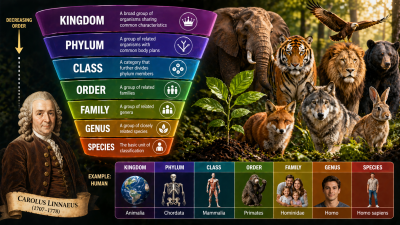
The taxonomic hierarchy is the process of arranging various organisms into successive levels of biological classification in either a decreasing or an increasing order from kingdom to species and vice versa. Each level in this hierarchy is referred to as a taxonomic category or taxon (plural: taxa). This framework was primarily developed by Carolus Linnaeus, which is why it is often referred to as the Linnaean Hierarchy.
The Seven Obligate Categories
In the ascending order of specificity (lowest to highest), the hierarchy consists of the following seven mandatory categories:
1. Species (The Basic Unit)
- Definition: A group of individual organisms with fundamental similarities that are capable of interbreeding to produce fertile offspring.
- Key Fact: It is the lowest and most specific level of classification.
- Example: Solanum tuberosum (Potato); here tuberosum is the species.
2. Genus
- Definition: A group of related species which has more characters in common in comparison to species of other genera.
- Example: The genus Panthera includes species like leo (lion), pardus (leopard), and tigris (tiger).
3. Family
- Definition: A group of related genera with still less number of similarities as compared to genus and species. Families are characterized on the basis of both vegetative and reproductive features.
- Example: Genera Solanum, Petunia, and Datura are placed in the family Solanaceae.
4. Order
- Definition: An assemblage of families which exhibit a few similar characters. The similar characters are less in number as compared to different genera included in a family.
- Example: Plant families like Convolvulaceae and Solanaceae are included in the order Polymoniales mainly based on floral characters.
5. Class
- Definition: This category includes related orders.
- Example: Order Primata (monkeys, gorillas) and Order Carnivora (tigers, cats, dogs) are both placed in Class Mammalia.
6. Phylum / Division
- Definition: Classes comprising animals like fishes, amphibians, reptiles, birds along with mammals constitute the next higher category called Phylum. In plants, the term Division is used instead of Phylum.
- Example: All organisms with a notochord and dorsal hollow neural system are included in Phylum Chordata.
7. Kingdom
- Definition: The highest category in the taxonomic hierarchy. All animals belonging to various phyla are assigned to the Kingdom Animalia, while all plants from various divisions are assigned to Kingdom Plantae.
Comparison of Taxonomic Categories: Human vs. Housefly
| Common Name | Biological Name | Genus | Family | Order | Class | Phylum/Division |
| Human | Homo sapiens | Homo | Hominidae | Primata | Mammalia | Chordata |
| Housefly | Musca domestica | Musca | Muscidae | Diptera | Insecta | Arthropoda |
| Mango | Mangifera indica | Mangifera | Anacardiaceae | Sapindales | Dicotyledonae | Angiospermae |
| Wheat | Triticum aestivum | Triticum | Poaceae | Poales | Monocotyledonae | Angiospermae |
Key Principles of the Hierarchy
- Inverse Relationship of Commonalities: As we go higher from Species to Kingdom, the number of common characteristics goes on decreasing.
- Complexity of Classification: The higher the category, the greater is the difficulty of determining the relationship to other taxa at the same level.
- Taxon vs. Category: “Category” is an abstract term representing a rank, while “Taxon” represents real biological objects assigned to that category (e.g., “Mammalia” is a taxon, while “Class” is a category).
UPSC Prelims Fact File
- Suffixes in Taxonomy: Specific suffixes are often used for plant categories:
- Family: ends in -aceae (e.g., Solanaceae).
- Order: ends in -ales (e.g., Sapindales).
- Class: ends in -opsida or -ae.
- Division: ends in -phyta.
- Monotypic Genus: A genus that contains only one species (e.g., Homo has only sapiens in the modern era).
- Polytypic Genus: A genus that contains more than one species (e.g., Panthera, Solanum).
- Taxonomic Aids: To identify the correct taxon of a specimen, scientists use “Keys,” which are based on contrasting characters in a pair called a couplet.