

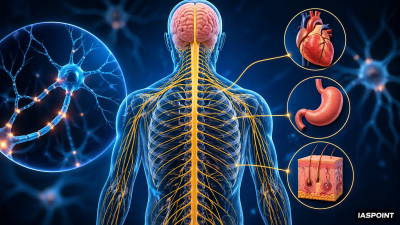
The Autonomic Nervous System (ANS) is a critical component of the Peripheral Nervous System (PNS) that regulates involuntary physiological processes. It operates largely below the level of conscious awareness, maintaining internal homeostasis by controlling smooth muscles, cardiac muscles, and glands.
Anatomy and Connectivity
The ANS connects the Central Nervous System (CNS) to the visceral organs. Unlike the Somatic Nervous System, which uses a single neuron to reach its target, the ANS typically employs a two-neuron relay:
- Pre-ganglionic Neuron: Located in the brain or spinal cord.
- Autonomic Ganglion: A cluster of nerve cell bodies outside the CNS where the first neuron meets the second.
- Post-ganglionic Neuron: Sends the impulse from the ganglion to the effector organ.
Functional Divisions: Sympathetic vs. Parasympathetic
The ANS is divided into two antagonistic branches that work in tandem to balance bodily functions.
Sympathetic Nervous System (The “Fight or Flight” System)
- Origin: Thoracolumbar outflow (emerges from the thoracic and lumbar segments of the spinal cord).
- Function: Mobilizes the body’s resources during stress, exercise, or emergencies.
- Primary Neurotransmitter: Norepinephrine (Noradrenaline).
- Physiological Responses:
- Increases heart rate and blood pressure.
- Dilates bronchioles for increased oxygen intake.
- Dilates pupils (Mydriasis) to improve peripheral vision.
- Shunts blood away from the skin and digestive tract toward skeletal muscles.
- Stimulates the release of glucose from the liver for immediate energy.
Parasympathetic Nervous System (The “Rest and Digest” System)
- Origin: Craniosacral outflow (emerges from cranial nerves—III, VII, IX, and X—and the sacral segments of the spinal cord).
- Function: Conserves energy and maintains “business as usual” functions.
- Primary Neurotransmitter: Acetylcholine.
- Physiological Responses:
- Slows heart rate and lowers blood pressure.
- Constricts bronchioles.
- Constricts pupils (Miosis).
- Stimulates digestion, salivation, and lacrimation (tears).
- Contracts the bladder for urination.
Comparison Table: ANS Regulatory Effects
| Feature | Sympathetic Effect | Parasympathetic Effect |
| Heart | Increases rate and force of contraction | Decreases rate |
| Lungs | Relaxes bronchioles (dilation) | Constricts bronchioles |
| Digestive System | Inhibits peristalsis and secretion | Stimulates peristalsis and secretion |
| Eyes | Pupil dilation | Pupil constriction |
| Salivary Glands | Inhibits salivation (dry mouth) | Stimulates salivation |
| Adrenal Medulla | Stimulates secretion of Adrenaline | No effect |
| Urinary Bladder | Relaxes bladder (prevents voiding) | Contracts bladder (promotes voiding) |
The Enteric Nervous System (ENS)
Often referred to as the “Second Brain,” the ENS is a specialized branch of the ANS embedded in the lining of the gastrointestinal tract.
- Autonomy: While it communicates with the CNS through the sympathetic and parasympathetic systems, it can function independently to coordinate local digestive reflexes.
- Complexity: It contains roughly 100 million neurons, managing peristalsis and enzyme secretion.
UPSC Prelims Fact File
- Vagus Nerve (Cranial Nerve X): It is the most important component of the parasympathetic system, supplying nearly 75% of all parasympathetic fibers to the heart, lungs, and stomach.
- Adrenal Medulla: This gland acts as a modified sympathetic ganglion. When stimulated by pre-ganglionic sympathetic fibers, it releases Adrenaline (Epinephrine) directly into the blood, amplifying the “fight or flight” response.
- Homeostasis: The constant tug-of-war between the sympathetic and parasympathetic systems is known as autonomic tone, ensuring the body remains in a steady state.
- Hypothalamus: It acts as the overall integration center for the ANS, receiving sensory input and coordinating the appropriate autonomic response.