

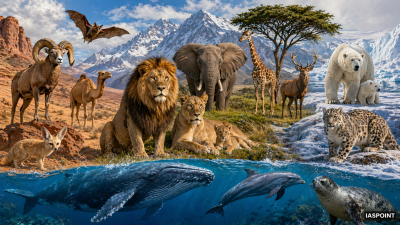
Mammals, belonging to the class Mammalia, are homeothermic (warm-blooded) vertebrates characterized by the presence of mammary glands, hair or fur, and a four-chambered heart. To survive in diverse ecological niches—ranging from deep oceans to arid deserts—mammals have evolved specific anatomical, physiological, and behavioral adaptations.
Morphological and Anatomical Adaptations
Body Integument and Thermoregulation
- Hair and Fur: Provides insulation by trapping a layer of air near the skin. In aquatic mammals like whales, hair is lost and replaced by blubber (a thick layer of subcutaneous fat) for buoyancy and heat retention.
- Integumentary Glands: Mammals possess sweat glands (sudoriferous) for cooling, sebaceous glands for skin conditioning, and mammary glands for nourishing young.
- Specialized Limbs: Pentadactyl limbs are modified based on habitat:
- Cursorial (Running): Elongated limbs in horses and cheetahs.
- Fossorial (Digging): Short, powerful limbs with claws in moles and shrews.
- Arboreal (Climbing): Prehensile tails in New World monkeys and opposable thumbs in primates.
- Volant (Flying): Patagium (skin membrane) in bats, the only mammals capable of true powered flight.
Cranial and Dental Specializations
- Heterodont Dentition: Unlike reptiles, mammals have different types of teeth (Incisors, Canines, Premolars, Molars) adapted for specific diets.
- Thecodont Attachment: Teeth are embedded in sockets of the jawbone, providing the strength needed for mastication.
- Diphyodonty: Most mammals have two sets of teeth (deciduous and permanent) during their lifetime.
Physiological Adaptations
Homeostasis and Osmoregulation
- Endothermy: Mammals maintain a constant body temperature through high metabolic rates.
- Kidney Function: Mammals possess Loops of Henle in their nephrons, which allow for the production of hypertonic (concentrated) urine, a critical adaptation for water conservation in terrestrial and desert environments.
Respiratory and Circulatory Efficiency
- Diaphragm: A muscular partition between the thoracic and abdominal cavities that increases breathing efficiency.
- Enucleated Red Blood Cells: Mature mammalian RBCs lack a nucleus to provide more space for Hemoglobin, optimizing oxygen transport.
- Four-Chambered Heart: Ensures complete separation of oxygenated and deoxygenated blood, supporting high energy demands.
Habitat-Specific Adaptations: Case Studies
| Habitat | Examples | Key Adaptations |
|---|---|---|
| Desert | Kangaroo Rat, Camel | Estivation, concentrated urine, metabolic water production from fat oxidation. |
| Aquatic | Whales, Dolphins, Seals | Streamlined bodies, blowholes (dorsal nostrils), echolocation, and bradycardia (slowing heart rate during dives). |
| Polar | Polar Bear, Arctic Fox | White camouflage fur, small ears (Allen’s Rule) to minimize heat loss, and thick adipose tissue. |
| Subterranean | Moles, Naked Mole-rat | Reduced eyesight, tactile whiskers (vibrissae), and high tolerance for Carbon Dioxide. |
Export to Sheets
Reproductive Adaptations
Mammals are categorized into three groups based on their reproductive strategies, representing an evolutionary transition in parental care:
Monotremes (Prototheria)
- Characteristics: Egg-laying mammals that lack nipples (milk is secreted onto skin patches).
- Examples: Duck-billed Platypus, Echidna (Spiny Anteater).
- Significance: They represent the evolutionary link between reptiles and mammals.
Marsupials (Metatheria)
- Characteristics: Give birth to underdeveloped young (joey) which complete development in a maternal pouch (marsupium).
- Examples: Kangaroo, Koala, Opossum, Tasmanian Devil.
Placentals (Eutheria)
- Characteristics: Young are nourished in the uterus via a placenta, which facilitates nutrient and gas exchange between mother and fetus.
- Examples: Humans, Elephants, Blue Whales.
Critical Biological Rules for Prelims
Allen’s Rule
Postulates that mammals from colder climates generally have shorter ears and limbs to minimize the surface area through which heat can escape.
Bergman’s Rule
Suggests that within a broadly distributed taxonomic group, populations and species of larger size are found in colder environments, while populations and species of smaller size are found in warmer regions.
Facts and Trivia for UPSC
- Smallest Mammal: The Etruscan shrew (by weight) or the Bumblebee bat (by skull size).
- Largest Mammal: The Blue Whale, which is also the largest animal to have ever existed.
- Echolocation: High-frequency sound waves used by bats and cetaceans (whales/dolphins) to navigate and hunt in low-visibility environments.
- Hibernation vs. Estivation: Hibernation is winter sleep (e.g., bears, though technically “torpor”), while Estivation is summer sleep to avoid heat and desiccation (e.g., some desert rodents).