

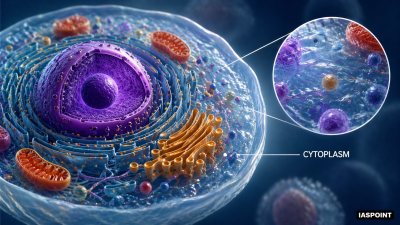
The cytoplasm is the jelly-like substance filling the interior of the cell, bounded by the plasma membrane. It serves as the primary site for most metabolic pathways and houses the cell’s organelles.
Composition of the Cytoplasm
The cytoplasm is not a simple fluid; it is a complex, organized system comprising three major components:
- Cytosol: The aqueous, semi-fluid portion consisting of water (nearly 80%), ions (salts), and organic molecules (proteins, enzymes, and sugars).
- Cell Organelles: Membrane-bound “little organs” (like Mitochondria and Ribosomes) that perform specialized functions.
- Cytoplasmic Inclusions: Non-living materials such as starch grains, oil droplets, or pigment granules that are stored temporarily.
Structural Zones
In many cells, particularly unicellular organisms like Amoeba, the cytoplasm is divided into two distinct zones:
- Ectoplasm: The outer, clearer, and relatively rigid (gel-like) layer just beneath the plasma membrane.
- Endoplasm: The inner, more fluid (sol-like) region containing the bulk of the organelles.
Critical Functions of the Cytoplasm
- Metabolic Hub: It is the site for vital chemical reactions, most notably Glycolysis (the first step of cellular respiration), which occurs in the cytosol rather than the mitochondria.
- Structural Support: Through the Cytoskeleton (a network of fibers), it maintains cell shape and facilitates the movement of organelles.
- Cytoplasmic Streaming (Cyclosis): A constant swirling motion of the cytoplasm that helps in the distribution of nutrients, enzymes, and genetic information throughout the cell.
- Storage: Acts as a reservoir for essential raw materials like amino acids, glucose, and ions required for cellular processes.
The Cytoskeleton: The Internal Framework
The cytoplasm is reinforced by a proteinaceous framework called the cytoskeleton, which is categorized into three types of filaments:
| Filament Type | Composition | Primary Function |
| Microtubules | Tubulin protein | Cell shape, intracellular transport, and spindle formation during division. |
| Microfilaments | Actin protein | Muscle contraction, cell movement (Amoeboid movement), and cytokinesis. |
| Intermediate Filaments | Keratin/Fibrous proteins | Mechanical strength and anchoring organelles (like the nucleus). |
Facts and Trivia for UPSC Prelims
- Protoplasm vs. Cytoplasm: Protoplasm refers to the entire living content of the cell (Cytoplasm + Nucleus). The term “Cytoplasm” specifically excludes the Nucleus.
- The Sol-Gel Transformation: The cytoplasm can change from a fluid state (sol) to a solid state (gel) and back. This property is fundamental to the movement of cells like White Blood Cells (Leukocytes) and Amoeba.
- Signal Transduction: The cytoplasm acts as a medium through which signals from the cell membrane are transmitted to the nucleus (Signal Transduction Pathways).
- Molecular Crowding: The cytoplasm is so densely packed with proteins and molecules that it behaves more like a “crowded room” than a simple watery solution, affecting how fast molecules can diffuse.
- Anaerobic Respiration: In the absence of oxygen, the entire process of fermentation (energy production) is completed within the cytoplasm.
Distinction Between Cytosol and Cytoplasm
| Feature | Cytosol | Cytoplasm |
| Definition | The fluid part of the cytoplasm. | The entire region between the membrane and nucleus. |
| Components | Water, ions, and soluble proteins. | Cytosol + Organelles + Inclusions. |
| Role | Site of chemical reactions. | Provides structure and houses organelles. |