

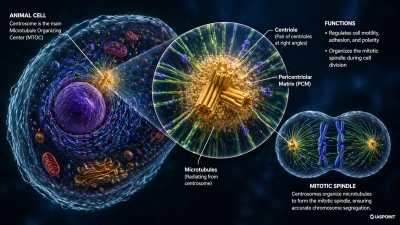
The centrosome is a non-membranous organelle that serves as the main Microtubule Organizing Center (MTOC) in animal cells. It plays a critical role in regulating cell motility, adhesion, and polarity, but its most vital function is the organization of the mitotic spindle during cell division.
Structure of the Centrosome
A centrosome consists of two mutually perpendicular structures called centrioles, surrounded by an amorphous mass of protein known as the pericentriolar material (PCM).
The “9+0” Arrangement
- Microtubule Triplets: Each centriole is composed of nine evenly spaced peripheral triplets of microtubules.
- Hub and Spoke Model: The central part of the centriole is proteinaceous and called the hub, which is connected to the peripheral triplets by radial spokes made of protein. This resembles a “cartwheel” appearance in cross-section.
- Chemical Composition: Centrioles are primarily composed of the protein tubulin.
Key Functions in Animal Cells
Cell Division and Spindle Formation
During the S-phase of the cell cycle, the centrosome duplicates. During mitosis, the two centrosomes move to opposite poles of the cell, where they organize the spindle fibers (mitotic spindle) that attach to and separate chromosomes.
Basal Body Formation
Centrioles form the basal bodies of cilia and flagella. These basal bodies act as the anchors from which the microtubule cytoskeleton of the cilia or flagella radiates (typically in a “9+2” arrangement, distinct from the “9+0” of the centriole itself).
Comparative Analysis: Animal vs. Plant Cells
| Feature | Animal Cells | Higher Plant Cells |
| Centrosome Presence | Present | Absent |
| Centrioles | Present (in pairs) | Absent |
| Spindle Formation | Centric (astral) mitosis | Acentric (anastral) mitosis |
| Cilia/Flagella Origin | From centriolar basal bodies | Generally absent (except in some lower plants) |
Clinical and Biological Significance
- Aneuploidy: Defective centrosome duplication or function can lead to an unequal distribution of chromosomes during division, a hallmark of cancer cells.
- Ciliopathies: Since centrioles form the base of cilia, mutations affecting centriolar proteins can lead to diseases such as Polycystic Kidney Disease (PKD) or Bardet-Biedl Syndrome.
Facts for UPSC Prelims
- Membrane Status: Centrosomes and centrioles are non-membrane bound organelles, similar to ribosomes.
- Discovery: The centrosome was discovered by Edouard Van Beneden in 1883 and later described and named by Theodor Boveri in 1888.
- Self-Duplication: Centrosomes duplicate during the S-phase of the Interphase, coinciding with DNA replication.
- Nerve Cells: Mature neurons in humans typically lack functional centrosomes and do not undergo cell division, which is why nerve damage is often permanent.
- Evolutionary Context: While higher plants lack centrioles, they still possess MTOCs to organize spindles, proving that centrioles are helpful but not strictly “essential” for the physics of spindle formation across all life forms.