

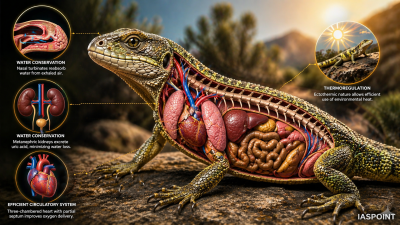
The physiology of reptiles is defined by their status as the first truly terrestrial vertebrates. Their internal systems are specialized for water conservation, temperature management, and efficient energy usage in diverse environments.
1. Thermoregulation: Ectothermy and Poikilothermy
Reptiles are ectothermic (cold-blooded), meaning they do not generate sufficient internal metabolic heat to maintain a constant body temperature.
- Heliothermy: The practice of basking in the sun to gain heat. This increases metabolic activity for digestion and movement.
- Basking and Shading: Reptiles move between sun and shade to maintain an “optimal operating temperature.”
- Thermal Inertia: Large reptiles, like crocodiles, lose heat more slowly due to their body mass, a phenomenon sometimes called gigantothermy.
- Brumation: A state of dormancy similar to hibernation, where reptiles significantly lower their metabolic rate during cold winter months.
2. Circulatory System and Blood Composition
The reptilian circulatory system shows an evolutionary progression toward complete separation of oxygenated and deoxygenated blood.
- Three-Chambered Heart: Found in most reptiles (two atria, one partially divided ventricle). The Interventricular Septum reduces the mixing of blood.
- Four-Chambered Heart: Exclusive to Crocodilians, providing a mammalian-like efficiency in oxygen transport.
- Nucleated Red Blood Cells: Unlike mammals, reptilian RBCs contain a nucleus and are oval in shape.
- Foramen of Panizza: A unique valve in crocodilian hearts that allows blood to bypass the lungs while they are submerged for long periods.
3. Respiratory System (Pulmonary Respiration)
As reptiles have waterproof skin, they cannot breathe through it. They rely entirely on lungs.
- Aspiration Pump: Reptiles use a “negative pressure” system. By expanding the rib cage (using intercostal muscles), they create a vacuum that pulls air into the lungs.
- Structural Complexity: Reptilian lungs are more “septated” (divided) than amphibian lungs, providing a higher surface area for gas exchange.
- Cloacal Respiration: Some aquatic turtles can exchange gases through highly vascularized membranes in their cloaca while underwater.
4. Osmoregulation and Excretion
Water conservation is the hallmark of reptilian physiology, essential for survival in arid regions.
- Uricotelism: Terrestrial reptiles convert nitrogenous waste into Uric Acid. It is excreted as a semi-solid white paste (urates), requiring very little water for elimination.
- Metanephric Kidneys: These are advanced kidneys capable of producing concentrated waste.
- Salt Glands: Marine species (Sea Turtles, Sea Snakes) possess specialized glands (nasal or lingual) to “cry” or excrete excess salt, preventing dehydration from saltwater ingestion.
5. Digestive Physiology and Metabolism
- Metabolic Efficiency: Because they do not spend energy on generating heat, reptiles require only about 10% of the food a mammal of similar size would need.
- Thecodont Dentition: Found in crocodiles, where teeth are set in deep bony sockets.
- Gastroliths: Some reptiles (like crocodiles) swallow stones to help grind food in their stomachs and assist in buoyancy control.
6. Sensory Physiology
- Jacobson’s Organ (Vomeronasal Organ): A primary sensory system in snakes and lizards. The tongue flickers to gather chemical particles and delivers them to this organ in the roof of the mouth for “smelling.”
- Infrared Thermoreception: Pit vipers and pythons possess Pit Organs located between the nostril and the eye. These organs detect heat signatures of warm-blooded prey, allowing for hunting in total darkness.
7. Reproductive Physiology
- Internal Fertilization: Mandatory for terrestrial life to prevent desiccation of sperm.
- The Amniotic Egg: A self-contained life support system.
- Amnion: Provides a fluid-filled cushion for the embryo.
- Allantois: Handles respiration and waste storage.
- Chorion: Controls gas exchange through the shell.
- Parthenogenesis: Some lizard species (e.g., Whiptail lizards) can reproduce without mating, where females produce offspring from unfertilized eggs.
Comparison Table: Physiological Adaptations
| System | Adaptation | Advantage for UPSC Prelims |
| Excretory | Uric Acid Excretion | High water conservation in deserts. |
| Circulatory | Partially divided ventricle | Improved oxygenation compared to amphibians. |
| Respiratory | Rib-based ventilation | Efficient breathing without needing moist skin. |
| Sensory | Heat-sensing pits | Detection of endothermic (warm-blooded) prey. |
| Metabolic | Ectothermy | Survival for long periods without food. |
Trivia: Temperature-Dependent Sex Determination (TSD)
In many reptiles (Crocodiles and Turtles), the sex of the hatchling is not determined by chromosomes but by the incubation temperature of the egg. For most turtles, cooler temperatures produce males, while warmer temperatures produce females—a fact of significant concern regarding global warming and population imbalances.
Last Modified: April 24, 2026